The Trinity framework evolves multimodal agent Harnesses, reports 34-point gain
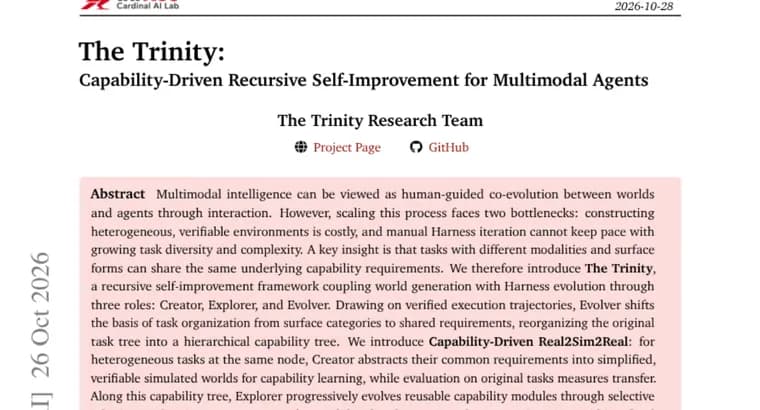
The paper, listed on Hugging Face Papers as 2610.36077, starts from a framing: multimodal intelligence can be seen as human-guided co-evolution between worlds and agents through interaction. Scaling that process, the authors say, hits two bottlenecks. Building heterogeneous, verifiable environments is costly, and manual iteration on the agent's Harness cannot keep pace with growing task diversity and complexity.
Their key insight is that tasks with different modalities and surface forms can share the same underlying capability requirements. On that basis they introduce The Trinity, a recursive self-improvement framework that couples world generation with Harness evolution through three roles: Creator, Explorer and Evolver.
The mechanism works in stages. Drawing on verified execution trajectories, Evolver changes how tasks are organized, moving from surface categories to shared requirements. It reorganizes the original task tree into a hierarchical capability tree. The paper then introduces Capability-Driven Real2Sim2Real. For heterogeneous tasks that sit at the same node of the tree, Creator abstracts their common requirements into simplified, verifiable simulated worlds where capabilities can be learned, while evaluation on the original tasks measures how well the learning transfers.
Along the capability tree, Explorer progressively evolves reusable capability modules through selective inheritance. The result is a Harness tree, whose validated updates accumulate across iterations within a fixed topology. Because the resulting Harnesses specialize in different capabilities, the authors add a Capability-Aware Harness Router. It uses public task information to select compatible module configurations from the tree.
The headline result: the evolved Harnesses improve mean performance by 34 points across 28 training benchmarks and by 26 points across 18 unseen benchmarks, which include two real-world embodied tasks. The abstract gives these figures in points only.
Key facts
- The Trinity is a recursive self-improvement framework for multimodal agents that couples world generation with Harness evolution through three roles: Creator, Explorer and Evolver.
- Evolver reorganizes the original task tree into a hierarchical capability tree, grouping tasks by shared capability requirements instead of surface categories.
- Creator builds simplified, verifiable simulated worlds for tasks at the same tree node (Capability-Driven Real2Sim2Real), and evaluation on the original tasks measures transfer.
- Explorer evolves reusable capability modules into a Harness tree; a Capability-Aware Harness Router then picks compatible module configurations using public task information.
- Reported results: mean performance up 34 points across 28 training benchmarks and 26 points across 18 unseen benchmarks, including two real-world embodied tasks.
Why it matters
The authors point to two bottlenecks in scaling how agents and their environments improve together: environments that are heterogeneous and verifiable are costly to build, and hand-tuning an agent's Harness cannot keep up as tasks multiply and grow more complex. The Trinity is their attempt to automate both sides at once. Its central idea is to organize tasks by the capabilities they require rather than by how they look, so that one simplified simulated world can serve many different-looking tasks.
Who it affects
The work is aimed at researchers and builders of multimodal agents, especially those who maintain Harnesses by hand across many tasks and modalities. The evaluation includes two real-world embodied tasks among the 18 unseen benchmarks, so the claim reaches beyond purely simulated settings.
How to use it
The abstract describes the method but does not mention a code, dataset or model release, so there is nothing to download or run from the source alone. Practitioners can take the design pattern: group tasks into a capability tree, learn shared capabilities in simplified verifiable simulations, keep validated module updates in a Harness tree, and route each new task to a compatible configuration with a router that sees only public task information.
How solid is it
The evidence here is the paper's own abstract. It reports a 34-point mean gain on 28 training benchmarks and a 26-point gain on 18 unseen ones, but the baseline against which those gains are measured is not stated, nor is the scale or metric of the points. The benchmarks are not named, and the base models or agents used are not specified. No comparison with other methods or prior self-improvement frameworks is given. The unseen-benchmark figure is the more telling of the two, since it tests generalization, but it cannot be judged without the full paper.
Risks and caveats
The two real-world embodied tasks are not described, and no separate result is given for them. It is also unclear whether the 34 and 26 point figures are relative or absolute percentages; the abstract says only points. The authors state that validated updates accumulate within a fixed topology, which suggests the Harness tree is not restructured during the process, though the abstract does not discuss what that limits. Treat the numbers as the authors' claims until the full results can be checked.
“tasks with different modalities and surface forms can share the same underlying capability requirements”
— From the paper's abstract