TT-RSI proposes label-free self-improvement for LLMs at test time
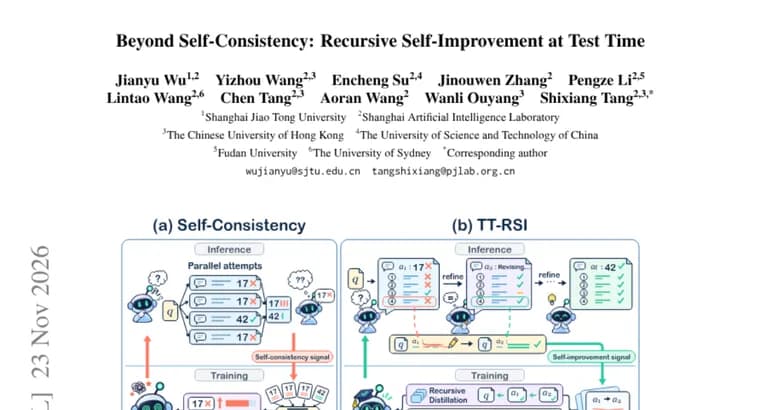
A paper titled "Beyond Self-Consistency: Recursive Self-Improvement at Test Time" proposes Test-Time Recursive Self-Improvement (TT-RSI), a framework for improving large language models at test time without labels. The authors start from the premise that LLMs which keep improving after deployment, for example through recursive self-improvement, offer a promising path toward general intelligence.
Their target is the way current test-time methods pursue that goal on unlabeled questions. These rely primarily on self-consistency: the model generates independent solutions, and majority voting either selects an answer or constructs training targets. According to the authors, this leaves earlier reasoning unused at inference and can reinforce an incorrect majority during training. Humans, they argue, instead build on earlier attempts to keep useful reasoning, correct mistakes and improve their problem-solving strategies. TT-RSI follows that principle through two components that reinforce each other.
The first, In-Context RSI, re-solves each question repeatedly with the full previous solution as a reference. The model decides whether and how to use that reference, so compute spent at inference builds on earlier reasoning.
The second, In-Weight RSI, distills successive refinements into the model's weights. The authors say this allows progress beyond an initially wrong majority and, in theory, brings the model's first attempt toward its infinite-step refinement limit. The updated model then answers better and refines more effectively, which produces stronger references for further training.
In what the authors describe as extensive experiments, TT-RSI improves average accuracy by +13.89% over the base model. Under the same test-time scaling budget, it beats the strongest self-consistency-based method by +4.79%.
Key facts
- TT-RSI is a proposed label-free framework for improving LLMs at test time, working on unlabeled questions.
- In-Context RSI re-solves each question repeatedly, giving the model its full previous solution as an optional reference.
- In-Weight RSI distills successive refinements into the weights, and the updated model then generates stronger references for further training.
- The authors report an average accuracy improvement of +13.89% over the base model.
- Under the same test-time scaling budget, the reported margin over the strongest self-consistency-based method is +4.79%.
Why it matters
The paper questions a common recipe for test-time improvement. With self-consistency, a model produces independent attempts and the majority wins. The authors see two weaknesses: earlier reasoning goes unused at inference, and a wrong majority can be reinforced in training. Their alternative treats each attempt as material for the next one, then writes the gains into the weights. They frame continued improvement after deployment as a promising route toward general intelligence, which is the motivation for the work and not a result it reports.
Who it affects
The work is most relevant to researchers and engineers who improve LLMs on unlabeled questions, particularly those who use majority voting to pick answers or build training targets. TT-RSI is positioned as an alternative to that family of methods, and the reported comparison is against the strongest of them.
How to use it
The recipe has two parts. At inference, have the model solve a question again with its full previous solution in view, and leave it free to decide whether and how to use that solution. In training, distill the successive refinements into the weights, then use the updated model to generate better references for the next round. The method is described as label-free. No code or model release is mentioned in the abstract.
How solid is it
The evidence available here is the paper's abstract. It reports average gains of +13.89% over the base model and +4.79% over the strongest self-consistency-based method at the same test-time scaling budget. It does not name the base models, datasets, benchmarks or that competing method, and gives no absolute accuracy values. It also does not state whether the gains are percentage points or relative improvements. The convergence toward an infinite-step refinement limit is described as theoretical.
Risks and caveats
Treat the figures as the authors' own averages, which say nothing here about how results vary from task to task. The separate contributions of the in-context and in-weight components are not reported in the abstract. Neither is the size of the scaling budget, the number of refinement iterations or the compute cost, all of which matter to anyone weighing the method against simpler voting. Check the full paper for the experimental setup before relying on the numbers.
“This leaves earlier reasoning unused at inference and can reinforce an incorrect majority during training.”
— The paper's authors, on self-consistency methods