TwinLab-Bench tests AI scientists on self-designed lab experiments
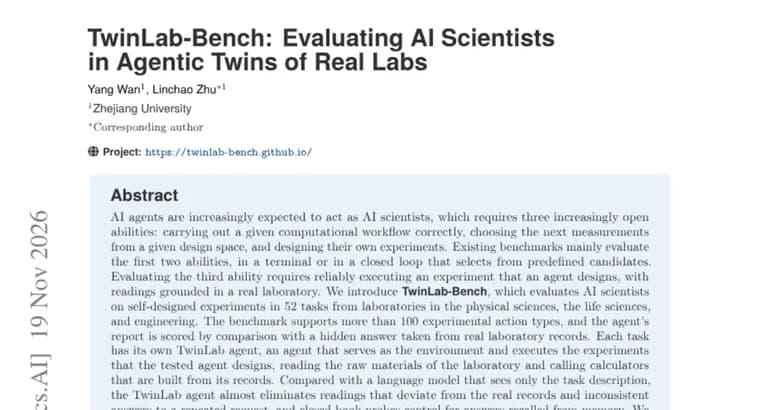
A new paper introduces TwinLab-Bench, a benchmark for AI agents that are meant to work as AI scientists. The authors say such an agent needs three increasingly open abilities: carrying out a given computational workflow correctly, choosing the next measurements from a given design space, and designing its own experiments.
In the authors' account, existing benchmarks mainly cover the first two abilities, either in a terminal or in a closed loop that selects from predefined candidates. Testing the third ability is harder. It requires reliably executing an experiment that the agent itself designed, with readings grounded in a real laboratory.
TwinLab-Bench targets exactly that. It has 52 tasks from laboratories in the physical sciences, the life sciences, and engineering, and it supports more than 100 experimental action types. The agent under test writes a report, and that report is scored by comparison with a hidden answer taken from real laboratory records.
The core mechanism is the TwinLab agent. Each task has its own. It acts as the environment: it executes the experiments the tested agent designs, reading the raw materials of the laboratory and calling calculators that are built from the laboratory's records.
The authors compare the TwinLab agent with a language model that sees only the task description. They report that the TwinLab agent almost eliminates two problems: readings that deviate from the real records, and inconsistent answers to a repeated request. They also use closed-book probes to control for answers recalled from memory.
The headline result is that the tasks remain hard for frontier models. The strongest, Claude Fable 5.2, averages a score of only 45.0. The authors also run an empirical study of where that model fails.
Key facts
- TwinLab-Bench evaluates AI scientists on experiments they design themselves, in 52 tasks from physical-science, life-science and engineering laboratories.
- It supports more than 100 experimental action types, and agent reports are scored against a hidden answer taken from real laboratory records.
- Each task has its own TwinLab agent, which acts as the environment and executes the experiments the tested agent designs, using the lab's raw materials and calculators built from its records.
- Compared with a language model that sees only the task description, the TwinLab agent almost eliminates readings that deviate from real records and inconsistent answers to repeated requests.
- The strongest model tested, Claude Fable 5.2, averages a score of only 45.0, and the authors study where it fails.
Why it matters
The authors argue that existing benchmarks mainly test two of the three abilities an AI scientist needs: running a given workflow and picking the next measurements from a given design space. The third, designing one's own experiments, is the open-ended one, and it needs an environment that can run whatever the agent proposes while staying tied to real lab data. TwinLab-Bench is built to supply that environment.
Who it affects
Researchers building and evaluating AI scientist agents are the direct audience, along with laboratories in the physical sciences, the life sciences and engineering, whose records underpin the tasks. Developers of frontier models are affected too, since the benchmark reports that even the strongest one tested, Claude Fable 5.2, averages only 45.0.
How to use it
The source describes the benchmark's design: 52 tasks, more than 100 experimental action types, a TwinLab agent per task as the environment, and report scoring against a hidden answer from real laboratory records. No code, dataset release, or availability is mentioned, so there is no stated way to run it yourself.
How solid is it
The claims come from the authors' own description of their benchmark. They say the TwinLab agent almost eliminates deviating readings and inconsistent answers compared with a language model that sees only the task description, and that closed-book probes control for answers recalled from memory. The score scale is not stated, and neither is what the 45.0 is averaged over. No scores are given for any model other than Claude Fable 5.2, and the number of models tested is not given.
Risks and caveats
The 45.0 figure has no stated scale, so it is hard to judge how far it sits from a perfect score. The findings of the failure study are not described, only that it was conducted. No author names or institutions are given, and no publication date is given.
“We find that these tasks remain hard for frontier models”
— TwinLab-Bench authors