VETO paper: projecting out text-only directions curbs shortcut learning in VideoLLM fine-tuning
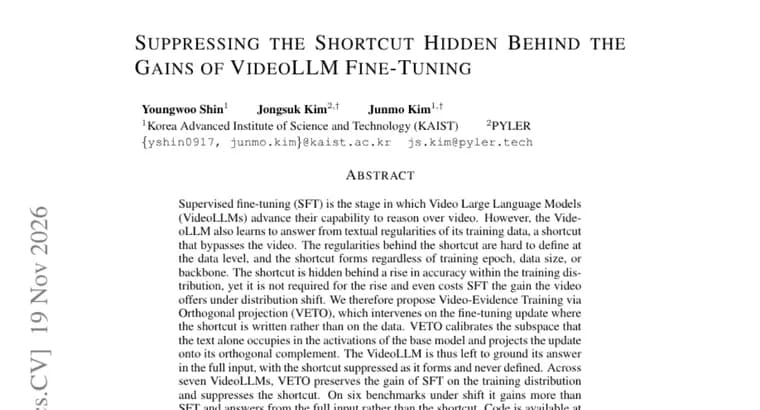
The paper starts from a familiar step: supervised fine-tuning (SFT) is the stage where Video Large Language Models (VideoLLMs) improve at reasoning over video. The authors argue that SFT also teaches the model something unwanted. The VideoLLM learns to answer from textual regularities in its training data, a shortcut that bypasses the video altogether.
They say this shortcut is hard to pin down at the data level, so filtering or rebalancing the data is not an easy cure. They also say it forms regardless of training epoch, data size or backbone. It is hidden behind a rise in accuracy within the training distribution, which is why it is easy to miss. The authors add that the shortcut is not required for that rise, and that it even costs SFT the gain the video would otherwise offer when the data distribution shifts.
Their answer is VETO, short for Video-Evidence Training via Orthogonal projection. Instead of editing the data, VETO intervenes on the fine-tuning update, the place where the shortcut is written. It calibrates the subspace that text alone occupies in the activations of the base model, then projects the update onto the orthogonal complement of that subspace. The result, in the authors' words, is that the VideoLLM is left to ground its answer in the full input, with the shortcut suppressed as it forms and never defined.
The reported results are qualitative in the abstract. Across seven VideoLLMs, VETO preserves the gain of SFT on the training distribution and suppresses the shortcut. On six benchmarks under distribution shift, it gains more than SFT and answers from the full input rather than the shortcut. Code is available on GitHub at Youngwoo-git/VETO.
Key facts
- The authors argue SFT of VideoLLMs also teaches a shortcut: answering from textual regularities in the training data, bypassing the video.
- They say the shortcut forms regardless of training epoch, data size or backbone, and is hidden behind a rise in in-distribution accuracy.
- VETO (Video-Evidence Training via Orthogonal projection) projects the fine-tuning update onto the orthogonal complement of the subspace that text alone occupies in the base model's activations.
- Across seven VideoLLMs, VETO is reported to keep SFT's in-distribution gain while suppressing the shortcut.
- On six benchmarks under distribution shift, VETO is reported to gain more than SFT; code is on GitHub.
Why it matters
Video models are often judged by accuracy on data close to what they were trained on. The authors say that a rise in that accuracy can hide a shortcut: the model leans on text patterns and not on the video. They also say the shortcut costs SFT the gain the video offers when the data shifts. VETO takes a different route from data cleaning. It works on the update itself, so the shortcut never has to be defined at the data level.
Who it affects
Researchers and engineers who fine-tune VideoLLMs with SFT are the direct audience. The abstract reports the method across seven VideoLLMs, so it is framed as applying to more than one model.
How to use it
The authors released code at https://github.com/Youngwoo-git/VETO. The method calibrates the text-only subspace in the base model's activations and then projects the fine-tuning update onto its orthogonal complement. The abstract does not give further setup details.
How solid is it
This account rests on the abstract as shown on Hugging Face Papers. The claims are the authors' own. They report that VETO preserves SFT's in-distribution gain across seven VideoLLMs and gains more than SFT on six benchmarks under shift. The abstract gives no accuracy figures or margins, so the size of the gain is not stated.
Risks and caveats
The abstract does not name the seven VideoLLMs, the six benchmarks or the training datasets, and it does not quantify 'gains more than SFT'. It also does not state any computational cost or training overhead of VETO, or compare it with other methods for reducing shortcuts. Treat the results as the authors' claims until the full paper and code are checked.