VideoGen-Agent lifts video benchmark score from 56.5 to 75.6
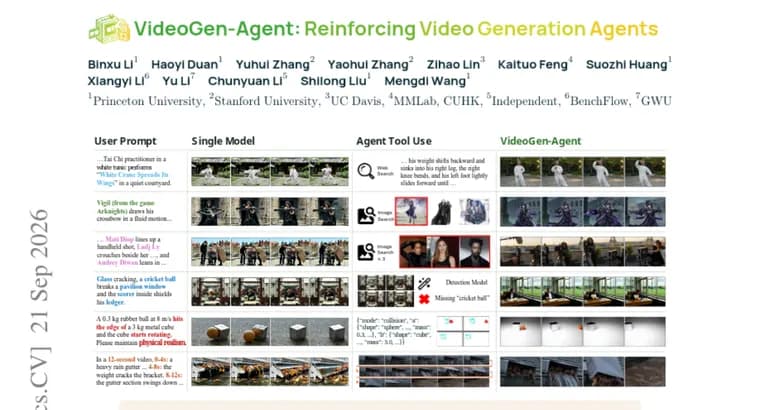
A team of researchers presents VideoGen-Agent, a multimodal agent trained through multitask agentic reinforcement learning to call external tools while generating video. Video generation models are already good at producing high fidelity, temporally coherent clips, but the paper argues they struggle with prompts that need specialized knowledge, specific identities, physical consistency, or events in a set order. VideoGen-Agent tries to close that gap not by making the underlying generator better, but by wrapping it in an agent that coordinates augmentation, generation, and verification tools across multiple turns, using the prompt and its own intermediate observations to decide what to do next.
Training happens in two stages. First, supervised fine-tuning on trajectories generated by a teacher model establishes basic tool-use behavior. That behavior is then refined with reinforcement learning, guided by a category-aware hybrid reward that scores three things at once: whether a tool call is valid, whether the tool chosen fits the task, and the quality of the resulting video. The shared policy is trained on a category-balanced dataset spanning six tasks.
To measure the result, the authors built VABench, a held-out benchmark of 600 prompts covering procedural knowledge, identity preservation for both single and multiple entities, physical consistency, scene composition, and multi-shot temporal structure. On VABench, VideoGen-Agent improves over its own base text-to-video generator by 19.1 points, from 56.5 to 75.6. Swapping in upgraded generation tools, without any further training of the agent itself, pushes the score to 86.1. In a human evaluation, raters preferred that upgraded configuration over the strongest standalone baseline in 84.3% of comparisons. The authors conclude that the results support learning tool use across video-generation tasks, and that an agent trained this way keeps benefiting as the underlying generation tools improve, without needing to be retrained each time.
Key facts
- VideoGen-Agent is a multimodal agent trained with multitask agentic reinforcement learning to coordinate augmentation, generation, and verification tools across multi-turn interactions.
- Training starts with supervised fine-tuning on teacher-generated trajectories, then reinforcement learning guided by a hybrid reward covering tool-call validity, task-appropriate tool use, and video quality.
- On the new VABench benchmark, a held-out set of 600 prompts across six task categories, VideoGen-Agent raises the base text-to-video generator's score from 56.5 to 75.6, a gain of 19.1 points.
- Upgrading the generation tools alone, with no extra agent training, lifts the score further to 86.1.
- Human raters preferred the upgraded configuration over the strongest standalone baseline in 84.3% of comparisons.
Why it matters
Video generators have gotten fluent at producing smooth, coherent clips, but they still trip on prompts that demand specialized knowledge, exact identities, physically consistent motion, or a specific order of events. VideoGen-Agent's bet is that the fix does not have to come from a bigger or better generator: an agent that plans, calls tools, checks its own output, and tries again can pick up a large share of that gap on top of an existing text-to-video model.
Who it affects
The immediate audience is researchers and engineers building or evaluating video generation systems, especially anyone weighing whether to invest in a bigger base generator versus an agent layer that orchestrates existing tools. The new VABench benchmark also gives the field a shared, held-out way to test exactly the failure modes, specialized knowledge, identity preservation, physical consistency, and ordered events, that plain video generators tend to miss.
How to use it
The source is a research paper, not a product announcement: it does not name a release date, a code or model release, or the specific upgraded generation tools that pushed the score to 86.1. What it does establish is an architecture and training recipe, supervised fine-tuning followed by reinforcement learning with a category-aware hybrid reward, plus the VABench benchmark for anyone who wants to reproduce or extend the evaluation.
How solid is it
The claims rest on the authors' own held-out benchmark of 600 prompts across six categories, plus a human preference study where the upgraded configuration won 84.3% of comparisons against the strongest standalone baseline. That is a real quantitative evaluation, not just a demo, but VABench is introduced by the same paper that reports the score gains on it, and there is no mention of outside replication.
Risks and caveats
The paper does not name the specific generation tools that were upgraded to reach 86.1, nor the standalone baseline used in the human evaluation, which limits how easily the results can be checked or reproduced. It also gives no author names, institutional affiliations, publication venue, or timeline for training, so the work cannot currently be tied to a specific lab or dated beyond its appearance on Hugging Face's paper feed.
“These results support learning tool use across video-generation tasks and show that the trained agent can benefit from subsequent advances in generation tools.”
— the paper's authors