VideoNexus, a training-free video agent, reports 88.6% on LVBench
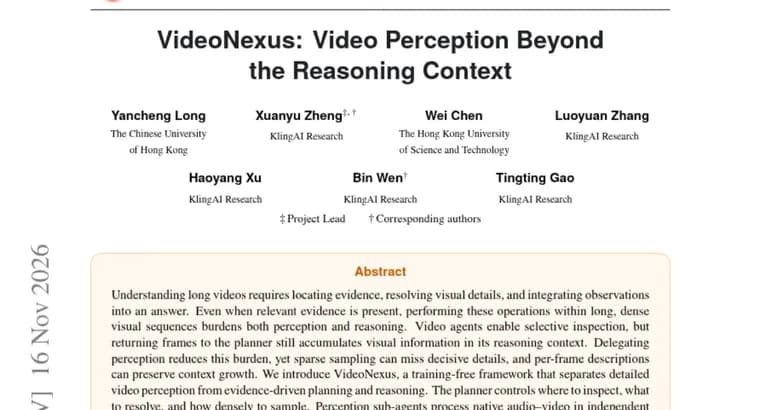
The paper starts from a problem with long videos. Answering a question about one means locating evidence, resolving visual details and integrating observations into an answer, and doing all of that inside long, dense visual sequences burdens both perception and reasoning. Video agents help because they can inspect selectively, but if they return frames to the planner, visual information still piles up in its reasoning context. Delegating perception reduces that burden, the authors say, yet sparse sampling can miss decisive details, and per-frame descriptions can preserve context growth.
Their answer is VideoNexus, a training-free framework that separates detailed video perception from evidence-driven planning and reasoning. The planner controls where to inspect, what to resolve and how densely to sample. Perception sub-agents process native audio-video in independent contexts and return compact, temporally grounded evidence, which the planner uses for iterative search and verification.
The headline result uses Gemini 3.8 Flash for both planning and perception. In that setup VideoNexus reaches 88.6% accuracy on full LVBench. That exceeds same-backbone static ingestion by 3.6 points and same-backbone built-in agentic processing by 1.1 points, and it does so at 44% of the built-in agentic processing baseline's measured API cost.
Two further results are reported. A paired ablation on an LVBench subset shows lower planner input and higher accuracy, though the summary gives no figures for either. And with Kimi K3 as the shared backbone, VideoNexus improves over the official Video-GAIA ReAct harness by 8.5 points in the authors' own evaluation. The authors conclude that the results support compact evidence exchange for combining detailed observation with efficient planning and reasoning.
Key facts
- VideoNexus is a training-free framework that separates detailed video perception (sub-agents with independent contexts) from evidence-driven planning and reasoning.
- With Gemini 3.8 Flash for both planning and perception, it reports 88.6% accuracy on full LVBench.
- That beats same-backbone static ingestion by 3.6 points and built-in agentic processing by 1.1 points, at 44% of the latter's measured API cost.
- With Kimi K3 as the shared backbone, it improves over the official Video-GAIA ReAct harness by 8.5 points in the authors' evaluation.
- A paired LVBench subset ablation shows lower planner input and higher accuracy, without figures in the summary.
Why it matters
Long-video agents run into a context problem: every frame returned to the planner adds visual information to its reasoning context. VideoNexus tackles this by keeping detailed observation in sub-agents and passing back only compact, temporally grounded evidence. The reported payoff is a mix of accuracy and cost: 88.6% on full LVBench, and 44% of the built-in agentic baseline's measured API cost. The accuracy margins over the same-backbone baselines are modest (3.6 and 1.1 points), so the cost saving is a large part of the pitch.
Who it affects
Mainly researchers and engineers building agents that answer questions about long videos, and teams that pay API bills for such pipelines. The results come from two backbones, Gemini 3.8 Flash and Kimi K3, so the design is presented as working across different models.
How to use it
The framework is training-free, so the approach is a way of organising existing models rather than a new model to train. The planner decides where to look, what to resolve and how densely to sample; perception sub-agents return evidence for search and verification. No code, model release, or license is mentioned.
How solid is it
This rests on a short summary of the paper, and the numbers are the authors' own. The 8.5-point Video-GAIA gain is measured in the authors' own evaluation. The absolute accuracies of the static-ingestion and built-in agentic baselines are not stated; only the margins (3.6 and 1.1 points) are. The absolute accuracy of the Video-GAIA ReAct harness and of VideoNexus on Video-GAIA are not stated either. The size of the gain, planner input reduction and accuracy gain in the paired LVBench subset ablation are not quantified. It is not stated whether the results are state of the art or how they compare with other published LVBench systems.
Risks and caveats
The 44% cost figure is relative to the built-in agentic processing baseline only; no absolute dollar cost is given. The authors' own wording is that the results support compact evidence exchange, not that they prove it. No limitations, failure cases or independent replication are mentioned. The paper itself notes that sparse sampling can miss decisive details, which is the failure mode this kind of design has to avoid.
“These results support compact evidence exchange for combining detailed observation with efficient planning and reasoning.”
— VideoNexus paper abstract