Xing 4 report details 285B model pretrained on 8,192 Ascend 910C cards
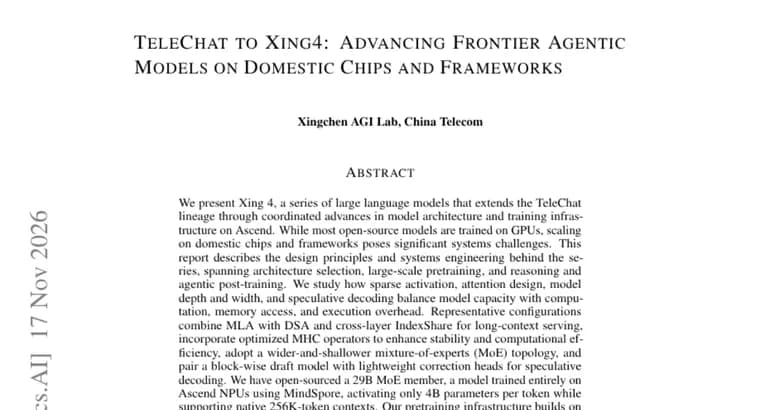
The report introduces Xing 4, a series of large language models that extends the TeleChat lineage. The authors frame it as coordinated advances in model architecture and in training infrastructure on Ascend hardware. The document describes the design principles and systems engineering behind the series, covering three areas: architecture selection, large-scale pretraining, and reasoning and agentic post-training.
On architecture, the authors study how sparse activation, attention design, model depth and width, and speculative decoding balance model capacity against computation, memory access, and execution overhead.
The pretraining infrastructure builds on MindSpore HyperParallel. It combines topology-aware hybrid sharding, efficient distributed optimizer execution, and coordinated management of long-sequence workloads and activation memory. CPU affinity and core isolation are said to further reduce host scheduling interference. Together, these mechanisms support pretraining of a 285B-parameter model on 8,192 Ascend 910C cards. The authors describe that run as a concrete setting for their architectural and systems studies.
For post-training, the report introduces TeleGym, a unified agent execution platform. It connects execution, evaluation, and trajectory construction to policy optimization. Three techniques handle long and uneven agent tasks: disaggregated asynchronous execution, bounded oversampling, and partial rollout. According to the authors, they accommodate heterogeneous task durations while preserving trajectory continuity across policy updates.
The authors conclude that these advances establish an Ascend-oriented training foundation for the continued development of Xing 4 across model scales and increasingly demanding reasoning and agent workloads.
Key facts
- Xing 4 is a series of large language models that extends the TeleChat lineage, built on Ascend hardware.
- A 285B-parameter model was pretrained on 8,192 Ascend 910C cards using MindSpore HyperParallel.
- The pretraining stack combines topology-aware hybrid sharding, efficient distributed optimizer execution, and management of long-sequence workloads and activation memory.
- TeleGym, a unified agent execution platform, links execution, evaluation, and trajectory construction to policy optimization.
- Disaggregated asynchronous execution, bounded oversampling, and partial rollout handle tasks of uneven duration while keeping trajectories continuous across policy updates.
Why it matters
The report is a worked example of training a large model, 285B parameters on 8,192 Ascend 910C cards, with an Ascend-oriented software stack (MindSpore HyperParallel) rather than a different hardware ecosystem. It also pairs the pretraining work with an agentic post-training platform, TeleGym, so one document covers architecture, pretraining systems, and reasoning and agent training.
Who it affects
Teams that train large models on Ascend hardware or with MindSpore are the most direct audience, since the report describes sharding, optimizer, memory, and scheduling choices for that setting. Researchers building agent post-training pipelines may also find the TeleGym design relevant, in particular its handling of tasks with different durations.
How to use it
The report is a description of design principles and systems engineering, to be read for the techniques it names: topology-aware hybrid sharding, CPU affinity and core isolation, bounded oversampling, and partial rollout. No release or open-weights information is given, so there is nothing here to download or run.
How solid is it
The material is the authors' own account of their work. No benchmark results or scores for Xing 4 are given, and no comparison with other models. No training token count, training duration, or hardware utilisation figure is given either. The claims about reduced scheduling interference and about handling heterogeneous task durations are stated by the authors without supporting numbers in the text.
Risks and caveats
No architecture details are given for the 285B model, such as active parameters, expert count, or context length, and the text does not say whether it is dense or sparse or whether it is the largest in the series. No other model sizes in the Xing 4 series are stated. The abstract names no authors or institutions and does not say who develops TeleChat, so readers cannot judge provenance from the text alone.
“Together, these advances establish an Ascend-oriented training foundation for the continued development of Xing 4 across model scales and increasingly demanding reasoning and agent workloads.”
— Xing 4 technical report, abstract