VLA-Δ trains robot models on physical state changes, beats π0.5 on real robots
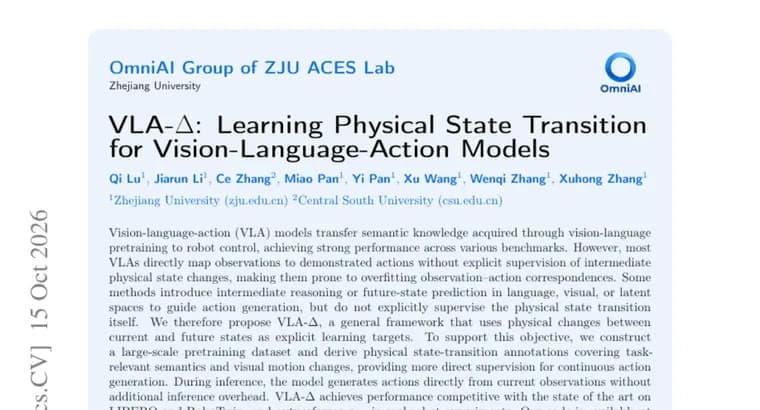
A paper on Hugging Face Papers introduces VLA-Δ, a general framework for vision-language-action (VLA) models, the class of robot-control models that carry semantic knowledge from vision-language pretraining over to physical action.
The authors start from a weakness they see in current VLAs. Most of them map observations directly to demonstrated actions, with no explicit supervision of the intermediate physical state changes. That, the authors say, makes them prone to overfitting observation-action correspondences. Some methods add intermediate reasoning or future-state prediction in language, visual or latent spaces to guide action generation, but according to the authors they still do not explicitly supervise the physical state transition itself.
VLA-Δ does exactly that: it uses the physical changes between the current state and a future state as explicit learning targets. To make this possible, the authors build a large-scale pretraining dataset and derive physical state-transition annotations from it. The annotations cover task-relevant semantics and visual motion changes, and are meant to give more direct supervision for continuous action generation.
At inference time the model generates actions directly from current observations, and the authors state there is no additional inference overhead.
On results, the authors report that VLA-Δ is competitive with the state of the art on the LIBERO and RoboTwin benchmarks, and that it outperforms π_{0.5} in real-robot experiments. The code is released on GitHub in the ZJU-OmniAI organization's VLA-Delta repository.
Key facts
- VLA-Δ is a general framework for vision-language-action robot models that uses the physical change between current and future states as an explicit learning target.
- The authors build a large-scale pretraining dataset and derive physical state-transition annotations covering task-relevant semantics and visual motion changes.
- At inference the model produces actions directly from current observations, with no additional inference overhead according to the authors.
- Reported results: competitive with the state of the art on LIBERO and RoboTwin, and better than π_{0.5} in real-robot experiments.
- Code is available at github.com/ZJU-OmniAI/VLA-Delta.
Why it matters
VLA models reuse knowledge from vision-language pretraining for robot control, but the authors argue that most train by mapping observations straight to demonstrated actions, which invites overfitting to observation-action pairs. VLA-Δ tries a different supervision signal: the physical change between the current and a future state. Existing methods that predict future states in language, visual or latent spaces, the authors say, still do not supervise the physical transition itself.
Who it affects
Mainly robotics and embodied-AI researchers working on VLA models, particularly those who use LIBERO and RoboTwin or compare against π_{0.5}. The paper is a research contribution, not a product.
How to use it
The code is public at https://github.com/ZJU-OmniAI/VLA-Delta. Practitioners can inspect it to see how the state-transition annotations are derived and how the training objective is set up. The authors say that inference uses only the current observation, with no extra inference cost.
How solid is it
The claims come from the paper's own abstract. Performance is described as competitive with the state of the art on LIBERO and RoboTwin, which is not the same as best. The edge over π_{0.5} is stated only for real-robot experiments. No success rates, scores or margins are given in the text available, and neither the dataset size beyond 'large-scale' nor the robots and tasks used in the real-robot tests are specified.
Risks and caveats
Without numbers, the size of the gains cannot be judged. The comparison with π_{0.5} is reported for real-robot experiments only, not for the simulated benchmarks. Model size, training compute and base vision-language model are not stated, so cost and reproducibility are open questions until the full paper and code are examined.