WeVisCut paper: 9B video-editing agent comparable to Claude Opus 5
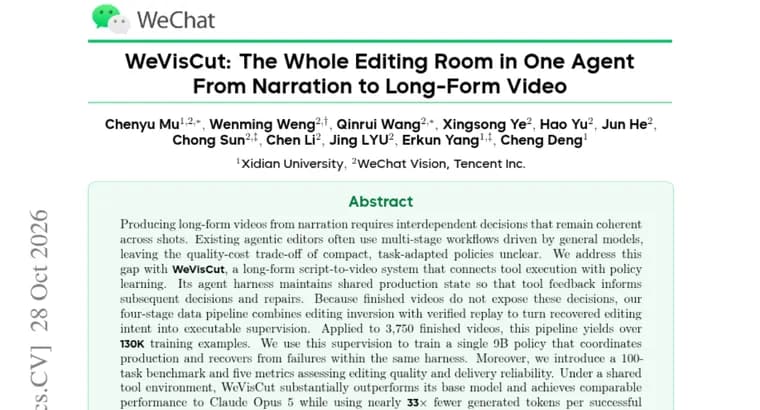
The paper introduces WeVisCut, a long-form script-to-video system that connects tool execution with policy learning. Its starting point is that producing long videos from narration demands interdependent decisions that must stay coherent across shots. Existing agentic editors, the authors say, often rely on multi-stage workflows driven by general models, which leaves the quality-cost trade-off of compact, task-adapted policies unclear. WeVisCut is their attempt to close that gap.
The system has two main parts. The first is an agent harness that maintains shared production state, so that feedback from tools informs later decisions and repairs. The second is a data pipeline. Finished videos do not reveal the editing decisions behind them, so the authors built a four-stage pipeline that combines editing inversion with verified replay. It turns recovered editing intent into executable supervision. Applied to 3,750 finished videos, the pipeline yields over 130K training examples.
On that supervision the authors train a single 9B policy. It coordinates production and recovers from failures within the same harness. To evaluate it, they introduce a 100-task benchmark and five metrics that assess editing quality and delivery reliability.
The reported results: under a shared tool environment, WeVisCut substantially outperforms its base model and achieves performance comparable to Claude Opus 5, while using nearly 33x fewer generated tokens per successful output minute. It also outperforms task-matched native editors on the authors' proposed metrics. The abstract gives these as qualitative comparisons rather than numeric scores.
Key facts
- WeVisCut is a long-form script-to-video system that links tool execution with policy learning; a single 9B policy coordinates production and recovers from failures.
- A four-stage data pipeline (editing inversion plus verified replay) applied to 3,750 finished videos yields over 130K training examples.
- The authors introduce a 100-task benchmark and five metrics covering editing quality and delivery reliability.
- Under a shared tool environment, WeVisCut substantially outperforms its base model and achieves comparable performance to Claude Opus 5 with nearly 33x fewer generated tokens per successful output minute.
- It also outperforms task-matched native editors on the authors' own proposed metrics.
Why it matters
The paper tackles an open question in agentic video editing: whether a compact policy trained for the task can compete with editors driven by general models. The authors report that a 9B policy reaches performance comparable to Claude Opus 5 while generating nearly 33x fewer tokens per successful output minute. If that holds up, small specialised agents could be a cheaper route for long-form production. The data idea is also notable: since finished videos hide their editing decisions, the pipeline reconstructs them and replays them to check they work.
Who it affects
Researchers building agentic editors and tool-using video systems are the main audience, along with teams weighing a small fine-tuned model against a large general one for a narrow production task. Anyone producing long-form video from narration or scripts may eventually care, though the abstract describes research results, not a product.
How to use it
Nothing in the abstract is a ready-to-use tool. The abstract does not say whether the model weights, code, data or benchmark are released. The transferable idea is the recipe: recover editing intent from finished videos, verify it by replay, and train one compact policy inside the same tool harness it will run in.
How solid is it
The claims come from the paper's abstract and are the authors' own. The benchmark (100 tasks) and the five metrics were introduced by the same authors, and the win over task-matched native editors is on those proposed metrics. The result against Claude Opus 5 is described as comparable, not better. The abstract gives no numeric scores for the five metrics, only qualitative comparisons. The abstract does not say which models count as the task-matched native editors.
Risks and caveats
The 33x figure is about generated tokens per successful output minute only; no cost in money, latency or wall-clock time is stated. The abstract does not specify whether the 33x comparison is against Claude Opus 5 specifically, though it follows directly after that comparison in the same sentence. The base model is not named, and the abstract does not state the length of the produced videos or the sources of the 3,750 finished videos. Results on a self-proposed benchmark may not carry over to other editing tasks.