Wiener-informed Decoding (WiD) eases pixel-space flow model training, hitting FID 1.53
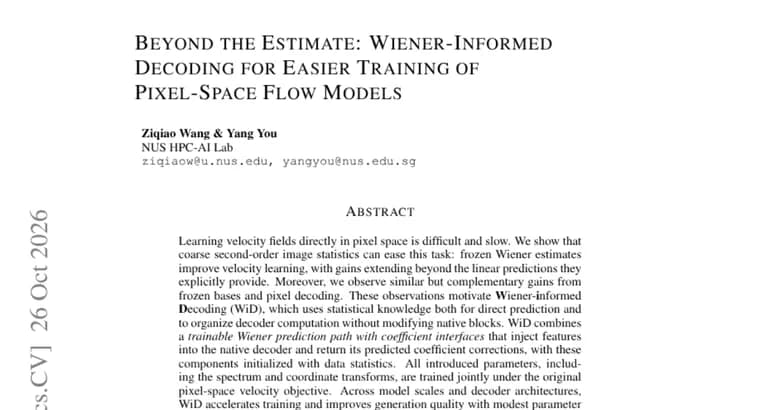
The paper starts from a problem: learning velocity fields directly in pixel space is difficult and slow. The authors show that coarse second-order image statistics can ease the task. Frozen Wiener estimates improve velocity learning, and the gains extend beyond the linear predictions those estimates explicitly provide. The authors also observe similar but complementary gains from frozen bases and from pixel decoding.
These observations motivate Wiener-informed Decoding (WiD). It uses statistical knowledge in two ways: for direct prediction, and to organize the decoder's computation, all without modifying the native blocks of the model. WiD combines a trainable Wiener prediction path with coefficient interfaces. The interfaces inject features into the native decoder and return its predicted coefficient corrections. These components are initialized with data statistics. All the parameters WiD introduces, including the spectrum and coordinate transforms, are trained jointly under the original pixel-space velocity objective.
According to the authors, WiD accelerates training and improves generation quality across model scales and decoder architectures, with modest parameter overhead. It also yields smoother gradient trajectories and remains effective with representation alignment. It improves class-conditional and text-to-image generation across different resolutions.
The headline result is on ImageNet 256 x 256: PixelDiT-XL with WiD reaches FID 1.53 after 500 epochs (lower FID is better). That is comparable in quality to PixelDiT while using 37.5% fewer training epochs. The paper closes with its main conclusion: statistical denoisers contribute beyond the estimate, because their computational structure can also ease pixel-space training.
Key facts
- Wiener-informed Decoding (WiD) feeds coarse second-order image statistics into a pixel-space flow model's decoder to make velocity learning easier.
- On ImageNet 256 x 256, PixelDiT-XL with WiD reaches FID 1.53 after 500 epochs.
- WiD matches the quality of PixelDiT with 37.5% fewer training epochs.
- It leaves the native blocks unchanged, adds a trainable Wiener prediction path and coefficient interfaces, and trains all new parameters under the original pixel-space velocity objective.
- The authors report gains across model scales and decoder architectures, for class-conditional and text-to-image generation, with modest parameter overhead.
Why it matters
Pixel-space generation skips a separate latent autoencoder, but the authors describe learning velocity fields there as difficult and slow. WiD targets that cost. The reported result is a 37.5% cut in training epochs for comparable quality against PixelDiT, plus FID 1.53 on ImageNet 256 x 256 after 500 epochs. The paper's wider point is that statistical denoisers help through their computational structure, not only through the estimate they produce.
Who it affects
Researchers and engineers training pixel-space flow or diffusion-style image models, especially decoder-based designs like PixelDiT. Because WiD does not modify native blocks, the authors present it as something that can sit on top of different decoder architectures. The paper also says it stays effective with representation alignment.
How to use it
The listing describes the recipe, not a release. Add a trainable Wiener prediction path and coefficient interfaces to the native decoder, initialize them with data statistics, and train everything jointly under the original pixel-space velocity objective. The spectrum and coordinate transforms are learned as part of that same training.
How solid is it
The evidence is the authors' own report, in an abstract-level listing. The one concrete benchmark figure is FID 1.53 for PixelDiT-XL with WiD on ImageNet 256 x 256 after 500 epochs, with the 37.5% epoch saving stated against PixelDiT. No authors or institutions are named. No baseline FID value for PixelDiT is given, nor the number of epochs PixelDiT needs for comparable quality. Claims about text-to-image generation and other resolutions come without numbers.
Risks and caveats
The size of the parameter overhead is not quantified; the authors say only that it is modest. No text-to-image metrics, resolutions other than 256 x 256, or model sizes other than XL are given. No code, weights or release is mentioned, and no compute cost, wall-clock time or hardware is stated, so the 37.5% saving is counted in epochs only.
“Statistical denoisers contribute beyond the estimate: their computational structure can also ease pixel-space training.”
— Closing sentence of the paper's abstract, Hugging Face Papers listing