WorldBridge aims to turn scattered images into coherent 3D worlds
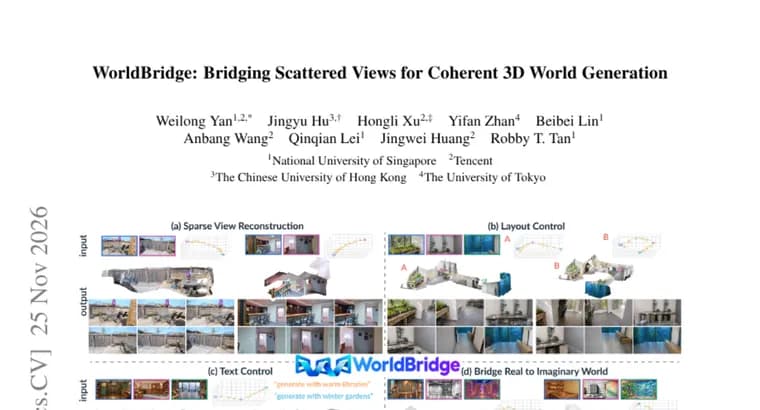
A paper listed on Hugging Face presents WorldBridge, a framework for coherent and controllable 3D world generation from scattered images that share little or no visual overlap.
The authors call it a fundamental and long-standing computer vision challenge to generate coherent, explorable 3D worlds from such inputs. In their account, existing geometry-aware methods fail to address it. Existing image-based and video-based methods may generate the unseen regions, but they produce geometry that is inconsistent across views. WorldBridge is meant to close that gap.
The framework has three described parts. First, it encodes the scattered reference images into a global scene context, which guides the generation of both geometry and appearance across views. Second, a temporal and spatial reference attention mechanism further improves the fidelity of temporal references along the target trajectory, and also supports flexible spatial references outside that trajectory. Third, a plug-and-play latent-reference consistency strategy improves fidelity to the references through reprojection-guided optimization at test time.
The authors also introduce the WorldBridge benchmark suite, built to evaluate 3D world generation from scattered, low-overlap references. They say current benchmarks rarely explore this setting.
On results, the authors report that both qualitative and quantitative evaluations show the method enables controllable and coherent 3D world generation and surpasses existing state-of-the-art solutions. The abstract gives no figures for that comparison and does not name the competing methods. A project page is available at https://davidyan2001.github.io/WorldBridge/.
Key facts
- WorldBridge targets controllable, coherent 3D world generation from scattered images with little or no visual overlap.
- Scattered references are encoded into a global scene context that guides geometry and appearance across views.
- A temporal and spatial reference attention mechanism handles references both along the target trajectory and outside it.
- A plug-and-play consistency strategy uses reprojection-guided test-time optimization to improve reference fidelity.
- The authors add a WorldBridge benchmark suite and report beating existing state-of-the-art solutions, with no figures in the abstract.
Why it matters
The problem is how to build one consistent, explorable 3D world when the input pictures barely connect, or do not connect at all. The authors describe a two-sided gap: geometry-aware methods fail to address this case, while image-based and video-based methods may fill in unseen areas but lose geometric consistency between views. WorldBridge is their attempt to get both generation and coherence. The accompanying benchmark suite addresses evaluation, in a setting the authors say current benchmarks rarely explore.
Who it affects
The work is most directly relevant to researchers in computer vision who study 3D world generation, particularly from sparse or disconnected reference images. Those who evaluate such systems may also want to look at the benchmark suite, since it is designed specifically for scattered, low-overlap references.
How to use it
The starting point is the project page at https://davidyan2001.github.io/WorldBridge/. The abstract does not say whether code, model weights or benchmark data are released. It describes the latent-reference consistency strategy as plug-and-play and as working through reprojection-guided optimization at test time. No compute cost, generation speed or hardware requirements are given.
How solid is it
The evidence available here is the authors' own abstract. It says qualitative and quantitative results show the method surpassing existing state-of-the-art solutions, but it gives no numbers, metrics or margins and does not name the methods compared. The size, composition and metrics of the new benchmark suite are not described, and no peer-review venue is given. Treat the performance claim as the authors' assertion until you have checked the underlying results.
Risks and caveats
The benchmark suite comes from the same authors as the method, so it is worth checking how it was built before reading much into scores on it. The abstract discusses no limitations. It also does not state how many input images are supported, or describe the underlying base model or training data. The cost of the test-time optimization step is likewise not given, which matters for anyone weighing practical use.
“To bridge this gap, we present WorldBridge, a framework for coherent and controllable 3D world generation under scattered images with little or no visual overlap.”
— WorldBridge paper abstract