WorldCast generates consistent character video under large-angle camera moves
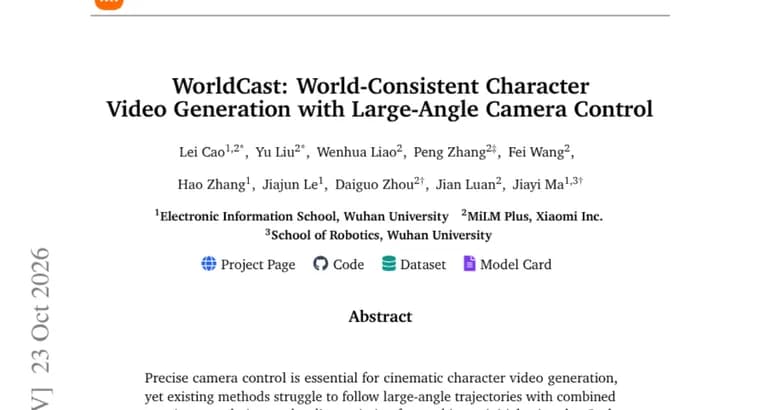
A paper on Hugging Face tackles a specific weakness in video generation: following a camera that moves through large angles around a character. The authors say precise camera control is essential for cinematic character video, yet existing methods struggle with large-angle trajectories that combine rotation, translation and changes in radius, starting from arbitrary initial azimuths. Such moves also reveal parts of the character that were not visible in the initial frame, which causes geometric distortions, appearance degradation and identity drift.
To study these coupled problems, the paper introduces CLACT, a large-scale character-centric dataset and benchmark. It covers diverse large-angle camera trajectories and provides accurate camera geometry and multi-view character observations for training and evaluation.
The paper also proposes WorldCast, a framework for world-consistent character video generation under diverse large-angle camera motions. It works in two parts. First, it back-projects the initial frame into a 3D point cloud using estimated depth, aligns the point-cloud scale with the target camera trajectory, and renders the cloud along that trajectory. This yields explicit geometric guidance and coverage masks.
Second, because the point cloud only holds what the initial frame shows, the authors add Geometry-Aligned Memory Attention (GAMA) to fill in the missing character information. Relative camera poses are estimated jointly from the initial frame and multi-view character anchors, so the anchor views and the target views are expressed in a common coordinate frame. GAMA uses that alignment to guide the retrieval and injection of view-relevant character features during generation.
The authors report that evaluations across diverse large-angle camera trajectories show accurate trajectory following while preserving character geometry, appearance and identity.
Key facts
- CLACT is a large-scale character-centric dataset and benchmark of diverse large-angle camera trajectories, with accurate camera geometry and multi-view character observations.
- WorldCast back-projects the initial frame into a 3D point cloud from estimated depth, scales it to the target camera trajectory and renders it along the path for geometric guidance and coverage masks.
- Geometry-Aligned Memory Attention (GAMA) retrieves and injects view-relevant character features, using relative camera poses that put anchor and target views in one coordinate frame.
- The targeted failures are geometric distortion, appearance degradation and identity drift when large viewpoint changes reveal unseen character regions.
Why it matters
Camera control is central to cinematic video, and large orbits around a character are where current generators break down. The paper names the failure modes: distorted geometry, degraded appearance and identity drift once the camera reveals regions the first frame never showed. A dedicated benchmark, CLACT, gives the problem a shared way to be measured, and WorldCast pairs explicit 3D guidance with a memory mechanism to address it.
Who it affects
Researchers working on camera-controlled and character-centric video generation are the direct audience, since the work offers both a dataset and a method. Anyone building tools for cinematic character shots, where the camera must circle a subject without the subject changing, faces the same problem the paper targets.
How to use it
The source gives no mention of released code, data or models, so there is nothing to run yet. The practical takeaways are the design ideas: render a depth-based point cloud along the target trajectory to get geometry guidance and coverage masks, and use pose-aligned memory attention to bring in character features for regions the first frame did not show.
How solid is it
This rests on the authors' own abstract. They state that evaluations across diverse large-angle trajectories show accurate trajectory following while preserving geometry, appearance and identity. The source gives no quantitative results, metrics or baseline comparisons, and does not state the size of CLACT or name the underlying video model. Treat the claims as unverified until the full paper and any release can be checked.
Risks and caveats
Without numbers or named baselines, the size of the improvement cannot be judged. The method depends on estimated depth for the point cloud and on estimated relative camera poses, though the source does not say how errors in those estimates affect results. No authors or institutions are named in the source, and no release of code, data or models is mentioned.