WorldClaw turns text prompts into explorable 3D worlds
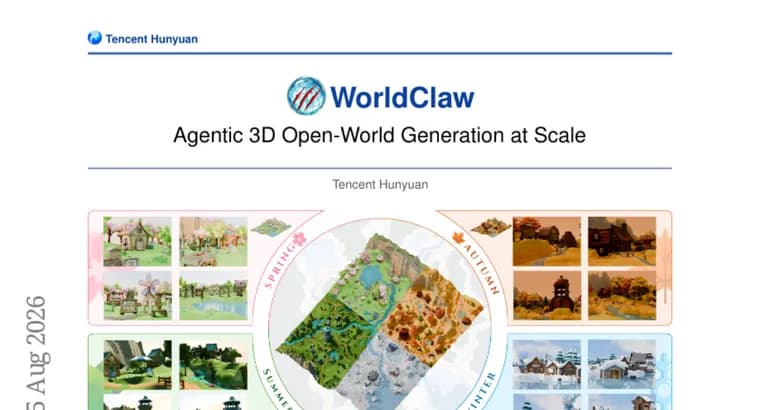
Generating a large, freely explorable 3D world from an open-ended text prompt is hard, the researchers behind WorldClaw argue, because a system has to hold three things at once: coherence across the whole space, rich detail in any given spot, and assets that can be pulled out, edited, and reused afterward rather than baked into a single frozen render.
WorldClaw is their answer: a fully agentic, coarse-to-fine framework for open-world 3D scene generation. It starts with planning agents that convert the text prompt into a structured specification covering regions, terrain, assets, materials, and how they relate to one another spatially. From that specification, WorldClaw builds a globally coherent terrain foundation using semantic layouts, reusable assets, generative or procedural materials, and a region-aware height field.
For regions that call for more detail, the system generates terrain-conditioned compositions, reconstructs them as editable textured meshes, and works out where each one sits on the terrain. A separate set of render-based agents then goes back over the result to refine the terrain, the individual objects, their appearance, and how they contact the ground.
Across a range of open-world prompts, the researchers report that WorldClaw produced large-scale scenes with coherent spatial organization, visually compelling local content, and editable instance-level assets, all while keeping the overall terrain structure consistent. The material does not include quantitative benchmark results, a comparison against prior systems, runtime or compute figures, or any statement on whether code, a trained model, or a dataset will be released.
Key facts
- WorldClaw is a fully agentic, coarse-to-fine framework that turns an open-ended text prompt into a large, freely explorable 3D world.
- Planning agents first convert the prompt into a structured specification covering regions, terrain, assets, materials, and spatial relations.
- The system builds a globally coherent terrain foundation, then adds terrain-conditioned detail as editable, reusable textured-mesh assets in regions that need it.
- Render-based agents refine terrain, objects, appearance, and ground contacts after the initial build.
- The material gives no quantitative benchmark results, no comparison to prior systems, and no information on code, model, or dataset release.
Why it matters
Most text-to-3D generation either commits to one fixed scene or trades off coherence against detail. WorldClaw's stated goal is a world that stays consistent at the scale of the whole map while still being specific at the level of an individual region, built from pieces that can be edited and reused rather than a static render, according to the researchers.
Who it affects
The framework targets people who build large 3D environments from scratch: game and virtual-world developers, XR and simulation teams, and anyone doing procedural content generation at scale, since the output is described as editable, instance-level assets meant for downstream reuse rather than a finished, unmodifiable scene.
How to use it
The material gives no pricing, licensing terms, or word on whether code, a trained model, or a dataset will be released, so there is currently no stated way to run WorldClaw yourself.
How solid is it
This is an abstract-level description of the system with no quantitative evaluation, no benchmark numbers, and no comparison to prior open-world generation systems included in the material. The claims of coherent, large-scale, editable output come from the researchers themselves, without independent figures attached.
Risks and caveats
Because there are no benchmark numbers, no comparison to competing systems, and no runtime or compute figures given, terms like large-scale and coherent should be read as the researchers' own characterization of their results until an independent evaluation or a public release of the assets is available.