ZimaBlue turns egocentric video into robot skills, hits 78% success
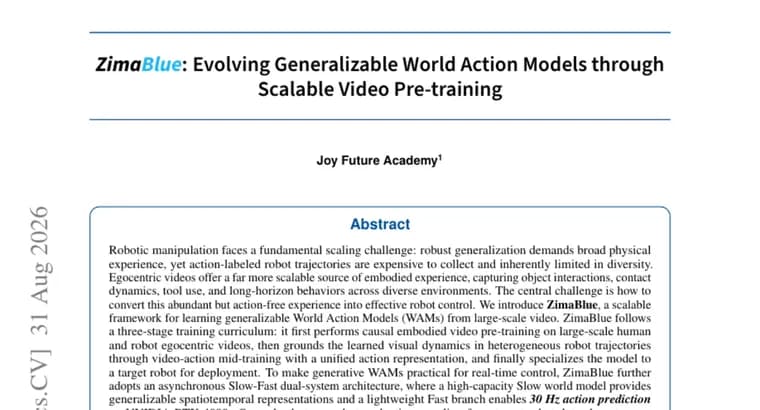
Robotic manipulation has a scaling problem: teaching a robot to generalize needs broad physical experience, but action-labeled robot trajectories, where every move is tagged with the control commands that produced it, are slow and expensive to collect and stay limited in variety. Egocentric video, footage captured from a first-person viewpoint as someone or something interacts with the world, is far cheaper and more abundant, and it already shows object interactions, contact dynamics, tool use and long, multi-step behaviors across many settings. The problem is that this video carries no action labels, so the question is how to turn that action-free footage into working robot control.
A new paper introduces ZimaBlue, a framework built to do exactly that: learn a generalizable World Action Model, a model that predicts how the world changes in response to an action, from video at scale. Training runs in three stages. First comes causal embodied video pretraining on large-scale human and robot egocentric footage, teaching the model how scenes evolve over time. Second, video-action mid-training grounds those learned visual dynamics in heterogeneous robot trajectories through a unified action representation, a shared format for describing actions across different robots. Third, the model is specialized to a specific target robot for deployment.
To make a generative world-action model fast enough for real-time control, ZimaBlue splits itself into an asynchronous Slow-Fast dual-system architecture: a high-capacity Slow world model builds generalizable spatiotemporal representations, while a lightweight Fast branch handles action prediction at 30 Hz on a single NVIDIA RTX 4090 GPU, a consumer-grade card rather than specialized data-center hardware.
On real-robot zero-shot evaluations, meaning the robot attempts tasks it was not specifically trained on, scaling the video pretraining data from target-robot data alone to more than 120,000 hours of embodied video raised task success from 36.1% to 77.8%. The paper reports ZimaBlue also performs strongly across multiple benchmarks, with the largest gains showing up on tasks the model had not seen before. The text does not name the paper's authors, their institution, the specific benchmarks used, or the target robot platform used in the final deployment stage.
Key facts
- ZimaBlue is a framework for learning generalizable World Action Models for robots from large-scale egocentric video rather than expensive action-labeled robot trajectories.
- Training follows three stages: causal embodied video pretraining, video-action mid-training with a unified action representation, then specialization to a target robot.
- An asynchronous Slow-Fast dual-system architecture separates a high-capacity Slow world model from a lightweight Fast branch that predicts actions at 30 Hz on an NVIDIA RTX 4090.
- Scaling pretraining video from target-robot data alone to over 120,000 hours of embodied video raised real-robot zero-shot task success from 36.1% to 77.8%.
- The source does not name the authors, their institution, the benchmarks used, or the target robot platform for deployment.
Why it matters
Robot learning has long been bottlenecked by action-labeled data: every robot trajectory needs its actions recorded alongside it, and collecting that at scale is slow and costly. ZimaBlue's pitch is that the much larger supply of ordinary egocentric video, footage with no action labels at all, can substitute for most of that physical data collection if the model first learns general dynamics from video and only later grounds those dynamics in a smaller set of real robot trajectories. The jump from 36.1% to 77.8% zero-shot success when video pretraining scales past 120,000 hours is the paper's central evidence that this substitution works.
Who it affects
The work targets robotics researchers and teams building generalist robot policies, manipulation systems meant to handle tasks or objects they were not explicitly trained on, that need to generalize beyond a narrow, hand-collected training set. It also speaks to anyone weighing how to source training data for embodied AI: the paper argues video, not curated robot demonstrations, is the more scalable resource.
How to use it
The source text gives no code repository, license, model release, or pricing information, so none of that can be stated here. What it does specify is a hardware target for the fast inference path: the lightweight Fast branch runs action prediction at 30 Hz on a single NVIDIA RTX 4090, a consumer GPU, which is the detail relevant to anyone judging how deployable the resulting system is.
How solid is it
The headline result is a specific, quantified improvement (36.1% to 77.8% zero-shot success) tied to a specific scaling variable (video pretraining hours, past 120,000), and the paper reports it held across multiple benchmarks with the strongest gains on unseen tasks. But the source text does not name those benchmarks, the paper's authors, their institution, or the target robot platform used for final deployment, so none of that can be independently checked from what is available here.
Risks and caveats
The claims come from the paper's own reporting, with no independent replication mentioned in the source. Key context for judging the result, such as which benchmarks were used, who ran the evaluation, and what robot the final specialization stage targeted, is absent from the text, which limits how far the 77.8% figure can be checked or generalized beyond the paper's own setup.
“Egocentric videos offer a far more scalable source of embodied experience, capturing object interactions, contact dynamics, tool use, and long-horizon behaviors across diverse environments.”
— the ZimaBlue paper