ZwZ2 trains vision-language models to connect visual evidence
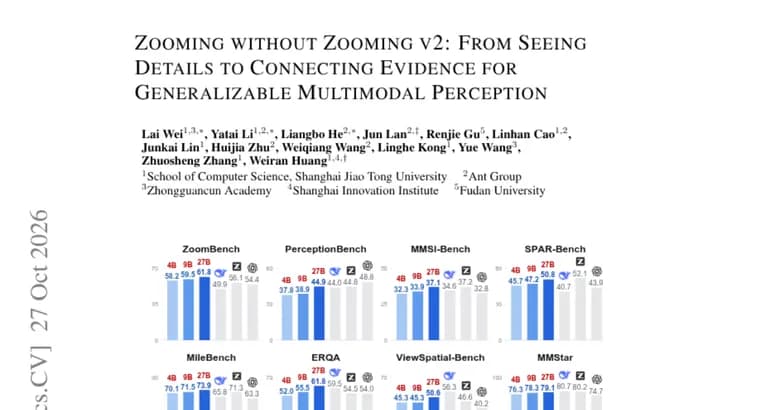
A new preprint, listed on Hugging Face Papers, introduces Zooming without Zooming v2 (ZwZ2), a vision-language model (VLM) training recipe built around a data synthesis framework called EvidenceConnect.
The starting point is a problem the authors describe. Spatial perception and multimodal long-context understanding are, in their words, two pivotal tasks underpinning embodied AI and multimodal agents. But synthesizing targeted, high-quality training data for them remains difficult and costly.
Their key insight is that these tasks share an underlying capability, which they call connecting evidence. They define it as identifying relevant visual facts, binding them to the correct entities, recovering their relations, and composing them into an answer. The authors argue that targeted training data are far easier to synthesize for this capability than for the tasks themselves.
EvidenceConnect is described as easy to implement. It uses zoomed views of related regions within a single image to generate questions that require comparison, aggregation, or chaining of visual evidence. Two checks control quality. A reference answer is kept only when independent VLMs agree on it. And region-ablation tests discard questions whose answer survives the removal of selected regions, which filters out questions that can be answered without the regions they are supposed to depend on.
The authors then train base VLMs on the resulting data with RLVR, and call the result ZwZ2. They stress that the synthesized data are not tailored to any downstream benchmark. Even so, they report that ZwZ2 improves fine-grained and spatial perception, with further gains on embodied spatial reasoning, multimodal long-context understanding, multimodal agent tasks, and general visual reasoning.
The authors conclude that the results establish EvidenceConnect as an effective framework for supervising evidence connection. They say the results suggest that strengthening this shared capability leads to more generalizable multimodal perception.
Key facts
- EvidenceConnect is a data synthesis framework that builds questions from zoomed views of related regions in a single image, requiring comparison, aggregation, or chaining of visual evidence.
- The authors name the shared skill behind spatial perception and long-context understanding "connecting evidence": finding visual facts, binding them to entities, recovering relations, and composing an answer.
- Quality control keeps a reference answer only when independent VLMs agree, and drops questions whose answer survives removal of selected regions.
- Base VLMs trained on this data with RLVR are called ZwZ2; the authors report gains in fine-grained and spatial perception, embodied spatial reasoning, long-context understanding, agent tasks, and general visual reasoning.
- The synthesized data are not tailored to any downstream benchmark, according to the authors.
Why it matters
Training data for spatial and long-context multimodal tasks is hard and costly to synthesize, according to the authors. Their proposal is to sidestep that by training a shared underlying skill, connecting evidence, for which they say data is far easier to produce. If the approach holds up, it offers a cheaper route to broader multimodal perception than building task-specific datasets. The paper is a second version of the Zooming without Zooming line of work.
Who it affects
Researchers building and training vision-language models, particularly for embodied AI and multimodal agents, which the authors name as the downstream areas that depend on spatial perception and long-context understanding. Teams working on RLVR-style training for multimodal models may also find the data synthesis recipe relevant.
How to use it
The abstract describes the recipe at a high level. Take a single image, use zoomed views of related regions to generate questions that need comparison, aggregation, or chaining of evidence, keep only answers that independent VLMs agree on, discard questions that still have the same answer after selected regions are removed, then train a base VLM on the result with RLVR. The authors call the framework easy to implement.
How solid is it
This is a preprint abstract, and all claims are the authors' own. The gains are described only qualitatively: no benchmark names, scores, or sizes of improvement are given in the abstract. The abstract names no authors or institutions and does not specify the base VLMs. It mentions no comparison with other models or baselines and no release of code, models, or data. The conclusion is worded cautiously: the results "suggest" that strengthening the shared capability leads to more generalizable perception.
Risks and caveats
Without numbers, baselines, or named benchmarks in the abstract, the size and reliability of the reported improvements cannot be judged from it. The claim that the data generalizes beyond any specific benchmark rests on the authors' statement. The abstract does not say how much data was synthesized or what training cost. The link between strengthening evidence connection and broader perception is presented by the authors as a suggestion, not a proven result.
“Our key insight is that these tasks share an underlying capability, which we call connecting evidence”
— From the paper's abstract