AdvFD adversarial loss curbs Frechet distance hacking in generators
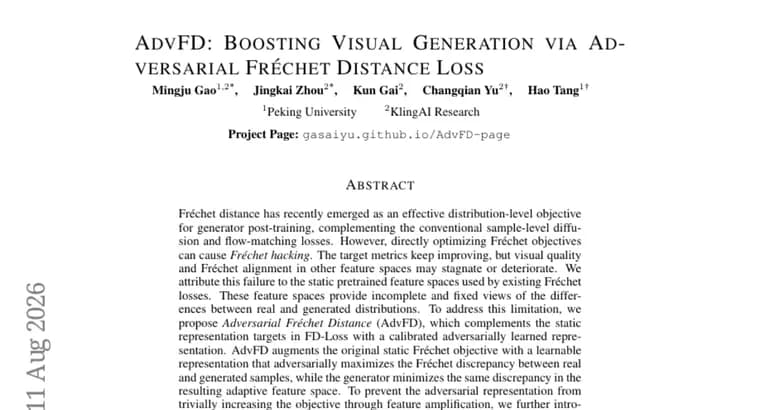
Frechet distance has recently become a popular distribution level training objective for post-training visual generators, used alongside the usual sample level diffusion and flow matching losses. The authors identify a failure mode they call Frechet hacking: when a model is optimized directly against a Frechet objective, the target metric keeps improving, but visual quality and Frechet alignment measured in other feature spaces can stagnate or get worse. They trace the cause to the feature spaces these losses rely on. Existing Frechet losses score the gap between real and generated samples inside a static, pretrained feature space, which gives only an incomplete and fixed view of that gap, so a generator can learn to satisfy the metric in that one space without actually closing the broader distribution gap.
To fix this, the authors propose Adversarial Frechet Distance (AdvFD). Instead of relying only on a static target representation, AdvFD adds a second, learnable representation that is trained adversarially: it tries to maximize the Frechet discrepancy between real and generated samples, while the generator is trained to minimize that same discrepancy inside this adapting feature space. Because a representation trained purely to maximize the objective could game it by simply amplifying feature magnitudes rather than capturing real distributional differences, the authors add a stabilizing step called real feature whitening, which normalizes the scale and covariance geometry of the real features and keeps the resulting min-max optimization stable.
The authors report that AdvFD consistently improves one-step generator post-training, holding across two different backbones, JiT and pMF, and across different model scales. The paper's text does not give specific numerical results, such as accuracy or quality scores or the size of the improvement, nor does it name the datasets or prior methods used as comparison baselines, so the magnitude of the gain is not stated in the abstract itself.
Key facts
- The authors describe a failure mode, Frechet hacking, where optimizing a Frechet distance loss directly improves the target metric while visual quality and Frechet alignment in other feature spaces stagnate or worsen.
- They attribute this to static pretrained feature spaces in existing Frechet losses, which give only an incomplete, fixed view of the gap between real and generated distributions.
- AdvFD adds a learnable representation that adversarially maximizes the Frechet discrepancy between real and generated samples, while the generator minimizes that same discrepancy in the resulting adaptive feature space.
- A real feature whitening step normalizes the scale and covariance geometry of real features to stop the adversarial representation from trivially inflating the objective through feature amplification, and to stabilize the min-max training.
- The authors report AdvFD consistently improves one-step generator post-training across both JiT and pMF backbones and across different model scales, though no specific numbers are given in the text.
Why it matters
Frechet distance losses are becoming a standard extra ingredient in post-training visual generators alongside diffusion and flow matching losses, precisely because they score distributions rather than individual samples. But a metric used as a training target can be gamed, and the authors document a concrete case of that: a generator can drive a static Frechet loss down while its actual visual quality, and its Frechet alignment measured in other feature spaces, stalls or gets worse. AdvFD's response is to make the loss's own feature space adapt during training instead of staying fixed, which is a different way of attacking metric gaming than simply adding more static losses.
Who it affects
The paper targets researchers and engineers who post-train one-step visual generators, that is, generators distilled or fine-tuned to produce an image or video in a single forward pass, using distribution level objectives on top of standard diffusion or flow matching training. The authors test AdvFD specifically on JiT and pMF backbones, so anyone building on top of those two architectures is the most direct audience, though the underlying idea, replacing a static Frechet loss with an adversarially learned one, is framed as applicable more broadly to Frechet based post-training.
How to use it
AdvFD is presented as a training time loss, not a shipped tool or product: it replaces or augments an existing static Frechet distance loss with an adversarial min-max objective, plus the real feature whitening step needed to keep that optimization stable. The source text gives no license, code repository, pricing, or release details, and it does not name the datasets or baseline methods used in the experiments, so applying it currently means implementing the method from the paper's description rather than adopting a packaged tool.
How solid is it
The claims come from a single paper, shared on Hugging Face's papers feed with modest traction (12 points, 1 comment) at the time of this writing. The authors state that AdvFD improves one-step generator post-training across two backbones and multiple model scales, but the text made available here does not include the actual numbers behind that claim, and it does not name author affiliations or institutions, so the result rests on the authors' own reported outcome without independent figures to check it against.
Risks and caveats
Because the source text lacks specific accuracy or quality scores, the magnitude of AdvFD's improvement over a plain static Frechet loss cannot be verified from this material alone, and no comparison baselines or datasets are named. Adversarial, min-max training objectives are also generally harder to stabilize than single-sided losses, which is exactly why the authors needed to add the real feature whitening step; that need is itself a sign the underlying instability is real and not fully eliminated, only managed.