Bonbon protein-ligand foundation model shows emergent zero-shot abilities
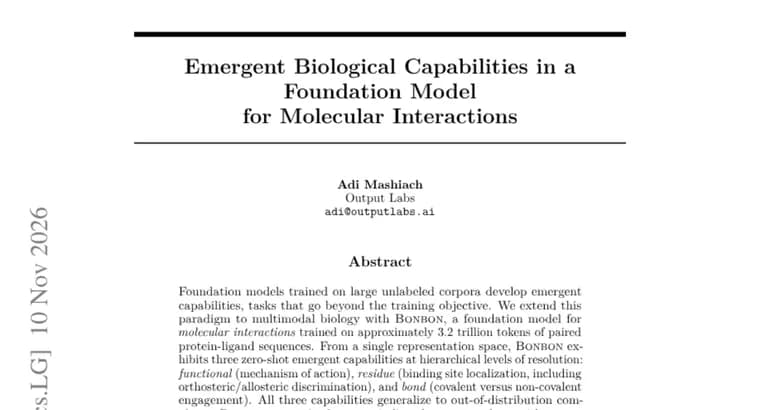
A new preprint introduces Bonbon, a foundation model for molecular interactions. It was trained on approximately 3.2 trillion tokens of paired protein-ligand sequences, and only on those: the authors say there was no task-specific supervision and no structural coordinates.
The central claim is that, from a single representation space, Bonbon shows three zero-shot emergent capabilities at different levels of resolution. The first is functional: identifying a ligand's mechanism of action. The second is at the residue level: localizing the binding site, including telling orthosteric from allosteric binding. The third is at the bond level: distinguishing covalent from non-covalent engagement. The authors say all three generalize to out-of-distribution complexes.
The team ran controlled scaling experiments across six model sizes, from 42M to 1.6B parameters. Every capability they evaluated shows a sharp jump at the largest scale on continuous metrics, even though pretraining loss decreases smoothly. From this they conclude that loss-based scaling laws alone are insufficient to predict when zero-shot emergent capabilities become available. The capabilities appear after training at a 1:2,000 parameter-to-token ratio, chosen to accommodate the sparsity of paired biological interaction data.
The same frozen representations also reach state-of-the-art binding and affinity prediction, the authors say, at five orders of magnitude greater speed than co-folding methods.
Finally, the paper reports prospective wet-lab validation across nine disease targets spanning seven protein families. Bonbon achieved a 61.5% dose-response hit rate on de novo compounds. The authors say this yielded structurally novel molecules not previously reported to inhibit these proteins, including for out-of-distribution targets.
Key facts
- Bonbon is a foundation model for molecular interactions, trained on approximately 3.2 trillion tokens of paired protein-ligand sequences, with no task-specific supervision and no structural coordinates.
- It shows three zero-shot emergent capabilities: mechanism of action, binding site localization (including orthosteric/allosteric discrimination), and covalent versus non-covalent engagement.
- Across six scales from 42M to 1.6B parameters, every capability evaluated jumps sharply at the largest scale while pretraining loss falls smoothly.
- The frozen representations are reported to reach state-of-the-art binding and affinity prediction at five orders of magnitude greater speed than co-folding methods.
- In prospective wet-lab validation on nine disease targets across seven protein families, the authors report a 61.5% dose-response hit rate on de novo compounds.
Why it matters
Large language models are known for abilities that appear without being trained for directly. This paper argues the same happens in biology: a model fed only protein-ligand sequences picks up mechanism of action, binding site location and bond type. The authors also say that smooth pretraining loss did not signal when these abilities would arrive, so loss-based scaling laws alone are insufficient to predict when zero-shot emergent capabilities become available. If that holds up, it affects how teams decide how large to train such models.
Who it affects
Researchers building foundation models for biology, who get a reported scaling pattern to test. Computational drug-discovery groups that rely on co-folding methods for binding and affinity prediction are also in view, since the paper claims much faster frozen representations with state-of-the-art results. The wet-lab results concern nine disease targets across seven protein families.
How to use it
Nothing in the abstract lets a reader use the model today. No code, weights or data release is mentioned. For now the paper is something to read and to check against independent results, particularly the claim that capabilities appear only at the largest scale and at a 1:2,000 parameter-to-token ratio.
How solid is it
This is a preprint, and the numbers come from the authors' own abstract. The scaling study is controlled across six sizes, and the wet-lab validation is described as prospective, which is a stronger design than retrospective benchmarking. But the abstract gives no hit-rate baseline to compare 61.5% against and no count of compounds tested. No benchmark names, baseline names or numeric size of the binding and affinity gains are given; only "state-of-the-art" is claimed. No authors or institutions are named in the abstract.
Risks and caveats
The abstract does not say which co-folding methods Bonbon is compared with, so the five-orders-of-magnitude speed advantage is hard to place. It does not state which exact scale showed the jump beyond "the largest scale", a range that tops out at 1.6B parameters. The wet-lab result is dose-response hits on de novo compounds; the abstract does not present the model as an approved or clinical drug-discovery tool. The emergence claim rests on six model sizes, so the sharpness of the jump is based on few data points.
“loss-based scaling laws alone are insufficient to predict when zero-shot emergent capabilities become available”
— Bonbon paper abstract