Carnegie Mellon's OATs put AI pet avatars on E Ink screens for household objects
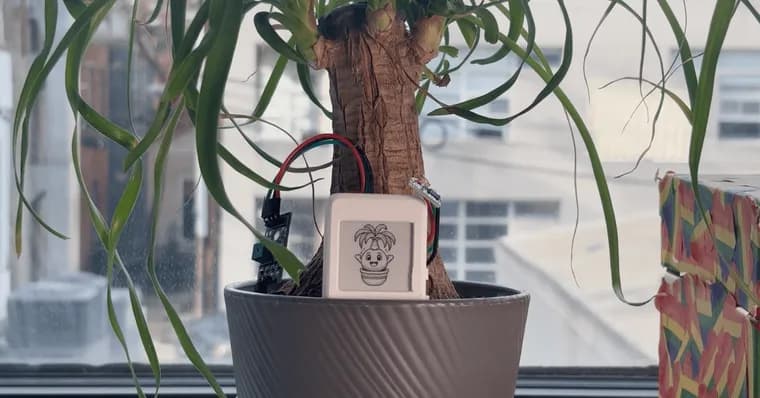
OATs, short for Object Agent Twins, are micro-agent AI avatars on tiny E Ink displays that pair with everyday household objects. The idea is simple. You forget to water a plant, and instead of yellowing leaves you see a plant-shaped pet on a small screen looking sad and dejected. Water the plant and the pet gets excited and happy.
The project was created by Daehwa Kim, a fifth-year PhD student in Carnegie Mellon's Future Interfaces Group. Kim presented it at the ACM Symposium on User Interface Software and Technology (UIST) in Detroit in early November and earned two Honorable Mention awards. Kim's aim was to bring something like the Tamagotchi experience, the 90s egg-shaped toys with digital pets that needed real-time care, to physical objects. "We bring this joy of caring from virtual to physical objects," Kim told WIRED. Kim also argues that people spend all day staring at mobile devices, and that AI agents, even ones built to handle tasks for you, still demand attention on a smartphone screen. OATs are a way to bring those interactions out into the real world. Although people have encouraged Kim to sell OAT kits online, Kim has not decided whether to pursue that as a business.
How it works: each OAT has an E Ink display connected to internal and external sensors that can track moisture, temperature, humidity, light, occupancy and motion. The hardware is relatively cheap, around $20 for the main module. The sprites are created with Google Gemini's Nano Banana image-generation service, which produces a suite of emotions for various states based on the sensor data. Setup happens through a web portal, where you name your OAT and choose which sensors to use for the object it is attached to. The web app then generates Positive and Negative behaviors from the object's name and description. For a plant, positive triggers could be consistent air temperature readings, or low humidity levels if the plant prefers dry conditions. You can customize these behaviors for your specific plant type.
It can also handle very simple jobs. Attach an OAT to a skateboard, and if it detects no motion for a few days the avatar looks sad and lonely; when you hop on, it shows a happy face. Kim says, "These kinds of inanimate objects can be more expressive."
The catch is battery life. OATs last around three to four days, and only a day when paired with the sound-level sensor. Charging is by USB-C for the lithium-ion polymer battery. Wired says this shows why the project is more a proof of concept than anything else.
Kim gave OATs to many people and found three kinds of use. The first is the question 'Am I being used?', for example an avatar on a coffee machine that gets excited when it starts grinding beans. The second is warning people near an object: 3D printers release toxic fumes while running, so an OAT on one can signal that the device is operational. The third is tracking one's own behavior. One person attached an OAT to a dumbbell to log how often they lifted, so they would keep exercising rather than disappoint the AI pet.
The demo at the symposium was popular, and Kim turned it into a contest for the most interesting ideas about which objects to pair with OATs. Kim's website has a gallery of sprites people made, from an animated conference badge to a panda avatar for an Owala water bottle.
The demo also set off a big discussion about anthropomorphizing AI, and whether it is proper to give sprites humanlike traits and emotions so people feel connected to them. Wired notes this is already a live topic in the AI industry: companies often describe chatbot behavior in human terms, such as when models 'hallucinate', and Anthropic announced a 'dreaming' feature this summer in which its AI agent cleaned up its local memory as a background process. Wired adds that such terms can distort moral judgments about AI and make people overly trust the tools. Kim says this is why OATs have very limited interactions, restricted to expressive emotions and the E Ink display.
Kim sees both sides. "Anthropomorphism can be very useful in certain ways, like helping people to change their behaviors. People name their car, and they name their bike. I rarely see people who name their iPhone. I feel like in the future of computing we will have more of a relationship with AI, but we should definitely be careful not to abuse this."
Wired places OATs against a wider push to give AI a physical body as companies chase 'the next smartphone': the failed Humane Ai Pin, OpenAI's upcoming hardware made with former Apple designer Jony Ive, and Meta's Muse Charm, a pocket-sized gadget housing Meta's Muse AI agent, expected to launch in December. Companies have increasingly leaned on cuteness to win wide adoption.
Key facts
- OATs (Object Agent Twins) are tiny E Ink displays showing an AI avatar that reacts to sensor data from the object it is attached to, such as a plant, skateboard or coffee machine.
- Daehwa Kim, a fifth-year PhD student in Carnegie Mellon's Future Interfaces Group, presented OATs at the ACM UIST symposium in Detroit in early November and won two Honorable Mention awards.
- The main module costs around $20 in hardware; sprites come from Google Gemini's Nano Banana, and sensors cover moisture, temperature, humidity, light, occupancy and motion.
- Battery life is three to four days, or one day with the sound-level sensor, so Wired calls it more a proof of concept than a product.
- Kim has not decided whether to sell OAT kits, and the demo sparked debate over anthropomorphizing AI; Kim limited OATs to expressive emotions and the E Ink display.
Why it matters
OATs take a different route from the AI gadgets Wired lists, such as the failed Humane Ai Pin, OpenAI's upcoming Jony Ive hardware and Meta's Muse Charm. Instead of a new all-purpose device, the AI lives as a small avatar on objects you already own. Kim's stated motivation is that AI agents still pull attention onto a smartphone screen, and OATs move the interaction into the physical world. The project also feeds a live argument: Wired notes that companies already use human terms like 'hallucinate' and 'dreaming', and that such language can distort moral judgments and cause overtrust.
Who it affects
Mainly HCI researchers and designers of AI companions and physical interfaces, the audience at UIST. Kim distributed OATs to many people, whose uses fell into three groups: checking whether an object is being used, warning people near an object, and tracking their own behavior. Companies building cute or embodied AI products are the wider context Wired draws.
How to use it
OATs are not on sale. People have encouraged Kim to sell kits online, but Kim has not decided. In the prototype you attach the module to an object, then use a web portal to name your OAT and choose its sensors. The web app generates Positive and Negative behaviors from the object's name and description, and you can customize them. Examples from the article: a skateboard that turns sad if unused for a few days, a coffee machine avatar that gets excited when grinding starts, a 3D printer warning, and a dumbbell that nudges you to keep lifting. Kim's website has a gallery of sprites people made. The hardware cost is around $20 for the main module.
How solid is it
This is a research prototype shown at an academic symposium, where it earned two Honorable Mention awards. The article is Wired's report, with Kim quoted directly. The usage patterns come from Kim's account of distributing OATs to many people. Wired itself describes the project as more a proof of concept than anything else, mainly because of the short battery life.
Risks and caveats
Battery life is the practical limit: three to four days, and about one day with the sound-level sensor. The larger caveat is anthropomorphism. The demo set off a big discussion about whether giving sprites humanlike traits and emotions is proper. Kim says this is why interactions are very limited, restricted to expressive emotions and the E Ink display. Kim also warns that people should be careful not to abuse a growing relationship with AI. No price or release date exists for OATs.
“We bring this joy of caring from virtual to physical objects”
— Daehwa Kim, fifth-year PhD student in Carnegie Mellon's Future Interfaces Group, to WIRED