Crows decide twice as fast as humans and monkeys, Science study finds
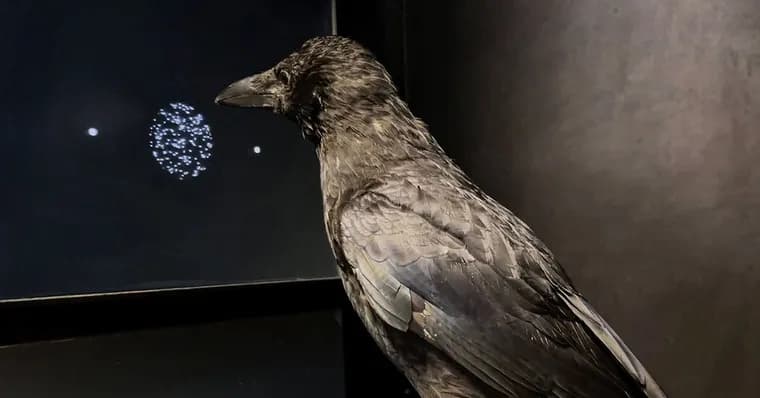
Lemmy and Iggy, two carrion crows, are old hands in a psychology lab. Earlier work with them helped show that birds can use tools to forage and can learn numbers and count objects. Now, in findings published in Science, researchers at the University of Tübingen in Germany report that the crows can process and respond to visual cues at twice the speed of humans and monkeys. The New York Times describes this as the first time the neural speed of avian decision-making has been quantified.
The team wanted to understand how crows make decisions, so they recorded the birds' brain activity with electrodes while the crows performed a visual task. After several weeks of training, and countless mealworm treats, Lemmy and Iggy learned to peck left or right to match the orientation of flashing white dots on a black screen. The dots randomly faced left or right. Sometimes a majority of the dots aligned in one direction, which made the task easy. Other times only a small percentage changed, which made it hard.
The researchers focused on the nidopallium caudolaterale, an area of the bird brain the article describes as comparable to the prefrontal cortex in primates. Andreas Nieder, a neurophysiologist at Tübingen and an author of the study, calls the prefrontal cortex "the C.E.O. in our brain": it handles planning, working memory and abstract thinking.
The crows were allowed three seconds per decision but needed less than one. They reliably pecked their answers in about 235 milliseconds, which the article says is twice as fast as rhesus monkeys or humans in similar experiments, and they did it without compromising accuracy. "This was a result that we didn't anticipate," Nieder said. To rule out a fluke, he retested the crows and then ran the methodology on every person he could get his hands on. "I think we tested all the people in my lab," he said. His undergraduate, Ph.D. and postdoctoral participants were no match for the crows.
Outside researchers who were not involved in the work comment on it. Mike Colombo, a neuroscientist and comparative psychologist at the University of Otago in New Zealand, says nobody would expect birds to beat monkeys or humans at this, "But they do. They're just incredibly fast." Michael Griesser, a biologist and bird behavior expert at the University of Konstanz in Germany, points to anatomy: a crow's nidopallium caudolaterale has nearly the same number of neurons as a rhesus monkey's prefrontal cortex, crammed into a smaller space. "So the bird brains are actually anatomically wired much more efficiently," he said.
The article sets this against a long history of dismissing birds. Their small and superficially simple brains led scholars in the 19th and much of the 20th century to conclude they were not cognitively competent, and even birdsong research did not turn that view. Colombo says it took the last 20 years for the scientific community to realize that bird brain architecture is quite fascinating. Recent work has found that pigeons can tell cancerous from noncancerous cells, numerical values, and words from non-words. Corvids, the group that includes crows, ravens, rooks and scrub jays, can recognize themselves, solve abstract problems, plan for the future and show theory of mind.
On why the speed evolved, the Tübingen team suspects, but has not shown, that quick decisions developed in response to the risks of flight, where reacting quickly or slowly to something in view could mean the difference between a smooth flight and crashing, or missing out on food. Colombo's summary of the bird brain: an "incredibly efficient machine."
Key facts
- A Science study from the University of Tübingen recorded brain activity in two carrion crows, Lemmy and Iggy, during a visual task.
- The crows reliably pecked answers in about 235 milliseconds, which the article says is twice as fast as rhesus monkeys or humans in similar experiments, without losing accuracy.
- They were given three seconds per decision but needed less than one; Andreas Nieder's lab members, tested to verify the method, were no match.
- The team focused on the nidopallium caudolaterale, comparable to the primate prefrontal cortex; per Michael Griesser, it holds nearly the same number of neurons as a rhesus monkey's prefrontal cortex in a smaller space.
- The Tübingen team suspects, without having shown it, that the speed evolved in response to the risks of flight.
Why it matters
The result challenges the old idea that small bird brains mean limited thinking. The article says scholars in the 19th and much of the 20th century judged birds cognitively incompetent, and that the field has only recently moved on. This study puts a number on how fast a crow decides, which the article calls a first for avian decision-making. It also points to a comparison with primates: a similar neuron count packed into less space, which Griesser reads as more efficient wiring.
Who it affects
Mainly researchers in neuroscience and comparative psychology, who now have a measured benchmark for bird decision speed next to primate data. The article also frames it as a rebuttal to the use of "birdbrain" as an insult, which touches anyone who still treats birds as unintelligent.
How to use it
This is a research finding, not a product or tool, so there is nothing to adopt. The practical takeaway for a reader is a reference point: in this task design, crows responded in about 235 milliseconds, roughly twice as fast as the human and rhesus monkey results the article compares them to.
How solid is it
The work is published in Science and reported by the New York Times with comments from two independent experts, Colombo and Griesser, neither of whom was involved. Nieder retested the crows and also tested humans to check the methodology, and the crows still came out ahead. Limits to keep in mind: the article gives no exact human or monkey reaction times, only the relative 'twice as fast' comparison. It is not stated whether 235 milliseconds is a mean or a median. The article reports no specific neural recording results, such as what the nidopallium caudolaterale activity showed.
Risks and caveats
Only two crows are named as participants, and the article does not say whether other crows or species were tested. The number of human participants is not given beyond Nieder's remark about his lab, and the source of the monkey data is described only as similar experiments. The flight explanation is a suspicion of the Tübingen team, not a demonstrated finding. The article gives no funding source or study timeline.
“But they do. They’re just incredibly fast.”
— Mike Colombo, neuroscientist and comparative psychologist at the University of Otago, who was not involved in the research