ESA's Euclid mission releases first major data: 900m galaxies
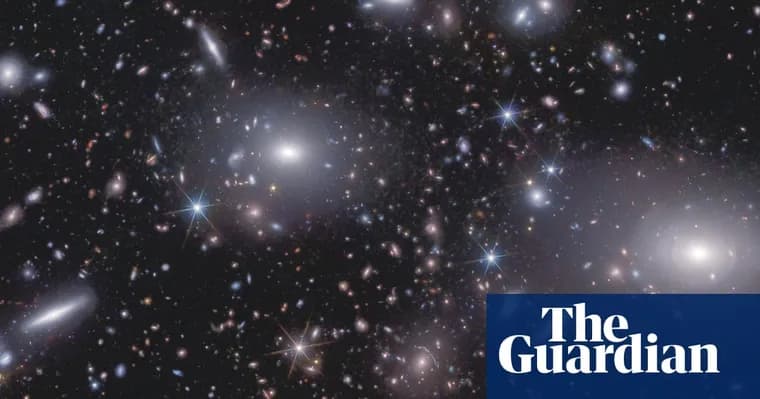
The European Space Agency's Euclid mission, which aims to build the largest 3D map of the universe, has published its first major data release. It covers more than 900m galaxies and more than 60m potential quasars, the blazing objects at the centre of distant galaxies that are powered by supermassive black holes. It also includes about 15,000 potential cases of strong gravitational lensing, a phenomenon that scientists say could help unlock the secrets of the 'dark universe'.
Euclid launched in July 2023 with a promise to create the largest cosmic map ever made, encompassing a third of the sky and more than 10bn years of cosmic history. Its goal is to shed light on dark energy and dark matter, thought to make up about 70% and 25% of the universe respectively. The new release covers about 14% of the total sky area that Euclid will map.
Prof Andy Taylor of the University of Edinburgh, who leads the UK science ground segment for the mission, said there are bigger surveys, but none with the detail and information content of Euclid. The Hubble telescope has produced images of incredible resolution but does not cover as large an area of sky. 'The technological leap that's Euclid is that we can keep that high resolution, but now we can basically map huge volumes of the sky, huge volumes of the universe,' Taylor said. He called the release 'the biggest high-resolution image of the universe we've ever had'.
Strong gravitational lensing was previously considered rare. It is a magnification effect that occurs when one galaxy, often embedded in a galaxy cluster, sits in front of another, distant galaxy. As Taylor notes, Einstein predicted that the foreground galaxy's gravity would distort space-time and bend the light from the background galaxy, creating bright arcs or rings. The effect is significantly boosted by dark matter, which increases a galaxy's mass and so its gravitational influence. Taylor said that by studying strong lensing, scientists may be able to rule out different theories on the nature of dark matter, because the lensing depends on how the dark matter is distributed in a galaxy, which in turn depends on its properties.
Stephen Serjeant, a professor of astronomy at the Open University, agreed. With strong lensing, he said, you find out how the dark matter is clumping, which is very diagnostic of the type of matter it is, since different types can clump in very different ways. He said there is a good chance, though he could not say it is certain, that the next breakthrough on what dark matter actually is might come from strong gravitational lensing.
The numbers show the scale of the jump. Experts previously knew of about 1,000 cases of strong lensing. The Euclid data contains about 15,000 probable cases, and an estimated 170,000 are expected to be discovered by the end of the mission.
A further data release is expected next summer, Taylor said. It will include results on the distribution of galaxies and on weak gravitational lensing, which is subtle distortions in distant objects caused by dark matter in the foreground. 'We can use that pattern of distortions to actually make a map of where all the dark matter is in the universe,' Taylor said. Scientists could then work out its statistical properties and compare them with different theories, since different types of dark matter and dark energy should produce slightly different patterns on the sky.
Taylor also noted the sheer volume of data. 'No human eyeball is able to look at all of the Euclid data any more. It's now too big,' he said.
Key facts
- Euclid's first major data release captures more than 900m galaxies and more than 60m potential quasars, covering about 14% of the sky area the mission will map.
- It includes about 15,000 probable strong gravitational lensing cases, against about 1,000 previously known; an estimated 170,000 are expected by the end of the mission.
- Strong lensing is boosted by dark matter, so scientists say studying it may help rule out theories of what dark matter is.
- The full map is planned to span a third of the sky and more than 10bn years of cosmic history.
- A further release is expected next summer, with results on galaxy distribution and weak gravitational lensing.
Why it matters
Dark energy and dark matter are thought to make up about 70% and 25% of the universe, and Euclid was built to shed light on both. The release gives researchers a high-resolution view over a far larger area than Hubble covers. The lensing numbers stand out: about 15,000 probable cases against about 1,000 previously known, for a phenomenon once considered rare. Serjeant says lensing shows how dark matter clumps, which is diagnostic of what kind of matter it is.
Who it affects
Mainly astronomers and cosmologists studying dark matter, dark energy, quasars and galaxy evolution, who now have data on more than 900m galaxies and more than 60m potential quasars. Taylor leads the UK science ground segment for the mission, and Serjeant at the Open University is among the researchers pointing to lensing as the likely route to progress on dark matter.
How to use it
This is a science data release rather than a product, so the practical use is for researchers to mine it. Taylor's remark that no human eyeball can look at all of the Euclid data any more points to the scale of the task. The lensing candidates let scientists compare patterns on the sky with different theories of dark matter and dark energy. The next release, expected next summer, will add galaxy distribution and weak lensing results, which Taylor says can be used to map where all the dark matter is.
How solid is it
The numbers and the account come from the Guardian's report, which relies on Taylor and Serjeant, both named academics with stated affiliations. The release itself is real and specific: more than 900m galaxies, more than 60m potential quasars, about 14% of the planned map area. Serjeant's own hedge is worth keeping: a breakthrough from lensing is a good chance, not a certainty.
Risks and caveats
The roughly 15,000 lensing cases are described as potential or probable, not confirmed. The 170,000 figure is an estimate of what is expected by the end of the mission. The quasar count is also given as potential. Nothing in the report says Euclid has already found the nature of dark matter or dark energy; scientists say lensing may help rule out theories. The next release is described as expected next summer, not guaranteed.
“It’s the biggest high-resolution image of the universe we’ve ever had”
— Prof Andy Taylor, University of Edinburgh