DisCo distills GitHub repos into skills, lifts ML agents 134% on MLE-bench
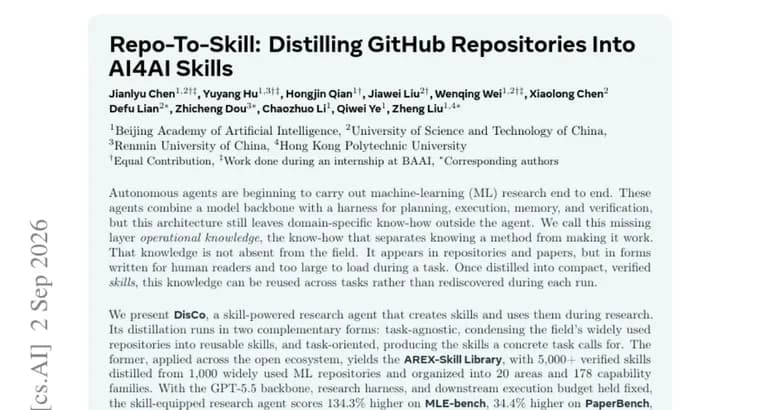
Autonomous agents are starting to run machine learning research end to end, pairing a model backbone with a harness for planning, execution, memory and verification. What that architecture still leaves out, the authors argue, is domain-specific know-how: the difference between knowing a method and actually making it work. That know-how exists, scattered across repositories and papers written for human readers and too large to load into a single task. Left in that form, an agent has to rediscover it on every run instead of reusing it.
The authors present DisCo, a skill-powered research agent that both creates skills and uses them during research. Its distillation works in two forms: task-agnostic, which condenses widely used repositories into skills meant to be reused across many jobs, and task-oriented, which produces the specific skills a single concrete task calls for. Applying the task-agnostic form across the open ecosystem produced the AREX-Skill Library: over 5,000 verified skills distilled from 1,000 widely used ML repositories, organized into 20 areas and 178 capability families.
To measure the effect, the authors held the GPT-5.5 backbone, the research harness and the downstream execution budget fixed, and compared a skill-equipped agent against the same agent without skills. The skill-equipped agent scored 134.3% higher on MLE-bench, 34.4% higher on PaperBench, 9.2% higher on FrontierCS and 14.0% higher on PassNet. With everything else held constant, the authors attribute the gains to the added distilled operating context alone.
Key facts
- The AREX-Skill Library holds 5,000+ verified skills distilled from 1,000 widely used ML repositories, organized into 20 areas and 178 capability families.
- DisCo distills skills in two forms: task-agnostic, from the open repository ecosystem, and task-oriented, built for a single concrete task.
- With the GPT-5.5 backbone, harness and execution budget held fixed, the skill-equipped agent scored 134.3% higher on MLE-bench and 34.4% higher on PaperBench than the same agent without skills.
- Under the same fixed setup, the skill-equipped agent scored 9.2% higher on FrontierCS and 14.0% higher on PassNet.
- The authors attribute the measured gains to the added distilled operating context, since the backbone, harness and execution budget were otherwise identical.
Why it matters
Autonomous research agents plan, execute and verify, but the operational knowledge that separates knowing a method from making it work has stayed outside the agent, buried in repositories and papers written for people rather than machines. DisCo turns that knowledge into a compact, reusable asset instead of leaving each agent run to rediscover it from scratch.
Who it affects
The work targets builders of autonomous research and coding agents who want to reuse expertise already scattered across the open ML repository ecosystem, rather than starting from a single task's codebase each time.
How to use it
DisCo distills skills in two complementary ways: task-agnostic distillation condenses widely used repositories into skills meant to be reused across many jobs, and task-oriented distillation produces the skills a specific task calls for. Applying the task-agnostic form across the open ecosystem produced the AREX-Skill Library, currently 5,000+ verified skills drawn from 1,000 widely used ML repositories and organized into 20 areas and 178 capability families.
How solid is it
The comparison held the GPT-5.5 backbone, the research harness and the downstream execution budget fixed, and varied only whether the agent had access to distilled skills. Across four benchmarks, that single change produced score increases of 134.3% (MLE-bench), 34.4% (PaperBench), 9.2% (FrontierCS) and 14.0% (PassNet) over the same agent without skills, a controlled setup that isolates the skills themselves as the source of the gain.
Risks and caveats
The source text names no individual authors or institutions, gives no release date, licensing terms or code and data availability for DisCo or the AREX-Skill Library, and does not describe how skill verification is performed. It offers no comparison to any research agent other than the same agent without skills, and no breakdown of the 20 areas or 178 capability families beyond their counts.