EarlyEval cuts AI agent evaluation costs via early stopping
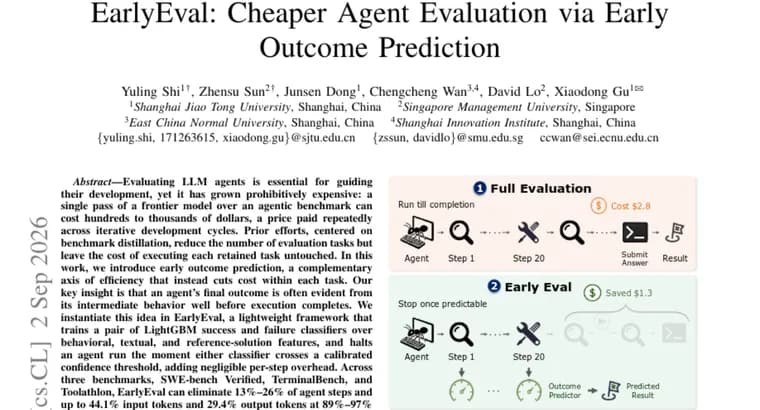
Evaluating large language model agents has become expensive: a single pass of a frontier model over an agentic benchmark can cost hundreds to thousands of dollars, and that bill repeats across every iteration of development. Researchers introduce early outcome prediction, an approach that cuts the cost of each benchmark task from the inside, rather than reducing the number of tasks run, which is what earlier benchmark-distillation methods did. The idea rests on a simple observation: an agent's eventual success or failure is often visible in its intermediate behavior well before the run actually finishes.
The researchers built this idea into EarlyEval, a lightweight framework that trains two LightGBM classifiers, one for predicting success and one for predicting failure, on features drawn from an agent's behavior, its text output, and the reference solution. During a run, EarlyEval checks these classifiers at each step and halts the agent the moment either one crosses a calibrated confidence threshold, adding only a negligible amount of overhead per step.
Tested across three agent benchmarks, SWE-bench Verified, TerminalBench, and Toolathlon, EarlyEval eliminated 13% to 26% of agent steps and up to 44.1% of input tokens and 29.4% of output tokens, figures aggregated across all three benchmarks rather than broken out individually. Prediction accuracy behind those savings ranged from 89% to 97%. The tradeoff was small: cutting runs short this way shifted per-agent resolve rates by only one to two percentage points on average, compared with letting every run finish.
Key facts
- A single frontier-model pass over an agentic benchmark can cost hundreds to thousands of dollars, a cost paid repeatedly through iterative development.
- EarlyEval trains a pair of LightGBM success/failure classifiers on behavioral, textual and reference-solution features to predict an agent run's outcome early and stop it.
- Across SWE-bench Verified, TerminalBench and Toolathlon, EarlyEval cut 13% to 26% of agent steps, up to 44.1% of input tokens and 29.4% of output tokens.
- Prediction accuracy behind those savings ranged from 89% to 97%.
- Early stopping changed per-agent resolve rates by only one to two percentage points on average.
Why it matters
Evaluating LLM agents on realistic, multi-step benchmarks is one of the biggest recurring costs in agent development: a single frontier-model pass over an agentic benchmark can run to thousands of dollars, and that bill repeats every iteration cycle. Prior work such as benchmark distillation cut the number of tasks run but left the cost of executing each remaining task untouched. Early outcome prediction attacks the other axis, the cost inside each task, on the observation that an agent's fate is often decided, and visible, well before its run actually stops.
Who it affects
Anyone who runs agent benchmarks repeatedly during development: teams building and iterating on LLM agents, benchmark maintainers, and researchers who need frequent evaluation passes to make development decisions, since the cost this targets is the money and compute spent on repeated agentic benchmark runs.
How to use it
EarlyEval is a framework that wraps an existing agent evaluation loop, not a benchmark of its own: it pairs LightGBM classifiers trained on behavioral, textual, and reference-solution features with each benchmark run, and stops a run once either classifier is calibrated-confident of the outcome. The source gives no price, license, or release/availability details for EarlyEval.
How solid is it
The method was tested across three separate agentic benchmarks, SWE-bench Verified, TerminalBench, and Toolathlon, with prediction accuracy of 89% to 97% behind the reported step and token savings. The paper also reports the effect on outcome quality directly: per-agent resolve rates moved by only one to two percentage points on average when runs were stopped early rather than allowed to run to completion.
Risks and caveats
The step and token savings are aggregated across the three benchmarks rather than broken out per benchmark, so it is not clear whether some benchmarks save more than others. Stopping a run early is a probabilistic call: at 89% to 97% accuracy, some predictions are wrong, which shows up as the one to two percentage point shift in resolve rates. The source gives no detail on how the classifiers were trained or how portable they are to agents or benchmarks beyond the three tested.
“an agent's final outcome is often evident from its intermediate behavior well before execution completes”
— the researchers