DyPES-VLA unifies control across robot embodiments
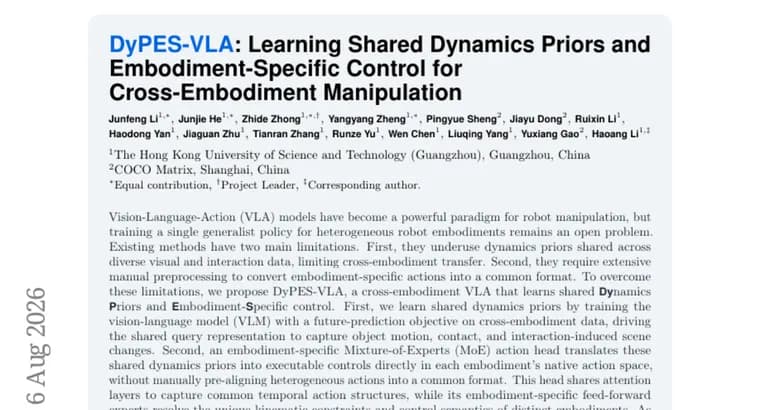
Researchers describe DyPES-VLA, a vision-language-action (VLA) model built to train one generalist control policy across robots with different bodies and joints, a task the authors call an open problem. They identify two limitations in existing approaches: such methods underuse dynamics priors shared across diverse visual and interaction data, which limits how well skills transfer from one robot to another, and they require extensive manual preprocessing to convert embodiment-specific actions into a common format before a model can even be trained. DyPES-VLA addresses both. First, the vision-language model is trained with a future-prediction objective on data drawn from multiple robot embodiments, pushing its shared internal representation to capture object motion, contact, and interaction-induced scene changes without needing that manual reformatting step. Second, an embodiment-specific Mixture-of-Experts (MoE) action head converts these shared dynamics predictions into executable commands directly in each robot's own native action space. The head shares attention layers across embodiments to capture temporal action structure common to all of them, while separate feed-forward experts for each embodiment handle its particular kinematic constraints and control semantics. As a generalist policy, the authors report DyPES-VLA achieves state-of-the-art performance across simulation and real-world evaluations, reaching 98.0% success on LIBERO, 59.25% on RoboCasa-GR1, and 89.02% on RoboTwin 2.0.
Key facts
- DyPES-VLA is a cross-embodiment vision-language-action model designed to train one policy that controls robots with different bodies.
- It trains the vision-language model with a future-prediction objective on cross-embodiment data to learn dynamics shared across robots, rather than relying on manual action-format preprocessing.
- A Mixture-of-Experts action head shares attention layers across embodiments but uses separate feed-forward experts per embodiment to handle each robot's native action space.
- Reported success rates: 98.0% on LIBERO, 59.25% on RoboCasa-GR1, and 89.02% on RoboTwin 2.0.
Why it matters
Robots built for different tasks have different joints, grippers, and action spaces, which has made it hard to train one policy that controls all of them well. The authors frame this as an open problem and point to two specific gaps in prior work: existing methods underuse dynamics priors shared across diverse visual and interaction data, so skills learned on one robot transfer poorly to another, and getting different robots' actions into a common format ahead of training requires extensive manual preprocessing. DyPES-VLA is presented as addressing both gaps directly, by learning shared motion dynamics from a future-prediction objective and by routing the resulting predictions through per-embodiment experts instead of a hand-built common action format.
Who it affects
The paper targets robotics and machine learning researchers building generalist manipulation policies, and any team that operates or evaluates robots across more than one physical platform, since the whole design point of DyPES-VLA is transferring learned control across heterogeneous hardware rather than training a separate policy per robot.
How to use it
The abstract describes an architecture, not a released product: a vision-language model trained with a future-prediction objective on cross-embodiment data, feeding a Mixture-of-Experts action head with shared attention layers and embodiment-specific feed-forward experts. The text does not state a release, license, code availability, or price, so none of that can be reported here.
How solid is it
The authors report DyPES-VLA reaching 98.0% success on the LIBERO benchmark, 59.25% on RoboCasa-GR1, and 89.02% on RoboTwin 2.0, describing these as state-of-the-art results across simulation and real-world evaluations. The source text gives only DyPES-VLA's own scores; it does not include the scores of competing or prior methods for direct comparison, and it does not describe what the LIBERO, RoboCasa-GR1, or RoboTwin 2.0 benchmarks actually test.
Risks and caveats
The text provided gives no author names, institutions, or affiliations, no submission or publication date, no comparison scores for prior or competing methods, and no details on training data, model size, or compute used. All performance figures come from the authors' own reporting rather than an independent evaluation, and there is no way to gauge from this text alone how the reported success rates compare to other approaches on the same benchmarks.