Economic World Models get a six-level capability ladder
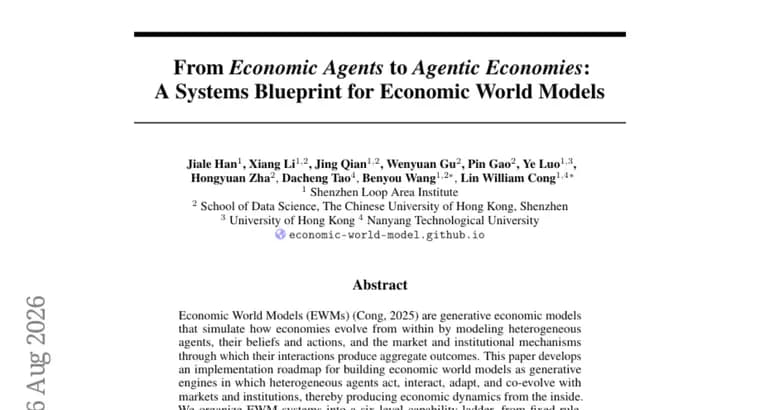
Economic World Models (EWMs) are generative economic models that simulate how economies evolve from within, modeling heterogeneous agents together with their beliefs and actions, and the market and institutional mechanisms through which those individual actions add up to aggregate outcomes. A paper titled "From Economic Agents to Agentic Economies: A Systems Blueprint for Economic World Models" sets out an implementation roadmap for building EWMs as generative engines in which agents act, interact, adapt and co-evolve with markets and institutions, producing economic dynamics from the inside rather than being scripted from the outside.
The paper organizes EWM systems into a six-level capability ladder. The lowest level covers fixed, rule-based agent worlds, where agent behavior is hard-coded. From there the ladder rises through adaptive and LLM-based agent worlds, where agents draw on learning or large language models to act; self-evolving agents, whose behavior changes over time; and evolving institutional worlds, where the rules and institutions themselves change rather than staying fixed. The top of the ladder is sim-to-real economic twins: simulations kept aligned with real-world observations rather than running purely on synthetic assumptions.
A systematic literature survey conducted across these levels finds that existing research is concentrated at the lower rungs, in agent and simulation environments. Systems that reach the higher levels, with self-evolving agents, institutions that emerge endogenously, persistent alignment with empirical data and validated economic mechanisms, remain rare.
By turning the EWM agenda into an implementation blueprint, the authors say they aim to accelerate development of a next generation of economic simulation environments meant to serve two purposes: high-fidelity sandboxes for human decision-makers, and training, planning, evaluation and safety substrates for AI agents. Alongside the paper, the authors release a curated paper list and related resources to support further research in the area.
Key facts
- Economic World Models (EWMs) are generative models that simulate economies from within by modeling heterogeneous agents, their beliefs and actions, and the market and institutional mechanisms that produce aggregate outcomes.
- The paper proposes a six-level capability ladder, running from fixed rule-based agent worlds through adaptive and LLM-based agent worlds, self-evolving agents and evolving institutional worlds, up to sim-to-real economic twins aligned with real observations.
- A systematic literature survey finds existing work concentrated at the lower levels of the ladder, while systems with self-evolving agents, endogenous institutions, persistent empirical alignment and validated economic mechanisms remain rare.
- The stated goal is to accelerate a next generation of simulation environments that can act as sandboxes for human decision-makers and as training, planning, evaluation and safety substrates for AI agents.
- The authors release a curated paper list and related resources alongside the paper to support further research.
Why it matters
Economic simulations that model how individual agents' decisions add up to market-wide outcomes are used both as decision-support tools and, increasingly, as environments for training and evaluating AI agents. This paper gives that scattered field a shared structure: a six-level capability ladder that lets researchers place any existing system on a common scale, from simple rule-based worlds to simulations kept aligned with real economic data. The survey's finding, that most existing work sits at the lower rungs, points to a concrete gap: relatively few systems combine self-evolving agents, endogenously changing institutions and validation against real-world observations.
Who it affects
The roadmap is aimed at researchers building agent-based and generative economic simulations, and at the wider AI research community that uses simulated environments to train, plan, evaluate and test the safety of AI agents. Because EWMs are proposed as sandboxes for human decision-makers as well, the framework also speaks to anyone who might eventually use such simulations to inform economic decisions, though the paper itself is a blueprint and literature survey rather than a deployed tool.
How to use it
There is no product, price or license attached to this work: the contribution is a conceptual framework plus a literature survey placing existing systems on it. The practical hook is the curated paper list and related resources released alongside the paper, which researchers can use to locate existing work at each level of the ladder and identify where to build next, most notably at the higher levels the survey found sparsely populated.
How solid is it
The paper frames itself as a blueprint and systematic literature survey, not a built system with reported experimental results. Its claims rest on a review of existing published work sorted against the six-level ladder, rather than on new experiments or benchmarks run by the authors. The available text gives no count of papers covered, no publication venue and no date range for the survey, so the scope of the literature review cannot be independently sized from what is here.
Risks and caveats
The available text gives no timeline, funding source, dataset or empirical validation results for the roadmap itself, and names no specific real-world economic mechanisms, markets or case studies as examples. It also gives no size or scope, no paper count, publication venue or date range, for the curated paper list the authors release. The source text does not name any authors or institutional affiliations for the paper. Because the survey finds the ladder's higher levels largely unoccupied by existing work, most of what the framework describes for self-evolving agents, endogenous institutions and sim-to-real alignment remains aspirational rather than demonstrated.