EffectLearner erases objects and their effects from video
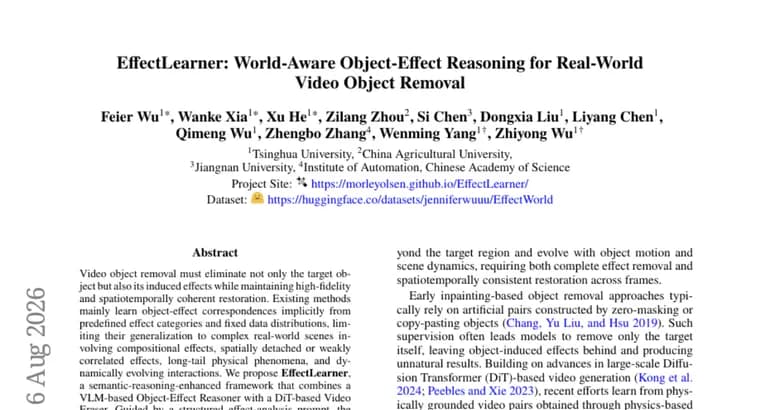
Video object removal tools face a problem beyond erasing the object itself: real-world scenes carry effects the object caused, such as shadows, reflections or disturbed surroundings, that removal systems often leave behind. According to the authors, existing methods mostly learn object-effect correspondences implicitly from predefined effect categories and fixed data distributions, which limits their ability to generalize to complex real-world scenes involving compositional effects, effects that are spatially detached or only weakly correlated with the object, long-tail physical phenomena, and interactions that evolve dynamically over time.
To address this, the authors propose EffectLearner, a semantic-reasoning-enhanced framework that pairs a VLM-based Object-Effect Reasoner with a DiT-based Video Eraser. Guided by a structured effect-analysis prompt, the Reasoner performs cross-modal reasoning over a target-highlighted video and extracts compact effect-aware context, which then guides the Eraser toward comprehensive removal of the object and its effects together. Motion-aware mask guidance and motion-consistency supervision are added on top, to improve removal coverage and keep the result spatiotemporally stable as objects move and scenes change.
The authors also built EffectWorld, a new paired video dataset designed specifically for complex object-induced effects, and trained the model with a progressive curriculum that combines ordinary supervision with this complex-effect data. On the existing ROSE-Bench benchmark, EffectLearner outperforms existing baselines on most metrics, and on two evaluation sets drawn from the new dataset, EffectWorld-Eval and the more difficult EffectWorld-Wild, it shows clear advantages as well. The paper does not report the specific numeric scores behind these comparisons, nor does it name the authors, their affiliations, a publication venue, or the size of the EffectWorld dataset.
Key facts
- EffectLearner combines a VLM-based Object-Effect Reasoner with a DiT-based Video Eraser to remove both a target object and the effects it caused from a video.
- A structured effect-analysis prompt guides the Reasoner to extract effect-aware context from a target-highlighted video, which then steers the Eraser.
- Motion-aware mask guidance and motion-consistency supervision improve removal coverage and stability under object motion and changing scene dynamics.
- The authors built EffectWorld, a new paired video dataset for complex object-induced effects, and trained the model with a progressive curriculum mixing ordinary and complex-effect supervision.
- On the ROSE-Bench benchmark, EffectLearner beats existing baselines on most metrics, and it also shows clear advantages on the new EffectWorld-Eval and EffectWorld-Wild sets, though no specific numeric scores are given.
Why it matters
Most video object removal tools focus on erasing the object itself but can leave behind the traces it left in the scene, a shadow, a reflection, disturbed water or similar consequences. EffectLearner targets that specific failure mode directly, aiming for removal that covers the object and its induced effects together, in scenes where those effects are compositional, spatially detached from the object, physically unusual, or changing over time.
Who it affects
The work is aimed at researchers and engineers building video inpainting and object-removal systems, including those working with diffusion transformer video models. It is also relevant to anyone assembling training or evaluation data for this task, since it introduces EffectWorld as a new resource for it.
How to use it
This is a research paper describing a framework and a new dataset, not a released product. The text does not state whether the EffectLearner code or the EffectWorld dataset are being made publicly available, so nothing can be said here about access, pricing or licensing.
How solid is it
The authors report that EffectLearner outperforms existing baselines on most metrics on the standard ROSE-Bench benchmark, and shows clear advantages on the new EffectWorld-Eval and EffectWorld-Wild evaluation sets built from their own dataset. The text does not give the underlying numeric scores or margins for any of these comparisons.
Risks and caveats
The results come from the authors' own description of their method and evaluation, without independently reported scores to check the margins against. The text also does not name the authors, their affiliations, a publication venue, or the size of the EffectWorld dataset, so those details cannot be verified from the source.