EditaLive brings real-time character editing to live streaming
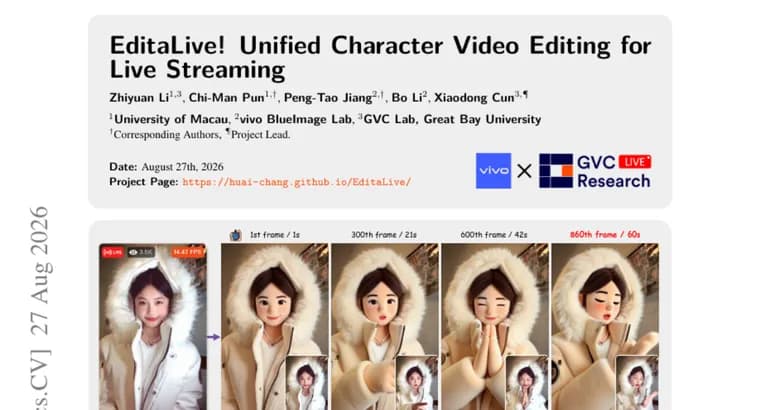
Conventional video editing tools focus on scene-level content, adjusting a whole scene or clip, but live streaming puts more emphasis on the human subject, the person actually on camera. The authors say that applying existing video-editing methods directly to this human-centric, live-streaming setting is difficult: those methods may introduce inconsistencies in facial expressions, and they typically depend on multiple offline inference steps, which makes them unsuitable for real-time interaction.
To address this, the authors propose EditaLive, a framework for real-time streaming character video editing. It starts from Wan-Animate, an existing pretrained image animation model that the authors say naturally decouples a subject's appearance from its motion. They repurpose Wan-Animate as the base model for instruction-based, human-centric video editing, training it through reference-frame editing and video reconstruction on a dataset collected for this work, called CharEdit-50K.
The authors then adapt the model from offline, bidirectional generation, meaning it can look both backward and forward across a whole clip, to causal streaming generation, which only uses information available so far, matching how a live stream actually works. To make that fast enough for real-time use, they design what they call an aligned self-rollout distillation strategy, which compresses the model into a two-step sampler. Two further techniques target specific problems that compression can cause: fixed RoPE and align forcing are meant to narrow the gap between how the model behaves during training and during inference, and a first-frame preserved sparse attention mechanism filters out redundant historical information to limit appearance drift, the tendency for a subject's look to gradually change as a stream goes on.
The authors report that, across extensive experiments, EditaLive delivers state-of-the-art editing performance while faithfully preserving facial expressions and running at the low latency that real-time streaming needs. The text gives no specific benchmark numbers, such as accuracy scores, latency in milliseconds, or frame rate, to support those comparisons, and it does not say what the '50K' in CharEdit-50K counts, whether video clips, frame pairs, or another unit. It also names no authors, institution, publication venue, or date, and does not say whether EditaLive's code, model weights, or the CharEdit-50K dataset will be released.
Key facts
- EditaLive repurposes Wan-Animate, a pretrained image animation model that the authors say naturally decouples appearance from motion, as the base for human-centric video editing.
- The authors train it for instruction-based editing through reference-frame editing and video reconstruction on a dataset they collected, called CharEdit-50K.
- The model is adapted from offline, bidirectional generation to causal streaming generation so it can run in real time during a live stream.
- An aligned self-rollout distillation strategy compresses the model into a two-step sampler; fixed RoPE and align forcing narrow the gap between training and inference, and first-frame preserved sparse attention filters redundant history to limit appearance drift.
- The authors report state-of-the-art editing performance with faithful facial-expression preservation and low latency, though the text gives no numeric benchmark results to support that claim.
Why it matters
Live streaming puts the emphasis on the person on camera, not the background, but the authors say existing video-editing methods are built for scene-level content and offline processing: applied directly to a live human subject, they can distort facial expressions and need multiple offline inference steps, which is too slow for real-time interaction. EditaLive targets that specific gap: an editing framework built around a person's appearance rather than a scene, and built for the constraint that a live stream cannot pause while it thinks. Starting from an existing animation model, Wan-Animate, rather than training a video editor from scratch, and then compressing it down to a two-step sampler, is the authors' route to instruction-based video editing that could run alongside a live feed instead of only on footage that has already been recorded.
Who it affects
The direct audience is researchers building real-time video generation and editing systems, and companies developing live-streaming tools, virtual avatars, or camera filters for creators, the people most likely to adapt a method like this into a product. Streamers and other people who broadcast live video are who such a tool would ultimately edit, though the text describes a research method rather than a released application anyone can point at a live camera today. The abstract text itself does not name the paper's authors, an institution, or a publication venue; a submitter name is attached to the Hugging Face listing, but it does not appear in the article text, so no individual or organization can be credited here.
How to use it
The text describes a research method, not a released product: it gives no price, licence terms, or download link, and it does not say whether EditaLive's code, model weights, or the CharEdit-50K dataset will be released. As described, reproducing the work would mean starting from Wan-Animate, then following the paper's training steps: reference-frame editing and video reconstruction on the CharEdit-50K dataset, followed by the aligned self-rollout distillation that produces the two-step sampler, rather than installing a tool that exists today.
How solid is it
The central claim, that EditaLive reaches state-of-the-art editing performance with faithful facial-expression preservation and low-latency real-time inference, is the authors' own characterization of their 'extensive experiments'; the text gives no accuracy figures, latency numbers, or frame rate, and names no benchmark to check any of it against. It also does not say what the '50K' in the CharEdit-50K dataset name counts, video clips, frame pairs, or something else, and it names no publication venue or date, so there is no way to independently trace or verify the work from this text alone. On Hugging Face's papers board, the submission has drawn light attention so far, 3 points and 2 comments, which reflects visibility rather than independent verification of the claims.
Risks and caveats
No numeric benchmark results, accuracy scores, latency in milliseconds, or frame rate, support the 'state-of-the-art' and 'low-latency' claims in the text available here, so the size of any improvement over prior methods cannot be judged from this description alone. As with any self-reported result in a research paper, EditaLive's claimed performance is the authors' own characterization of their experiments, not an independent evaluation, and is best read as a claim awaiting outside confirmation. The text also does not say whether EditaLive's code, model weights, or the CharEdit-50K dataset will be released, so there is not yet a way to test any of this directly.
“EditaLive delivers state-of-the-art editing performance with faithful preservation of facial expressions and low-latency real-time streaming inference.”
— the authors