Ego2Robot converts human video into 18,561 hours of robot data
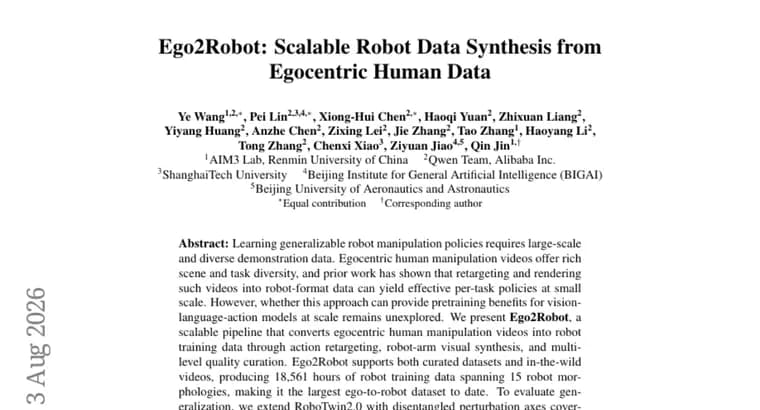
Training robot manipulation policies that generalize well requires large amounts of diverse demonstration data, and collecting it by teleoperating physical robots is slow and expensive. Egocentric human manipulation videos, footage of people performing tasks recorded from a first-person view, offer that diversity far more cheaply. Prior work had already shown that retargeting and rendering such videos into robot-format data can produce effective policies for individual tasks at small scale, but whether the approach could scale up to actually improve pretraining for today's general-purpose vision-language-action (VLA) models had not been tested.
The researchers present Ego2Robot, a pipeline that converts egocentric human manipulation videos into robot training data through three steps: action retargeting, robot-arm visual synthesis, and multi-level quality curation. It works on both curated video datasets and video collected in the wild, and it can target 15 different robot morphologies. Running the pipeline produced 18,561 hours of robot training data, which the authors say makes it the largest ego-to-robot dataset produced to date.
To test whether the synthetic data actually helps generalization, the researchers extended an existing benchmark, RoboTwin2.0, with disentangled perturbation axes covering visual appearance, scene layout, embodiment morphology, and task semantics, letting each factor be varied independently. Experiments show that pretraining jointly on Ego2Robot-synthesized data and real robot data consistently improves out-of-distribution generalization across these perturbation types, and the paper states the benefits were validated on real-robot deployment, not only in simulation.
Key facts
- Ego2Robot converts egocentric human manipulation video into robot training data via action retargeting, robot-arm visual synthesis, and multi-level quality curation.
- The pipeline produced 18,561 hours of robot training data spanning 15 robot morphologies, described as the largest ego-to-robot dataset to date.
- It supports both curated datasets and in-the-wild video as input.
- Evaluation used an extended RoboTwin2.0 benchmark with separate perturbation axes for visual appearance, scene layout, embodiment morphology, and task semantics.
- Joint pretraining on Ego2Robot data and robot data consistently improved out-of-distribution generalization, with the gains validated on real-robot deployment.
Why it matters
Collecting demonstration data by teleoperating physical robots caps how much training data vision-language-action models can get, which in turn caps how well they generalize outside their training distribution. Egocentric human video is abundant and cheap to record, but no prior work had shown it could scale up to actually improve pretraining for today's VLA models rather than just producing small per-task policies. Ego2Robot's 18,561-hour output is offered as evidence that human video can now supply data at pretraining scale.
Who it affects
Robotics researchers and labs building general-purpose manipulation policies, especially those pretraining vision-language-action models, gain a new data source and a benchmark extension for measuring generalization. This is a research pipeline and dataset, not a deployed consumer product, so the immediate audience is technical: people who build or evaluate robot policies rather than end users of robots.
How to use it
The paper points to a project page at https://www-ye.github.io/ego2robot_blog/ for further material. The available text does not state a licence, a release timeline, or whether the dataset or pipeline code has been made publicly downloadable. As described, the data is meant to be combined with real robot data during pretraining rather than used as a standalone replacement for it.
How solid is it
The core evidence is a stated dataset size (18,561 hours across 15 morphologies) and an experimental claim that joint pretraining improves out-of-distribution generalization, tested with an extended RoboTwin2.0 benchmark covering four separate perturbation axes and further checked through real-robot deployment rather than simulation alone. The source does not quantify the size of the generalization improvement, only that it is consistent across perturbation types, so the magnitude of the gain is not stated here.
Risks and caveats
The available text does not specify which 15 robot morphologies are covered, what the multi-level quality curation step actually filters for, or how the synthesized robot-arm visuals hold up in edge cases, so this text alone does not support an assessment of how faithful the human-to-robot conversion is. No author names, institutions, publication venue, or date appear in the available text.