GameWAM unifies world models and action policies for games
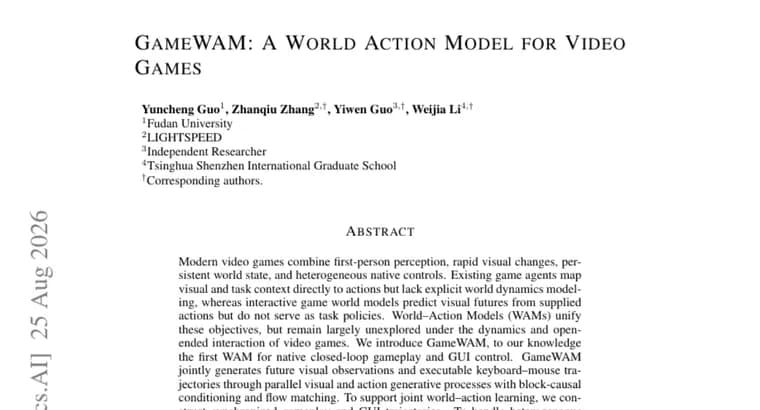
Video games mix first-person perception, fast-changing visuals, a persistent world state, and controls that switch between native gameplay input and GUI menus. According to the authors, existing game agents map what they see and the task at hand directly to actions but do not explicitly model how the world will change, while separate interactive world models predict future visuals from given actions but cannot act as task policies themselves. World-Action Models (WAMs) are meant to unify these two objectives, but the authors say WAMs remain largely unexplored for the dynamics and open-ended interaction that video games demand.
The authors present GameWAM as, to their knowledge, the first WAM built for native closed-loop gameplay and GUI control. It jointly generates future visual observations and executable keyboard-mouse action trajectories through parallel visual and action generative processes, using block-causal conditioning together with flow matching. To train this joint world-and-action behavior, the researchers built a dataset of synchronized gameplay and GUI trajectories; the source text does not state its size.
Because a game can call for either native gameplay actions or GUI interactions such as menu clicks, GameWAM predicts which of the two modes applies at each action step, then generates the action using mode-specific prediction distributions plus continuous-action normalization to reconcile the two control types.
For long-horizon play, the system uses block-cycle control: it plans beyond the horizon it has committed to, but executes only a short prefix of that plan before replanning from new observations. Fine-grained context within each cycle and a hierarchical history across cycles are meant to keep the agent's behavior temporally consistent as it repeatedly replans.
The authors report that experiments show competitive task success while GameWAM executes fewer native actions than the agents it was compared against. The source text does not name the benchmarks, games, or comparison agents involved, and gives no numeric scores.
The authors also report discovering Low-Frequency Action Source Imprinting (LASI): low-frequency components of the sampled action source systematically steer the coarse camera motion GameWAM generates, even when other conditioning is held fixed. They present this as a source-sensitivity failure mode in generative control more broadly, not just a quirk of GameWAM.
A project page for GameWAM is available at https://yunncheng.github.io/GameWAM/; the source text gives no further detail on code or dataset release.
Key facts
- GameWAM is presented as, to the authors' knowledge, the first World-Action Model for native closed-loop video game gameplay and GUI control.
- It jointly generates future visual observations and executable keyboard-mouse action trajectories through parallel visual and action generative processes using block-causal conditioning and flow matching.
- At each action step it predicts whether gameplay or GUI mode applies, then generates the action with mode-specific prediction distributions and continuous-action normalization to unify the two control types.
- Block-cycle control plans beyond the committed horizon but executes only a short action prefix before replanning from new observations, using within-cycle context and cross-cycle history to preserve continuity.
- The authors report competitive task success with fewer executed actions than compared agents, and describe a newly found failure mode, Low-Frequency Action Source Imprinting, where low-frequency noise in the action source biases generated camera motion.
Why it matters
GameWAM targets a real split in game AI: agents that act without modeling how the world will change, and world models that predict visuals without being able to act. Building both into one closed-loop system, covering native gameplay and GUI control together, is the contribution the authors claim as novel for this domain.
Who it affects
The paper speaks to researchers building game-playing agents, embodied and world-model researchers working on joint perception-action generation, and anyone developing GUI automation agents, since GameWAM's mode-switching mechanism covers GUI interaction as well as native gameplay input. It is a research architecture, not a released game or consumer product.
How to use it
The source text gives no pricing, licence, or code-release information. A project page is linked at https://yunncheng.github.io/GameWAM/; the text does not say whether code, weights, or the synchronized gameplay/GUI dataset used for training will be released.
How solid is it
The authors report competitive task success using fewer executed native actions than the agents GameWAM was compared against, but the source text does not name those comparison agents, the games or benchmarks used, or give any numeric scores, so the size of the improvement cannot be independently judged from what is available. The architecture itself combines several specific mechanisms, block-causal conditioning, flow matching, mode-specific action distributions, and block-cycle replanning, that the authors present as jointly novel.
Risks and caveats
The authors themselves flag a limitation: Low-Frequency Action Source Imprinting, where low-frequency components of the sampled action source systematically bias the coarse camera motion GameWAM generates even when other conditioning stays fixed. They describe it as a general source-sensitivity failure mode in generative control, not one they claim to have solved. Combined with the absence of concrete benchmark numbers in the available text, the practical robustness of the approach is not yet independently verifiable from the source alone.
“GameWAM jointly generates future visual observations and executable keyboard-mouse trajectories through parallel visual and action generative processes with block-causal conditioning and flow matching.”
— GameWAM paper