Gated Recurrent Transformer matches 12-layer GPT-2 with just 3 layers
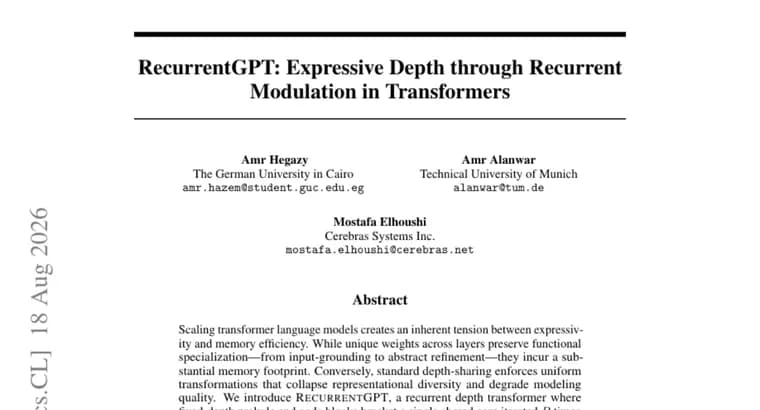
A new paper describes the Gated Recurrent Transformer, an architecture built to resolve a tradeoff in scaling transformer language models: giving every layer its own unique weights preserves functional specialization, from grounding the input to refining abstract representations, but costs a large memory footprint, while the usual fix of sharing weights across depth forces every layer to perform the same transformation and degrades quality. The design keeps fixed prelude and coda blocks at the start and end of the network, and in between iterates a single shared core block R times rather than stacking unique layers. Borrowing from gated recurrent neural networks, a lightweight projection paired with an elementwise update gate, conditioned on the current hidden state, the fixed prelude's output, and noise resampled at every step, modulates each recurrent update. The stated effect is that the model learns to specialize the same few layers to the input across recurrences, instead of needing many distinct layers to reach that diversity.
Under an isoFLOPS comparison, where architectures are matched on training and inference compute, a 3-layer Gated Recurrent Transformer matches the accuracy of a 12-layer GPT-2 Small baseline, and it beats two other depth-reuse baselines, mixture-of-recursions (MoR) and heavy-tail depth sampling, in all nine scale-by-budget cells the paper tests. At medium and large scale, the architecture approaches the quality of a standard dense (non-recurrent) model at the usual token training budget, and at medium scale it overtakes the dense model once that budget is doubled.
A separate isoPARAMS comparison, matching parameter count and training data rather than compute, finds that a deeper-recurrence version of the architecture reaches a 2.76 validation loss versus 2.84 for a non-recurrent counterpart at the same parameter and data budget.
The paper frames the practical payoff as a parameter-for-quality trade at large scale: 63% fewer parameters and 59% less peak decoding memory, at the cost of a 10% increase in compiled generation latency. It concludes that adaptive depth reuse, in this gated recurrent form, is a principled way to make that trade. The source text names no authors, no institution, and no code, model weight, or dataset release, and does not spell out what MoR or heavy-tail depth sampling are beyond naming them as the compared baselines.
Key facts
- Under matched training and inference compute (isoFLOPS), a 3-layer Gated Recurrent Transformer matches the accuracy of a 12-layer GPT-2 Small baseline.
- It leads two other depth-reuse methods, MoR and heavy-tail depth sampling, in all nine scale-by-budget cells tested.
- At medium scale, doubling the standard token training budget lets it overtake a dense (non-recurrent) model's quality.
- Under matched parameters and data (isoPARAMS), deeper recurrence reaches a 2.76 validation loss versus 2.84 for a non-recurrent counterpart.
- At large scale, the architecture cuts parameters by 63% and peak decoding memory by 59%, at the cost of a 10% increase in compiled generation latency.
Why it matters
Transformer scaling has faced a hard tradeoff: unique weights per layer keep each layer's job distinct but bloat memory, while sharing weights across depth saves memory but flattens every layer into the same transformation and hurts quality. The Gated Recurrent Transformer targets that tradeoff directly by iterating one shared core block and using a gate, conditioned on the hidden state, the fixed prelude output, and per-step noise, to let the model specialize that shared block differently at each recurrence. The headline result, matching a 12-layer GPT-2 Small's accuracy with 3 layers under equal compute, is a concrete demonstration that the specialization problem in depth-shared models can be addressed without giving every layer its own weights.
Who it affects
The result speaks most directly to researchers and engineers who design or train transformer language models and who care about the balance between parameter count, memory footprint, and inference cost. The large-scale numbers, fewer parameters and less peak decoding memory for a modest latency increase, are aimed at anyone weighing model size against the cost of running inference at scale, though the source does not name any specific team, lab, or product planning to adopt the approach.
How to use it
The source text does not mention a code release, model weights, or a dataset, and states no pricing, licensing, or availability terms. There is nothing here for a practitioner to run today; the contribution as presented is architectural and experimental.
How solid is it
The claims rest on two separate controlled comparisons: an isoFLOPS comparison across nine scale-by-budget cells against two named depth-reuse baselines (MoR and heavy-tail depth sampling), and a separate isoPARAMS comparison against a non-recurrent counterpart, each reported with specific accuracy, loss, parameter, memory, and latency figures rather than vague claims of improvement. What is missing from the text is any author or institutional affiliation, a publication venue, or independent replication, and the paper drew modest engagement on Hugging Face, 9 points and 5 comments, at the time it was captured.
Risks and caveats
The source text gives no absolute parameter counts for the 'medium scale' or 'large scale' settings it reports, only relative differences, which makes the headline savings hard to place against real model sizes. It also does not explain what MoR or heavy-tail depth sampling are beyond naming them as baselines, so readers cannot independently judge how strong those comparisons are. The efficiency gain is not free: the 10% latency increase at large scale is a real cost of the approach, and with no author, institution, or release named, the work cannot yet be checked against a broader track record or reproduced from public code.
“Our results demonstrate that adaptive depth reuse is a principled strategy for trading parameters for quality.”
— the paper's authors