Google DeepMind's WeatherNext gains a day of cyclone forecast lead time
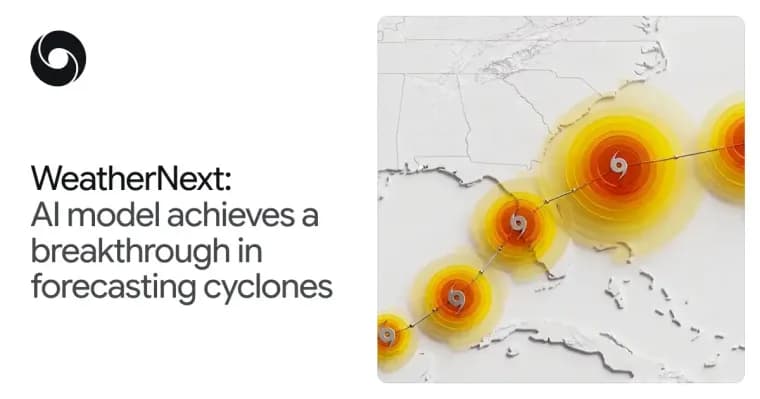
Google DeepMind, working with Google Research, published a paper in Nature describing WeatherNext, a single AI model that predicts a tropical cyclone's track, intensity and wind structure with state of the art accuracy. The headline result: WeatherNext's three day forecasts are as good as what prior models could only deliver two days out, an average gain of about a full extra day of predictive accuracy that the team frames as roughly a decade's worth of meteorological progress. The work was done with forecasters at the US National Hurricane Center (NHC), the Cooperative Institute for Research in the Atmosphere (CIRA), the UK Met Office and other weather agencies. During the 2025 hurricane season the model already had a real deployment: it helped the NHC predict Hurricane Melissa's rapid intensification and its landfall in Jamaica, giving teams on the ground extra time to prepare. This season the system is generating 1,000 possible scenarios per cyclone, up from 50 last year, to support forecaster decision-making. Cyclone forecasting has historically forced a trade off between coarse global models good at tracking a storm's path and higher resolution local models needed to capture the fine scale thermodynamics that drive its intensity. WeatherNext bridges that gap with one model, co-trained end to end on nearly 20 terabytes of global atmospheric data and the IBTrACS historical database of nearly 5,000 storms. It uses Functional Generative Networks to produce large prediction ensembles quickly, generating a full 15 day forecast in under a minute on a single TPU. WeatherNext Cyclones needs input data at only 28x28km resolution, about 100 times coarser than traditional models, while the smaller WeatherNext 2-mini runs at a coarser 111x111km and still performs well; the team says it does not yet fully understand why the models work this well at such low resolution and calls it an open research question. Alongside the Nature paper, Google DeepMind is open sourcing the code and weights for WeatherNext 2, WeatherNext Cyclones and the compact WeatherNext 2-mini, the last of which can run in a free public Colab notebook on a single TPU. The models and forecasts are viewable through Weather Lab, recently updated with a new interface covering both cyclone tracks and general global weather. Google DeepMind frames the release as an invitation for researchers, meteorological agencies and forecasters to build on the open models, while noting that official warnings should still come from local meteorological agencies and national weather services.
Key facts
- WeatherNext's three day cyclone forecasts match the accuracy prior models only reached two days out, an average one day gain in lead time.
- During the 2025 hurricane season the model helped the US National Hurricane Center predict Hurricane Melissa's rapid intensification and Jamaica landfall.
- The system now generates 1,000 scenario predictions per cyclone, up from 50 last year, and produces a 15 day forecast in under a minute on one TPU.
- WeatherNext Cyclones needs only 28x28km resolution input data, about 100 times coarser than traditional models, a result the team says it cannot yet fully explain.
- Google DeepMind is open sourcing WeatherNext 2, WeatherNext Cyclones and the compact WeatherNext 2-mini, the last runnable in a free Colab notebook.
Why it matters
Tropical cyclones have caused more than 700,000 deaths and $1.4 trillion in economic losses worldwide over the past 50 years, and warning lead time is the main lever forecasters have to save lives and property. WeatherNext is notable because it is a single model handling track, intensity and wind structure together, where forecasting had previously required trading off a coarse global model for track against a specialized high resolution local model for intensity. Getting an extra day of reliable lead time from one system, rather than a decade of incremental gains, is the scale of improvement DeepMind is claiming.
Who it affects
National weather agencies and forecasters are the direct users: the NHC, CIRA and the UK Met Office already worked with the model during the 2025 season, including the Hurricane Melissa forecast. Open sourcing extends the pool to academic researchers, other national meteorological agencies, and nonprofits building localized or specialized forecasting tools. Ultimately the model is aimed at communities in the path of cyclones and at sectors like renewable energy that plan around extreme weather.
How to use it
Google DeepMind is releasing the code and model weights for WeatherNext 2, WeatherNext Cyclones and WeatherNext 2-mini for free, covering academic research, operational forecasting and building specialized derivative models. WeatherNext 2-mini is small enough to run on a single TPU inside a free public Colab notebook. Forecasts and visualizations, including temperature, precipitation and wind speed alongside cyclone tracks, are available through the Weather Lab interface, part of Google Earth AI. DeepMind stresses that official warnings should still come from local meteorological agencies, not directly from the model's output.
How solid is it
The results are published in a peer reviewed Nature paper co-authored with forecasters from the NHC, CIRA and the UK Met Office, and the central claim, that three day forecasts match the prior two day accuracy, is stated in that same Nature paper. The model was trained end to end on nearly 20 terabytes of global atmospheric data plus the IBTrACS historical record of nearly 5,000 storms, and it already had a field test during the 2025 hurricane season with Hurricane Melissa. The article does not publish numeric accuracy metrics such as percentage error or RMSE for track, intensity or wind structure, relying instead on the relative day-of-lead-time comparison.
Risks and caveats
DeepMind itself flags an open research question: WeatherNext Cyclones needs input resolution only 28x28km, about 100 times coarser than traditional models, and the smaller WeatherNext 2-mini works at an even coarser 111x111km, yet both perform well, and the team says it does not yet fully understand why. No calendar date is given for the Nature paper's publication beyond 'today', and no year is stated for when WeatherNext 2 was operationalized in October or for the scale-up to 1,000 ensemble members. The blog post explicitly reminds readers that official warnings should come from local meteorological agencies, not from the model directly.