LLM writing assistants cut linguistic diversity 21-50%, study finds
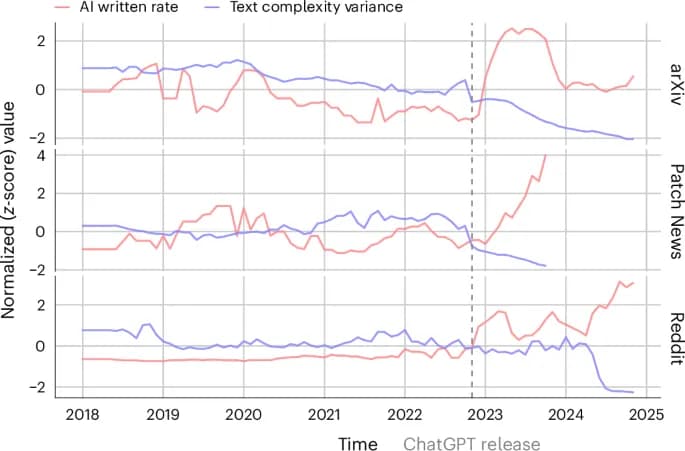
A new study reports that the growing use of large language models (LLMs) as writing assistants is linked to a measurable decline in linguistic diversity. The researchers ran three studies across seven datasets and more than 880,000 texts, comparing original writing with versions polished or rewritten by LLMs. The core content of a text survives the LLM pass, but its style does not: LLM editing homogenizes writing styles, reducing writing-complexity variance by a statistically significant 21 to 50 percent across the datasets and models tested (P is less than or equal to 0.05). The effect goes beyond simply averaging styles together. The study finds that LLM rewriting amplifies linguistic patterns associated with dominant characteristics in a dataset while suppressing others, so the result favors conformity over individual voice. The researchers report that this pattern holds across different LLMs, different prompts and different contexts, rather than being an artifact of one model or one way of asking it to rewrite text.
The seven datasets span very different kinds of writing: Reddit r/WritingPrompts posts, arXiv abstracts, Patch.com local news articles, floor speeches from the US Congressional Record, Facebook posts and Moral Foundations Questionnaire responses from the YourMorals research platform, the Empathic Conversations dataset, and an access-restricted corpus of student essays held by a University of Texas at Austin researcher. Six of the seven datasets are publicly available; the essays corpus is only available on request from its owner and could not be redistributed by the study team. The custom analysis code, written in Python 3.11.7 and R 4.4.2, has been released under the MIT license.
Because language carries information about a person's identity, psychological state and social context, the researchers argue that this homogenization has consequences beyond writing quality. They list diagnostic processes, personalization efforts, hiring assessments and cultural preservation as areas with potential implications, on the reasoning that all of them depend on reading individual or group variation out of language, which is exactly what LLM-mediated writing compresses.
Key facts
- Three studies across seven datasets and more than 880,000 texts link widespread LLM writing assistance to a decline in linguistic diversity.
- LLM-polished or LLM-rewritten text keeps its core content but homogenizes style, cutting writing-complexity variance by a statistically significant 21 to 50 percent across datasets and models (P is less than or equal to 0.05).
- The homogenization amplifies patterns tied to dominant characteristics while suppressing others, favoring conformity over individuality, and holds across different LLMs, prompts and contexts.
- The researchers flag potential implications for diagnostic processes, personalization efforts, hiring assessments and cultural preservation, since all of these rely on reading variation out of language.
- Six of the seven datasets are public (including Reddit, arXiv, Patch.com and US Congressional speeches); the seventh, a restricted essay corpus, is available only by request. Analysis code was released under the MIT license.
Why it matters
Language does not just carry a message, it carries signal about who wrote it: identity, psychological state, social context. Fields from psychology to marketing to healthcare read that signal out of text. If LLM-assisted writing systematically flattens stylistic variation, as this study finds, the text people produce day to day becomes a worse instrument for reading those signals, even though the underlying content of what is said stays intact.
Who it affects
Anyone who writes with an LLM's help sees their individual style pulled toward a shared, more conforming pattern rather than erased outright. The downstream effect lands on people who rely on written language as a signal about the writer: clinicians and researchers using linguistic markers for diagnosis, employers running hiring assessments on written material, teams doing personalization based on how someone writes, and researchers or communities working on cultural and linguistic preservation. The datasets used span creative writing, academic abstracts, local journalism, political speech and social media, suggesting the effect is not confined to one kind of writing.
How to use it
The paper is a research finding, not a tool, but it is a caution for anyone building or relying on systems that infer traits from written text: LLM-polished writing should not be assumed to carry the same individual signal as unedited writing, and results drawn from LLM-mediated text may skew toward dominant patterns in the training or editing process rather than reflecting the original writer. The underlying analysis code is released under the MIT license, and six of the seven datasets are public, so the methodology can be checked or extended by other researchers.
How solid is it
The reported effect, a 21 to 50 percent reduction in writing-complexity variance, is described as statistically significant (P is less than or equal to 0.05) and is said to replicate across three separate studies, seven datasets in different domains, and more than 880,000 texts, rather than resting on a single sample. The full methodology, including how 'linguistic diversity' and 'writing-complexity variance' are measured and which specific LLMs were used to polish or rewrite the texts, is not visible in the publicly accessible part of the paper, which sits behind a subscription paywall; only the abstract, and the data and code availability statements, are readable without access. No publication date and no author names are visible in that accessible portion either.
Risks and caveats
One of the seven datasets, the essay corpus, is access-restricted and was obtained by the researchers under a direct request that did not permit redistribution, so that part of the analysis cannot be independently reproduced from public data alone. The paper itself frames the downstream consequences, effects on diagnostics, personalization, hiring assessments and cultural preservation, as 'potential implications' rather than as effects the study directly measured, and does not spell out a mechanism connecting reduced linguistic diversity to harm in any of those specific areas. Because the specific LLMs, prompts and rewriting setups used are not stated in the accessible text, it is not possible to tell from the abstract alone whether the effect size would hold for a particular model or writing tool a reader might use.
“While core content is retained when LLMs polish and rewrite texts, LLMs also homogenize writing styles, reducing writing-complexity variance by a statistically significant 21-50% across datasets and models.”
— the study