MMLVE-Agent combines LLMs and VLMs for consistent multi-shot video editing
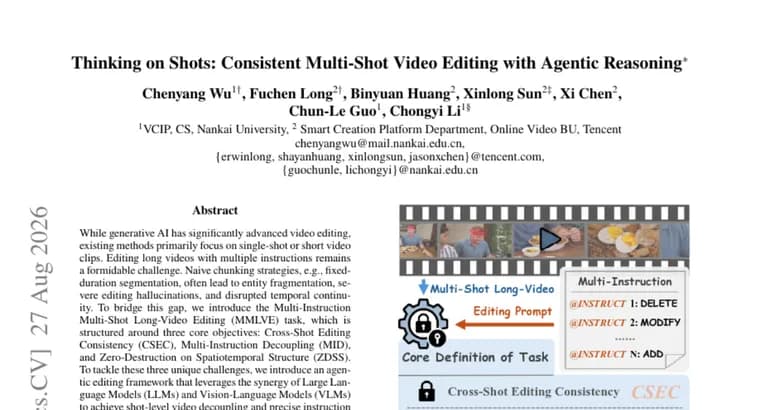
Generative AI has gotten much better at editing video, but mostly for single shots or short clips, according to a new paper. Editing a long video that needs multiple different instructions applied across multiple shots remains a hard problem. Naive fixes, such as splitting the video into fixed-duration chunks and editing each one separately, tend to fail: they fragment entities so the same object or character loses continuity between chunks, introduce severe editing hallucinations, and disrupt the video's temporal continuity.
To address this, the authors define the Multi-Instruction Multi-Shot Long-Video Editing (MMLVE) task around three core objectives: Cross-Shot Editing Consistency (CSEC), keeping an edit consistent as the video cuts between shots; Multi-Instruction Decoupling (MID), correctly separating and applying several distinct edit instructions; and Zero-Destruction on Spatiotemporal Structure (ZDSS), leaving the video's spatial and temporal structure intact through the edit.
Their proposed system, MMLVE-Agent, is an agentic editing framework that combines large language models (LLMs) and vision-language models (VLMs) to decouple a long video at the shot level and precisely parse editing instructions before applying them. To evaluate the task, the authors also built MMLVE-Bench, a dataset built around complex real-world spatiotemporal dynamics, a high density of varied instructions, and entities that are sparse and randomly distributed through the footage, together with three MMLVE-focused metrics designed to judge editing quality on this task.
According to the paper, extensive experiments show MMLVE-Agent outperforming existing closed-source state-of-the-art video editing approaches, citing Seedance 2.0 as one comparison point. The authors report that their framework eliminates editing hallucinations, preserves consistency across shots, and achieves seamless transitions in space and time.
Key facts
- The paper defines the MMLVE task around three objectives: Cross-Shot Editing Consistency, Multi-Instruction Decoupling, and Zero-Destruction on Spatiotemporal Structure.
- MMLVE-Agent pairs large language models with vision-language models to split a long video by shot and parse multiple editing instructions before applying them.
- The authors built MMLVE-Bench, an evaluation dataset with complex real-world dynamics and dense, varied instructions, plus three MMLVE-specific metrics to score editing quality.
- The authors report MMLVE-Agent outperforms closed-source systems such as Seedance 2.0, eliminating editing hallucinations and preserving consistency across shots.
Why it matters
Most real video, such as ads, films or social clips, is made of several shots stitched together, and creators often want more than one edit applied across the whole sequence, not just to a single shot. Current AI editing tools are good at a single shot or a short clip, but naive ways of scaling that up, like cutting a long video into equal chunks and editing each piece on its own, break down: objects and characters stop looking the same between chunks, edits hallucinate content that should not be there, and the video's flow gets disrupted. Defining MMLVE as its own task, with three explicit objectives, gives the field a shared, concrete target instead of everyone solving a slightly different, informal version of the same problem.
Who it affects
The direct audience is researchers working on video generation and editing, and companies building AI video editing products, who now have both a defined task (MMLVE) and a benchmark (MMLVE-Bench) to measure progress against. Indirectly, it points at anyone who might eventually use a video editing tool built on this kind of approach, since today's tools tend to struggle in exactly the situation this paper targets: a long video, several shots, and several edits that all need to hold together.
How to use it
The text does not say whether MMLVE-Agent's code, a trained model, or the MMLVE-Bench dataset will be released, and gives no price or licence terms, so there is nothing here to install or try yet. As described, this is a research contribution: a defined task, a proposed agentic method built on existing LLMs and VLMs, and a benchmark for measuring future systems against, rather than a shipped product.
How solid is it
The evidence offered is the authors' own: they say their experiments show MMLVE-Agent beating closed-source systems such as Seedance 2.0, and that it eliminates editing hallucinations, keeps edits consistent across shots, and achieves seamless spatiotemporal transitions. No quantitative scores for those comparisons appear in the text, so there is no way to judge from what is available here how large the improvement is or how it was measured. The paper also does not name its authors, their institutions, a publication venue, or a date, so there is no way to independently trace or check the claims from this text alone.
Risks and caveats
MMLVE-Bench's size, how many videos, clips or instructions it contains, is not given, so it is unclear how large or representative the evaluation is. As with any self-reported comparison in a research paper, the claim that MMLVE-Agent outperforms existing closed-source systems is the authors' own characterization of their results, not an independent evaluation. It is best read as a claim awaiting confirmation rather than a settled result, at least until code, a model, or third-party testing become available.