OpenAI unveils Dots agents, GPT-6.1 Sol and Ultrafast at DevDay 2026
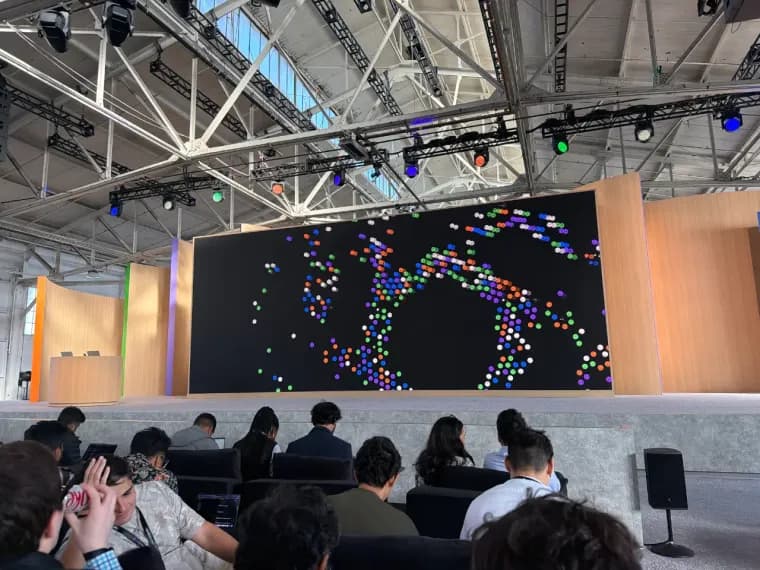
This is a retelling of a live blog from OpenAI DevDay 2026, held on 29 September 2026 at Fort Mason in San Francisco. The blogger attended with a free ticket and a seat in the 'creator' area, both given by OpenAI, and logged the keynote and later sessions as they happened. What follows is what was said on stage, plus the blogger's own asides, which are marked as such.
Sam Altman opened by promising 'our best DevDay yet' and listing shipped features people had asked for; Codex on Linux and Codex on your phone got applause. The headline product was Dots, a personal agent. Users pick its name and it is shown as a blob-like avatar. The blogger had guessed beforehand that it would be a personal agent similar to Muse and said the result does look very Muse-like. Dots are 'powered by Astra', which Altman called 'our most aligned model', so that you can trust your Dot with 'as much responsibility as you are comfortable with'. ChatGPT Pro and Enterprise customers get access to Dots today. OpenAI is also building 'specialist dots' for legal, finance and similar fields, working with enterprises, and doing something with Microsoft 365 around them.
For teams there is ChatGPT Space, a place to collaborate with Dots. The blogger thought Spaces look like shared artifacts, maybe Google Docs meets the artifacts pattern. Holly Li walked through building a fictional music app with a Dot called Dottie, which has access to ChatGPT, Slack, Teams and more. The live demo stalled: Dottie gave a 'still checking' message and there was an awkward silent moment. Later Dottie used Codex on the laptop to build the app and launch it in the iPhone Simulator. People at OpenAI also delegate to their Dots directly in Slack, where the Dots have their own identities.
On the model side, Altman said people had asked for GPT-6 Astra but cheaper and faster, so OpenAI launched GPT-6.1 Sol: 'Near-Astra level intelligence at a fifth of the price'. Alongside it came Ultrafast, which is 8x faster, up to 300 tokens per second, in the API, ChatGPT and Codex, at 6x the price of standard. Altman said 'you know what, it's worth it'. Ultrafast is available for Astra 6 today and for Sol 6.1 soon. A new Pro 500 plan includes Ultrafast and 25x the usage of Plus, and the $200/month plan goes back on sale for new subscribers. OpenAI also previewed a Decisions API that lets a model respond 'in a fraction of a second' by choosing from 'a predefined set of options', using the Luna model. The blogger said it sounds like a response to Jev, which came out of stealth less than two weeks earlier.
Tejal Patwardhan described how OpenAI uses its own models to speed up research. She said the models helped optimize the harness for Computer Use, producing 'a 2x latency win that we've shipped to all of you', and that the models are much less likely to make a mistake navigating the desktop and browser.
For developers, Altman said the open source Codex harness is where 'supporting developers' starts, and Codex is now 'fully in the cloud'. Codex Security Cloud launched, with scheduled scans and automatic de-duplication. There is an Agents API, now with Computer Use; the blogger was unsure whether it is new. Altman boasted about the 'most performant and reliable API'; the blogger read that as a jab at Claude, which had an outage that morning. The blogger skimmed the AWS partnership and enterprise privacy sections, so no detail is given.
Romain Huet ran live demos. Voice mode failed in the Ultrafast 3D modeling demo, so he typed commands, such as putting the livestream on the big screen of a 3D model of the venue, and it worked. He also built an app to hand out free tickets to random attendees, showed Astra working out a new vibe-coded game through Computer Use, ran Codex Remote building an iPhone app, sent Codex Cloud off to rewrite a backend in Rust, and finished with a Hugging Face Microduck robot.
Altman said 1.2B people use ChatGPT every week and turned to distribution. New pieces: sign in with ChatGPT, which lets people sign into your app and use the tokens they already pay for; plugin extensions, plugins that are 'entire applications' feeling native to ChatGPT and Codex, with a sample from Adobe; ChatGPT Sites that can be shared with specific people; and the OpenAI Marketplace, launching today with partners. The keynote ended with a video about people building on OpenAI's platform. OpenAI's blog carries posts on GPT-6.1 Sol, Introducing dots and a DevDay 2026 Recap. Every attendee also got a physical item shown in an image, plus a banked reset; it was pressed live and, the blogger says, affects everyone in the world.
In the afternoon ChatGPT Sites session, Jon Abrams was said to have first prototyped the tool out of frustration at how hard it was to ship internal tools. Sites launched earlier this year, already hosts 8m sites, and 70% of OpenAI employees make their own. Katia Gil Guzman turned a spreadsheet of DevDay launches into a Launch Radar app published as a Site. Sites now get a SQLite database, scheduled tasks (launching today), Sign in with ChatGPT support, and default to private. Plugins in Sites also launches today, letting a Site show data personalized for the visiting user from their plugins. Other people can be added as editors who publish updates themselves. Guzman also covered WebMCP and how much more efficient it is than Computer Use. The blogger's own try of the create-your-dot link told them to switch to a desktop.
Key facts
- Dots, a personal agent powered by Astra, is available today to ChatGPT Pro and Enterprise customers; teams collaborate with their Dots in the new ChatGPT Space.
- GPT-6.1 Sol is pitched as 'Near-Astra level intelligence at a fifth of the price'; Ultrafast runs 8x faster, up to 300 tokens per second, at 6x the price of standard.
- The new Pro 500 plan includes Ultrafast and 25x the usage of Plus, and the $200/month plan is back on sale for new subscribers.
- A Decisions API is in preview, while Codex Security Cloud, sign in with ChatGPT, plugin extensions and the OpenAI Marketplace were announced as launching or available today.
- ChatGPT Sites, launched earlier this year, hosts 8m sites; it now gets a SQLite database, scheduled tasks and Plugins in Sites.
Why it matters
OpenAI used DevDay to move from a chat product toward persistent agents. Dots are built on Astra, described on stage as 'our most aligned model', and are meant to be trusted with as much responsibility as the user is comfortable with. The same keynote gave developers a cheaper model in GPT-6.1 Sol, a much faster tier in Ultrafast, and a route to distribution through sign in with ChatGPT, plugin extensions and the OpenAI Marketplace. The blogger compared Dots to Meta's Muse agent, which they said was still number one on the iOS App Store free list.
Who it affects
ChatGPT Pro and Enterprise customers get Dots first. Teams get ChatGPT Space for working with their Dots, and enterprises in legal and finance are the target for specialist dots. Developers are addressed by the Agents API, the open source Codex harness, Codex Security Cloud, sign in with ChatGPT and the Marketplace. Anyone building internal tools may care about ChatGPT Sites, which now has a database, scheduled tasks and private-by-default sharing.
How to use it
Dots are available today to ChatGPT Pro and Enterprise customers. Ultrafast works in the API, ChatGPT and Codex, and is available for Astra 6 today and for Sol 6.1 soon. Pro 500 includes Ultrafast and 25x the usage of Plus, and the $200/month plan is back on sale for new subscribers. GPT-6.1 Sol is launching today. The Decisions API is only a preview. Sign in with ChatGPT lets people use the tokens they already pay for inside your app. Sites can be shared with specific people or added editors, and default to private.
How solid is it
This is a first-person live blog of the keynote and sessions, so most figures are what OpenAI said on stage, not independently checked: the 8x speed-up, the 2x latency win, 1.2B weekly ChatGPT users, and the 8m Sites with 70% of OpenAI employees building their own. Timestamps are logged as the blogger typed. The 'fifth of the price' line is a relative claim and the entry does not name the speaker. The blogger's remarks about Claude's outage, Muse's App Store rank and the Jev comparison are their own statements, not OpenAI's.
Risks and caveats
No absolute prices are given for Dots, Astra, GPT-6.1 Sol, Ultrafast or Pro 500. It is not stated whether GPT-6.1 Sol is available in the API, and the Decisions API has no availability date. The live demo of Dottie stalled, and voice mode failed in the Ultrafast 3D modeling demo, so Romain Huet typed instead. The blogger noted that Astra would be an expensive default model for Dots and that the create-your-dot link told them to switch to a desktop. Details of the AWS partnership, enterprise privacy features and Microsoft 365 work were not covered.
“you know what, it's worth it”
— Sam Altman, on Ultrafast costing 6x the standard price, OpenAI DevDay 2026