Paper proposes Fisher-geometry adversarial training that targets confidence structure
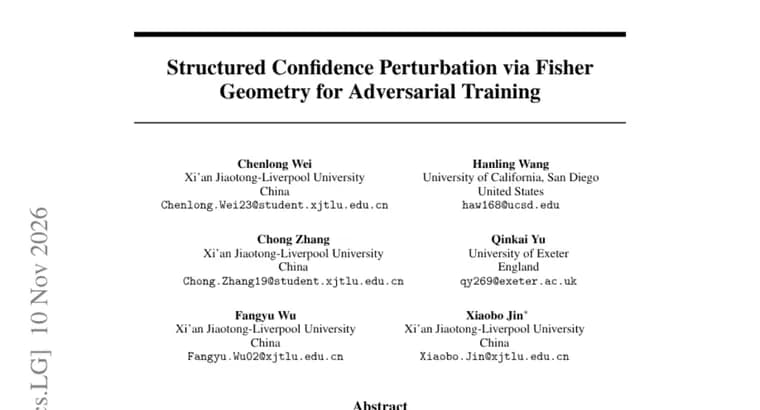
The paper starts from a complaint about adversarial training. Its authors say the method is often plagued by "pseudo-attacks": perturbations that significantly increase the loss value but fail to truly alter the model's confidence structure. A perturbation can look strong by the loss, in other words, without changing how the model distributes its confidence.
To address this, the authors propose two complementary approaches that directly attack and defend against confidence structure deformation.
The first builds on the traditional loss maximization view. It is a hybrid objective that integrates cross-entropy and KL divergence. The aim is for adversarial examples to disrupt prediction accuracy and distribution consistency at the same time.
The second is geometric. The authors reconstruct adversarial training by generating perturbations that maximize the distribution distance on the confidence manifold. Their theoretical analysis shows that the optimal perturbation direction aligns with the principal eigenvectors of the Fisher information matrix. They also propose an efficient algorithm to avoid high-dimensional matrix computations.
On results, the abstract says experiments on multiple datasets and model architectures demonstrate that the method outperforms existing methods in adversarial robustness and robust transferability. It singles out structural perturbations within high-confidence regions as the place where the method excels most.
Key facts
- The authors say adversarial training is often plagued by "pseudo-attacks": perturbations that raise the loss a lot but do not alter the model's confidence structure.
- The first of two proposed approaches is a hybrid objective combining cross-entropy and KL divergence, so adversarial examples disrupt both prediction accuracy and distribution consistency.
- The second approach generates perturbations that maximize distribution distance on the confidence manifold; theoretical analysis shows the optimal direction aligns with the principal eigenvectors of the Fisher information matrix.
- An efficient algorithm is proposed to avoid high-dimensional matrix computations.
- The authors report that experiments on multiple datasets and model architectures show better adversarial robustness and robust transferability than existing methods, especially for structural perturbations in high-confidence regions.
Why it matters
The paper targets a specific weakness in how adversarial attacks are judged. If a perturbation raises the loss but leaves the model's confidence structure intact, training against it may teach the model little. The authors respond by making the confidence structure itself the object of attack and defence, and by tying the optimal perturbation direction to the Fisher information matrix. It is a niche, technical contribution to robustness research.
Who it affects
Mainly researchers working on adversarial robustness and adversarial training. The abstract does not describe any product or deployment.
How to use it
There is no ready recipe in the abstract. The method has two parts: a hybrid cross-entropy plus KL divergence objective, and perturbations aimed along the principal eigenvectors of the Fisher information matrix, computed with an efficient algorithm that avoids high-dimensional matrix computations. No code release, training cost or runtime figures are mentioned.
How solid is it
This is a paper abstract, and every claim is the authors' own. The theoretical result on the optimal perturbation direction and the experimental claim of outperforming existing methods are stated without detail. No datasets, model architectures or baseline methods are named. No numerical results (accuracy, robustness gains, margins) are given. No authors or institutions are named.
Risks and caveats
The headline claim of outperforming existing methods cannot be weighed from the abstract alone, since there are no numbers, named baselines or named datasets. The abstract does not say how the efficient algorithm avoids high-dimensional matrix computations. The robustness gains are reported for the authors' own experimental setup, and the strongest results are described for structural perturbations within high-confidence regions.
“Adversarial training is often plagued by "pseudo-attacks", perturbations that significantly increase the loss value but fail to truly alter the model's confidence structure.”
— Paper abstract, Hugging Face Papers