Procedura writes 3D objects as editable procedural code
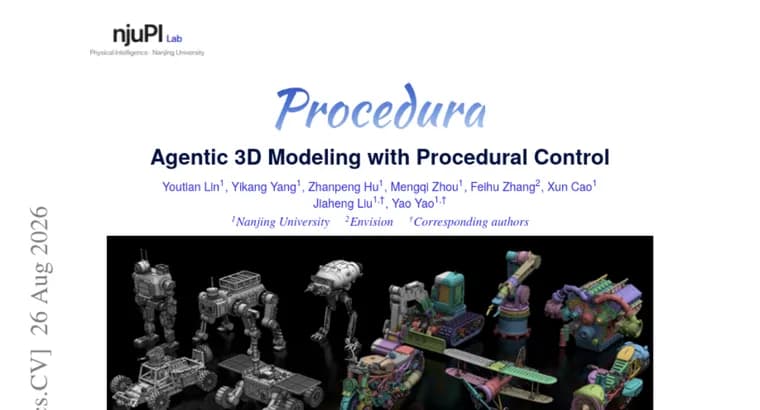
Native 3D generators can now recover impressive mesh geometry from a single image. But a dense mesh stays soft where a machined object should be sharp, carries no decomposition into parts, and exposes no parameter a person could later edit.
To address this, researchers explore treating 3D shape as code, leveraging the coding ability of a large language model for 3D modeling. They introduce Procedura, a 3D modeling agent framework that writes an object as a procedural assembly: a parametric program whose named parts are joined by typed, machine-checkable mates. Starting from a text prompt, the agent plans the object as an assembly graph, then writes the program part by part. Each part's placement is solved directly from its mated frame rather than guessed, and a part is admitted into the assembly only once it passes compile, mate, and connectivity checks. A decoupled vision critic then reviews the result and refines the assembly one diagnosed fix at a time. Because the object lives as a graph rather than a mesh, the same structure also carries per-part materials and an articulation that has been validated by a simulator.
The team evaluated Procedura on P3D-Bench, an existing assembly benchmark, under its own assembly judge, and on MechBench-36, a hard-surface benchmark of their own, scored by the same judge. Under judged quality, Procedura outperforms state-of-the-art native 3D generators and every prior 3D-code agent it was compared against. The paper reports it produces the sharpest edges of any method evaluated, and says it is the only one among them whose output stays an editable, part-structured program rather than a fixed mesh.
The text gives no numeric scores or margins for how much Procedura outperforms the alternatives, no author names or institutions, no release date or mention of code or dataset availability, and does not name the underlying LLM that drives the agent. Both benchmarks are named without further detail on their size or composition.
Key facts
- Procedura represents a 3D object as a procedural, parametric program (an assembly) built from named parts joined by typed, machine-checkable mates, rather than as a dense mesh.
- An LLM-driven agent plans an assembly graph from a text prompt, then writes the program part by part, positioning each part from its mated frame and admitting it only after compile, mate, and connectivity checks pass.
- A separate vision critic reviews the assembly and applies one diagnosed fix at a time to refine it further.
- The same graph representation also encodes per-part materials and a simulator-validated articulation.
- On P3D-Bench and the authors' own hard-surface benchmark, MechBench-36, both scored by the same assembly judge, Procedura outperforms prior native 3D generators and 3D-code agents on judged quality, produces the sharpest edges of any method tested, and is the only one with editable, part-structured output.
Why it matters
Native 3D generators can now recover convincing mesh geometry from a single image, but the result stays soft in places a machined or mechanical object should be sharp, has no separation into distinct parts, and leaves no parameter a person could later edit. Procedura addresses this by treating the 3D shape itself as code: an LLM writes the object as a parametric program instead of predicting a mesh directly, which is what makes the parts, their materials, and their joints editable after the fact.
Who it affects
The approach targets workflows that need hard-surface, mechanical, or part-based 3D content: product and game asset design, and CAD-adjacent prototyping, anywhere a mesh alone falls short because someone downstream needs to edit a part, swap a material, or move a joint. It also matters to researchers building 3D generation benchmarks, since the paper introduces MechBench-36 as a new hard-surface test set alongside its use of the existing P3D-Bench.
How to use it
The source does not say whether Procedura's code, trained models, or the MechBench-36 benchmark will be released, and it does not mention pricing, licensing, or any other access terms. There is nothing here pointing a reader toward trying it themselves.
How solid is it
The comparison rests on two benchmarks, P3D-Bench and the authors' own MechBench-36, both scored under the same assembly judge, and the paper claims Procedura beats state-of-the-art native 3D generators and every prior 3D-code agent it tested against on judged quality and edge sharpness. The text gives no numeric scores or margins for that lead and does not describe the size, composition, or origin of either benchmark, nor the judge's methodology, so the strength of the win is not independently checkable from what is available here.
Risks and caveats
This is a self-reported result set: the judge, the benchmarks, and the comparison baselines all come from the same paper, with no numbers given to weigh the margin and no third-party evaluation to check it against. The text also does not name the underlying LLM that powers the agent, nor give author names, institutions, or a release plan, so the claims are not yet independently reproducible or verifiable.