RLHEV proposes game engines as a reward signal for world models
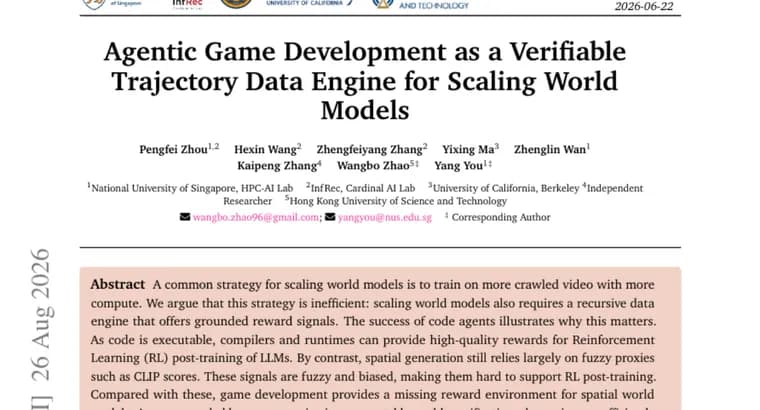
A new paper argues that the standard way of scaling world models, training on ever more crawled video with ever more compute, is an inefficient strategy. The authors' point of comparison is code: because code is executable, compilers and runtimes can check it and hand back a high-quality reward signal for reinforcement learning (RL) post-training of large language models. Spatial generation has no equivalent. It still leans on fuzzy proxies such as CLIP scores, and the authors describe these signals as fuzzy and biased, which makes them a poor foundation for RL post-training.
The paper's proposal is to borrow the same trick code agents use, but from game engines instead of compilers. A scene built inside a game engine is, in the authors' framing, an executable world specification: the engine can check collision, physics, navigability and bounded playability on its own, while a human developer supplies a separate acceptance judgment on whether the scene should be kept. Game development also generates long, real-world trajectories of the kind RL post-training needs, rather than short synthetic snippets.
Combining these two signal sources gives the paper's proposed method its name: Reinforcement Learning with Human-Engine Verification (RLHEV). It is described as a post-training paradigm that fuses dense, engine-computed reward signals with implicit human acceptance feedback collected during the act of building a game. The abstract text does not report any benchmark results, name a specific game engine or model, or give a release timeline for RLHEV.
Key facts
- The paper argues that scaling world models by training on more crawled video with more compute is inefficient.
- It contrasts this with code, where compilers and runtimes give RL post-training a grounded reward signal, unlike the fuzzy CLIP-score proxies used for spatial generation.
- It proposes using game engines as a reward environment: the engine checks collision, physics, navigability and bounded playability, and a developer adds an acceptance judgment.
- The proposed method is named Reinforcement Learning with Human-Engine Verification (RLHEV), combining engine reward signals with implicit human acceptance feedback from game development.
- The abstract gives no benchmark numbers, no named engine or dataset, and no release timeline for RLHEV.
Why it matters
World models are usually scaled the same way large language models were: more data, more compute, in this case more crawled video. This paper's argument is that the approach hits a ceiling that video alone cannot fix, because there is no equivalent of a compiler to check whether a generated scene is physically or spatially valid. Borrowing the reward structure that made RL post-training work for code agents, and applying it to game engines instead of compilers, is the paper's proposed way around that ceiling.
Who it affects
The idea targets teams building spatial or 3D world models and researchers working on RL post-training for generative systems, where reward quality is currently limited by fuzzy proxies like CLIP scores rather than by data volume.
How to use it
RLHEV is presented as a paradigm rather than a released tool: the abstract names no specific game engine, dataset, model checkpoint or code release, so there is nothing to install or run from this text alone.
How solid is it
The abstract lays out the argument and defines RLHEV conceptually, but reports no quantitative results, benchmark comparisons or evaluation metrics for the method. Whether the engine-plus-human reward signal actually outperforms training on crawled video is not shown here.
Risks and caveats
Without benchmark numbers, a named engine, or a dataset, the proposal cannot yet be checked against results. The reward signal also still depends on a human developer's acceptance judgment for the parts an engine cannot verify on its own, so it is not a fully automated pipeline as described.
“Game development provides a missing reward environment for spatial world models.”
— the authors