SA-OPD filters misleading teacher signals in on-policy distillation
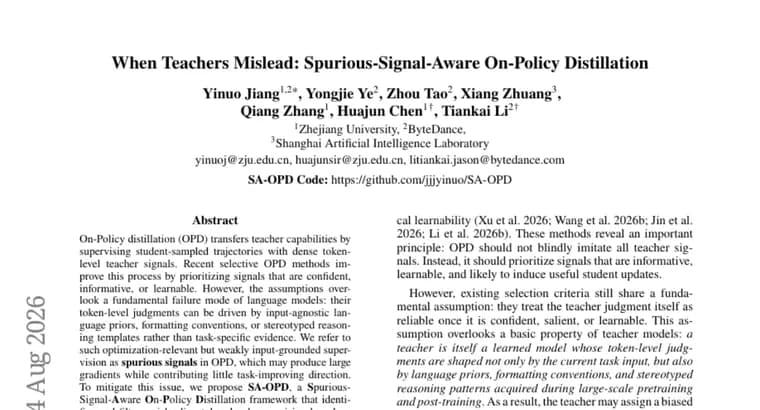
On-policy distillation (OPD) trains a student model on its own generated trajectories, supervising them with dense, token-by-token signals from a teacher model; the paper calls this unmodified baseline Vanilla OPD. Recent selective OPD methods try to improve on Vanilla OPD by prioritizing teacher signals that look confident, informative, or learnable. The authors argue this misses a basic failure mode of language models: a teacher's token-level judgment can be driven by input-agnostic language priors, formatting conventions, or stereotyped reasoning templates, rather than by the specific input in front of it. When that happens, the resulting supervision is what the authors call a spurious signal in OPD: it can still produce large gradients during training while contributing little toward actually improving the task.
To address this, the authors propose SA-OPD (Spurious-Signal-Aware On-Policy Distillation), a framework built to identify and filter out this kind of misleading, token-level supervision. SA-OPD adds a lightweight input-groundedness proxy, a mechanism that estimates whether a given token-level distillation signal genuinely depends on the input rather than on generic patterns. It then filters out only the tokens that combine two conditions at once: low input-groundedness and extreme distillation divergence, meaning signals that are both weakly tied to the input and unusually influential on training. The authors describe this as removing high-impact spurious updates while leaving the rest of the supervision intact, which they call fine-grained OPD optimization.
The paper reports extensive experiments on both large language model (LLM) and vision-language model (VLM) settings, in which SA-OPD is said to consistently outperform Vanilla OPD as well as competitive selective OPD methods, that is, the confidence-, informativeness-, or learnability-based approaches described earlier. The authors frame the result as establishing input-groundedness as a key dimension for choosing OPD supervision signals, and describe SA-OPD as a simple, effective strategy for mitigating spurious updates.
The text available here is the paper's abstract, titled 'When Teachers Mislead: Spurious-Signal-Aware On-Policy Distillation,' posted to Hugging Face's Papers page. It does not name individual authors or institutions, does not name the specific models or benchmarks used in the LLM and VLM experiments, gives no numeric results behind the outperformance claim, states no publication or submission date, and does not say whether code, data, or trained models are released.
Key facts
- On-policy distillation (OPD) supervises a student model's own generated trajectories with dense, token-level signals from a teacher model; recent selective OPD methods try to improve on this baseline, called Vanilla OPD, by prioritizing signals that are confident, informative, or learnable.
- The authors identify a failure mode selective OPD methods miss: a teacher's token-level judgments can be driven by input-agnostic language priors, formatting conventions, or stereotyped reasoning templates rather than the specific input, producing what they call spurious signals, supervision that can generate large gradients while contributing little to the task.
- SA-OPD (Spurious-Signal-Aware On-Policy Distillation) adds a lightweight input-groundedness proxy that estimates whether each token-level distillation signal truly depends on the input, then filters out only tokens that combine low input-groundedness with extreme distillation divergence, the most influential and least-grounded updates.
- In experiments the paper describes as extensive, covering both LLM and VLM settings, SA-OPD is reported to consistently outperform Vanilla OPD and competitive selective OPD methods, though the abstract gives no specific model names, benchmarks, or numeric results.
- The authors present the results as establishing input-groundedness as a key dimension for OPD supervision selection, describing SA-OPD as a simple, effective strategy for mitigating spurious updates.
Why it matters
On-policy distillation is a standard way to transfer a strong teacher model's abilities into a cheaper student model, and dense, token-level supervision is what makes it effective: nearly every generated token gets feedback. Selective OPD methods refined this by keeping only the teacher signals that look confident, informative, or learnable, on the assumption that those signals carry the most useful information. This paper's contribution is pointing out a blind spot in that assumption: a teacher's token-level judgment can look confident or informative while actually reflecting input-agnostic language priors, formatting conventions, or stereotyped reasoning templates rather than the input itself, and such signals can produce some of the largest gradients in training precisely because they look strong. SA-OPD's filter targets exactly that overlap, tokens that are both weakly grounded in the input and unusually influential on the gradient, which earlier confidence- or informativeness-based selection had no way to catch.
Who it affects
The work is aimed at researchers and engineers who build distillation pipelines that transfer a larger teacher model's abilities into a smaller student, in both text-only (LLM) and multimodal (VLM) settings. It speaks most directly to anyone already using a selective OPD method based on confidence, informativeness, or learnability, since the paper's argument is that those selection criteria alone can let high-impact spurious signals through. The abstract does not name the specific models, institutions, or teams involved in the reported experiments.
How to use it
This is a research method described in a paper abstract, not a released product: there is no price, license, or sign-up involved. The text does not say whether code, training data, or trained models are released, and it does not specify the architecture or threshold settings behind the input-groundedness proxy or what counts as extreme distillation divergence. A team wanting to apply SA-OPD would need the full paper, since the abstract describes the filtering logic only at the level of its two governing conditions, input-groundedness and distillation divergence, not as an implementable recipe.
How solid is it
The source is the abstract of a paper titled 'When Teachers Mislead: Spurious-Signal-Aware On-Policy Distillation,' posted to Hugging Face's Papers page; it does not name individual authors or institutions. The evidence cited is extensive experiments on both LLM and VLM settings, said to show SA-OPD consistently outperforming Vanilla OPD and competitive selective OPD methods, but the abstract gives no benchmark names, model names or sizes, or numeric results behind that claim, only the qualitative outcome. As with any abstract, the claims are the authors' own summary of their results, not independently verified.
Risks and caveats
The central limitation is that none of the abstract's claims come with numbers: no benchmark names, no baseline or SA-OPD scores, no effect sizes, so how large or consistent the improvement over Vanilla OPD and selective methods actually is cannot be assessed from this text. The abstract also gives no publication or submission date, no author or institution names, and no indication of whether code, data, or trained models will be released, all of which would normally help gauge how reproducible or how recent the work is.
“We refer to such optimization-relevant but weakly input-grounded supervision as spurious signals in OPD, which may produce large gradients while contributing little task-improving direction.”
— the authors, in the paper's abstract