Shopee deploys refreshable recommender, lifts GMV per user 1.75%
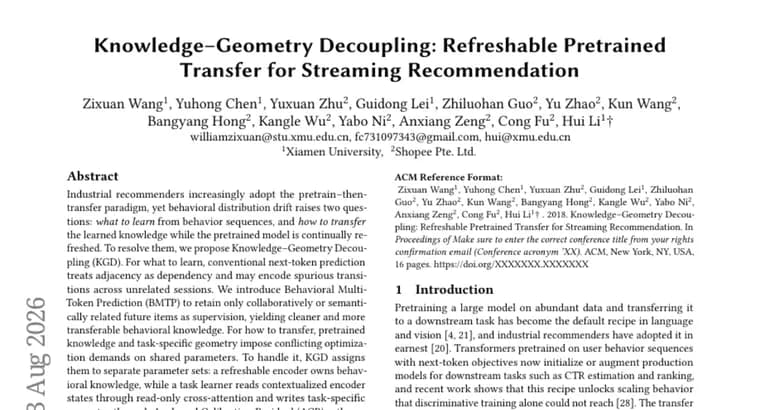
Industrial recommenders increasingly rely on a pretrain-then-transfer approach: a model learns general patterns from behavior sequences, then a task-specific layer is tuned on top of it. The authors say behavioral distribution drift raises two open questions for this approach: what exactly to learn from behavior sequences, and how to keep transferring that knowledge once the pretrained model itself needs to be continually refreshed. Knowledge-Geometry Decoupling (KGD) is their proposed answer to both.
The first half targets the training signal. Conventional next-token prediction treats every next item in a session as something worth predicting, which the authors say wrongly treats simple adjacency as dependency and can teach the model spurious transitions between unrelated sessions. KGD replaces this with Behavioral Multi-Token Prediction (BMTP), a training objective that keeps only future items collaboratively or semantically related to what came before as supervision and discards the rest, yielding what the authors call cleaner, more transferable behavioral knowledge.
The second half targets how that knowledge is used downstream. Pretrained knowledge and task-specific geometry pull a model's shared parameters in conflicting directions during optimization, so KGD splits them into two separate parameter sets instead of one shared model: a refreshable encoder holds the behavioral knowledge, while a separate task learner reads the encoder's contextualized states through read-only cross-attention and writes its own task-specific adjustments through a mechanism the authors call Anchored Calibration Residual (ACR), kept orthogonal to the pretrained embedding. Because ownership is split this way, the encoder can be refreshed continually without interference from the task learner's gradients and without invalidating whatever downstream adaptation has already happened.
On eight public benchmarks, KGD beats strong pretrain-transfer baselines by 4-12%. Tested over a 90-day production stream, it sustains that advantage while baseline methods show no further gains. KGD has been fully deployed in Shopee, and in a live A/B test on Shopee Homepage Search it increased GMV per user by 1.75% and advertising revenue by 1.53%.
A core implementation of KGD is released on GitHub at https://github.com/FuCongResearchSquad/KGD4REC. The source does not name individual authors or institutions, does not name the eight benchmarks or give absolute baseline scores behind the 4-12% figure, and gives no date for the Shopee deployment or the A/B test.
Key facts
- Knowledge-Geometry Decoupling (KGD) splits a recommender into two parameter sets: a refreshable encoder that owns behavioral knowledge, and a task learner that reads it through read-only cross-attention and writes task-specific adjustments through an Anchored Calibration Residual (ACR), so refreshing one does not disrupt the other.
- A new training objective, Behavioral Multi-Token Prediction (BMTP), keeps only future items that are collaboratively or semantically related as supervision, instead of treating every adjacent item in a session as a dependency worth predicting.
- KGD beats strong pretrain-transfer baselines by 4-12% on eight public benchmarks, and keeps that advantage over a 90-day production stream where the baselines show no further gains.
- KGD has been fully deployed in Shopee; a live A/B test on Shopee Homepage Search increased GMV per user by 1.75% and advertising revenue by 1.53%.
- A core implementation of KGD is released on GitHub at FuCongResearchSquad/KGD4REC.
Why it matters
Recommenders that pretrain on behavior sequences and then transfer that knowledge into a task-specific model face a structural conflict: the pretrained part needs to keep refreshing as user behavior drifts, but refreshing shared parameters tends to interfere with whatever task-specific tuning already sits on top of them. KGD is built to remove that trade-off by giving behavioral knowledge and task-specific adaptation separate parameter sets, so one can keep learning from new behavior without corrupting the other. What makes the result notable is that it is not confined to a benchmark: the same method sustains its edge over a 90-day production stream and, deployed in Shopee, moved GMV per user and advertising revenue in a live A/B test.
Who it affects
Teams building or maintaining large-scale recommendation systems on a pretrain-then-transfer approach, the design the paper says industrial recommenders increasingly adopt, particularly where user behavior drifts quickly enough that a pretrained model goes stale. The direct case study is Shopee Homepage Search, so the result speaks most concretely to teams facing the same problem: keeping a pretrained model learning from fresh behavior without breaking the task-specific tuning already built on top of it. It also affects Shopee's own business results, since the reported gains land on GMV per user and on advertising revenue.
How to use it
A core implementation of KGD is released on GitHub at https://github.com/FuCongResearchSquad/KGD4REC. There is no product to sign up for and no price or licence to weigh: this is a research method with published code, not a shipped tool, and the source gives no detail on KGD's model size, training data or computational cost, so a team wanting to adopt it would need to test it directly against its own infrastructure rather than assume Shopee's reported numbers carry over.
How solid is it
This is a paper posted to Hugging Face's Papers page, and the source available here does not name individual authors, institutions, or the eight public benchmarks used for evaluation. The evidence itself spans three layers: eight public benchmarks, where KGD beats strong pretrain-transfer baselines by 4-12% (the source gives no absolute scores behind that figure, only the relative gap); a 90-day production stream, where the advantage holds while baselines show no further gains; and a live A/B test on Shopee's real Homepage Search traffic, the highest-stakes kind of validation. All of it is self-reported by the authors rather than independently audited.
Risks and caveats
The gains are self-reported by the authors, not independently audited, and the source gives no date for the Shopee deployment or the live A/B test, so how recent this result is cannot be established from the material here. It also gives no population size or duration for the A/B test beyond describing it as live, and no absolute baseline scores behind the 4-12% benchmark improvement, only the relative gap, which limits how directly the result can be compared to other recommendation research.
“In a live A/B test on Shopee Homepage Search, it increases GMV per user by 1.75% and advertising revenue by 1.53%, demonstrating its high practical value.”
— the authors, in the paper's abstract