Self-OPD trains flow matching models with no teacher network
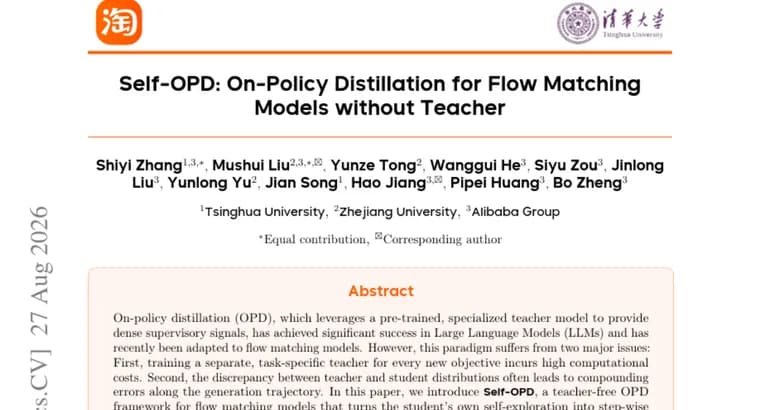
A paper titled "Self-OPD: On-Policy Distillation for Flow Matching Models without Teacher" proposes a way to train flow matching generative models that drops the teacher model normally required by on-policy distillation (OPD). On-policy distillation already works well for large language models and has recently been adapted to flow matching models, but it depends on a separate, task-specific teacher that supplies dense supervisory signals during training. The authors identify two problems with that setup: training a new teacher for every objective is computationally expensive, and any mismatch between the teacher's and the student's output distributions tends to compound into errors as the generation trajectory unfolds. Self-OPD removes the teacher entirely and instead turns the student model's own exploration into its training signal. At each timestep, the method branches the model's single deterministic next-state prediction into K stochastic SDE (stochastic differential equation) candidates, rolls each of them forward with an ODE (ordinary differential equation) sampler, and scores their outcomes against a deterministic self-reference baseline to produce normalized advantage values for each branch. The velocity field, the core quantity a flow matching model learns, is then optimized with what the authors call an all-branch pull-push objective: branches that scored a high advantage pull the student's predictions toward them, while low-advantage branches push the student away, with the pull and push effects adjusted through direction-aware attenuation and normalization by the SDE branches' variance. When a model needs to satisfy several objectives at once, Self-OPD combines the normalized reward scores directly rather than combining gradients, which the authors say avoids gradients from different objectives conflicting with each other. The paper reports that on benchmarks covering both single rewards and mixed multiple rewards, Self-OPD outperforms prior reinforcement-learning and on-policy-distillation methods that rely on task-specific teachers, though it does not give the specific numbers behind that comparison in the available text.
Key facts
- Self-OPD is a teacher-free on-policy distillation method for flow matching models, replacing the separate task-specific teacher with the student model's own self-exploration.
- At each timestep it branches the next-state prediction into K stochastic SDE candidates, rolls them out with an ODE sampler, and compares their rewards to a deterministic self-reference baseline to get normalized advantages.
- Training uses an all-branch pull-push objective on the velocity field: high-advantage branches attract the student's predictions, low-advantage branches repel them, under direction-aware attenuation and SDE-variance normalization.
- For tasks with multiple objectives, Self-OPD fuses normalized reward scores rather than gradients, which the authors say avoids direct gradient conflict.
- On single and mixed reward benchmarks, the authors report Self-OPD outperforms prior RL and OPD methods that still depend on task-specific teachers.
Why it matters
On-policy distillation has been an effective way to train flow matching generative models, but only by paying for a separate teacher model for every new objective, plus accuracy loss whenever the teacher and student diverge along the generation trajectory. Self-OPD's contribution is to show that the student's own branching self-exploration can substitute for that teacher, which removes both costs if the reported results hold up under independent testing.
Who it affects
This is aimed at researchers and engineers who build or fine-tune flow matching models, the generative modeling approach used for tasks like image and video synthesis, particularly anyone currently paying the overhead of training a bespoke teacher model per objective or handling multiple reward objectives at once.
How to use it
The source text does not mention a code or model release, a specific value for K (the number of SDE candidates branched per step), or licensing terms, so there is nothing here to install or run yet; anyone interested would need to watch for a code release or attempt to reimplement the method from the paper's description.
How solid is it
The claims come from the paper's own description of its method and its statement that it outperforms prior RL and OPD approaches on single and mixed reward benchmarks. The available text does not give the actual benchmark numbers, the margin of improvement, or details of the experimental setup, so the comparison cannot be independently checked from this source alone.
Risks and caveats
No author names, institutions or affiliations, publication date, benchmark magnitudes, or the value of K appear in the available source text, and no code or model release is mentioned. The performance claims should be treated as the authors' own reporting until benchmark figures or third-party evaluation are available.