SolarWM open-sources data engine and training recipe for video world models
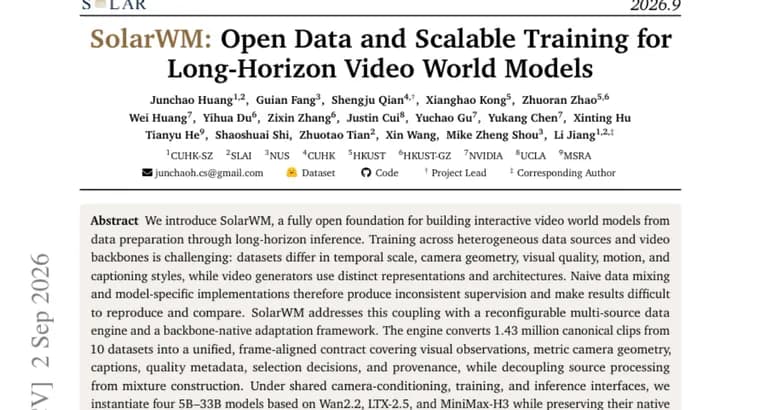
Researchers have released SolarWM, described as a fully open foundation for building interactive video world models, covering everything from data preparation to long-horizon inference. The stated problem is that training such models across heterogeneous data sources and video backbones is hard: datasets differ in temporal scale, camera geometry, visual quality, motion, and captioning style, while different video generators use distinct internal representations and architectures. Mixing data naively and writing model-specific pipelines for each backbone produces inconsistent supervision and results that are difficult to reproduce or compare between projects.
SolarWM's answer has two parts. First, a reconfigurable multi-source data engine converts 1.43 million canonical clips drawn from 10 datasets into one unified, frame-aligned format that carries visual observations, metric camera geometry, captions, quality metadata, selection decisions, and provenance, while keeping the processing of each source separate from how mixtures are built for training. Second, a backbone-native adaptation framework applies shared camera-conditioning, training, and inference interfaces across models without erasing what makes each backbone different.
Under that shared framework, the team instantiated four causal video world models ranging from 5B to 33B parameters, built on the Wan2.2, LTX-2.5, and MiniMax-H3 backbones, each keeping its own native representation and training objective. All four were trained with the same three-stage recipe: bidirectional adaptation, teacher-forced autoregressive initialization, and distribution matching distillation. The resulting models were trained on sequences only 5 seconds long, yet the authors report they support real-time interactive rollouts lasting anywhere from minutes to hours. SolarWM's data, processing pipeline, training recipes, model weights, and framework code are all being released, with the stated goal of giving other researchers a reproducible and extensible base for interactive world-model work rather than each group rebuilding this data and adaptation machinery from scratch.
Key facts
- The data engine unifies 1.43 million canonical clips from 10 different source datasets into one frame-aligned format covering visuals, camera geometry, captions, quality metadata, and provenance.
- Four causal video world models, ranging from 5B to 33B parameters, were built on the Wan2.2, LTX-2.5, and MiniMax-H3 backbones under one shared training and inference interface.
- All four models share a three-stage training recipe: bidirectional adaptation, teacher-forced autoregressive initialization, and distribution matching distillation.
- Trained on video sequences of only 5 seconds, the resulting models are reported to support real-time interactive rollouts ranging from minutes to hours.
- The project releases the data, processing pipeline, training recipes, model weights, and framework together, rather than any single component alone.
Why it matters
Interactive video world models need training data pulled from many different sources and need to run on more than one video-generation backbone, but those sources and backbones disagree on almost everything: clip length, camera geometry, visual quality, motion, and how clips are captioned, while the backbones themselves use different internal representations. Mixing that data by hand and writing separate pipelines per backbone, the usual approach, produces supervision that is inconsistent between projects and results that are hard to reproduce or compare. SolarWM's pitch is to fix the coupling itself: one reconfigurable data engine that normalizes any source into a common format, paired with an adaptation framework that imposes shared interfaces across backbones without discarding what makes each one distinct.
Who it affects
The intended audience is researchers building or studying interactive and long-horizon video world models, particularly teams who currently maintain their own bespoke data-processing code for each dataset and each backbone they use. Because SolarWM's four instantiated models sit on top of three different existing backbones, Wan2.2, LTX-2.5, and MiniMax-H3, work that depends on any of those systems is a direct fit for reusing the released pipeline and recipe rather than rebuilding equivalent machinery independently.
How to use it
The project releases the full stack together: the processed data, the data-engine pipeline that produced it, the three-stage training recipe, the resulting model weights for all four backbone variants, and the adaptation framework code itself. That combination is meant to let other researchers either reproduce the four released 5B to 33B models directly, or take the data engine and adaptation framework and apply them to a different backbone or a different data mixture without redoing the normalization work from scratch. No release date, license terms, or hosting location for these components is stated in the material available.
How solid is it
The claims here come from the project's own description of its data engine, adaptation framework, and training recipe, and there are no external benchmark results or quantitative comparisons against other video world models in the material available to check the claims against. The headline result, that models trained on only 5-second sequences support real-time rollouts of minutes to hours, is reported by the authors themselves rather than demonstrated against an independent baseline in what is available here.
Risks and caveats
No individual authors or institutions are named in the material available, and no benchmark numbers back the reported jump from 5-second training clips to minutes-to-hours interactive rollouts, so that capability rests on the authors' own account rather than a third-party evaluation. There is also no stated definition of what counts as 'long-horizon' beyond that minutes-to-hours range, and no license, release date, or hosting details are given for the promised data, weights, and code, so how open and how usable the release actually turns out to be is not yet established.