StudentSim outperforms GPT-5.4 at simulating real students
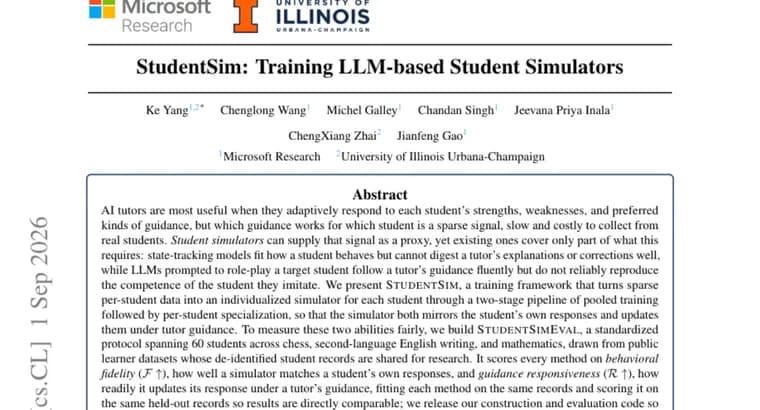
AI tutors work best when they adapt to a specific student's strengths, weaknesses, and preferred style of guidance, but collecting evidence on which guidance works for which student is slow, sparse, and expensive to gather from real learners. Student simulators can stand in as a proxy signal, but the authors argue existing approaches fall short in one of two ways: state-tracking models fit a student's behavior reasonably well but struggle to process explanations or corrections, while LLM role-play follows tutor guidance fluently but does not reliably track the actual competence of the student it is meant to imitate.
The researchers present StudentSim, a training framework that turns sparse per-student data into individualized simulators through pooled training followed by per-student specialization. The resulting simulators are meant to both mirror a given student's own responses and update those responses correctly when a tutor intervenes with guidance.
Alongside the framework, the authors introduce StudentSimEval, a standardized evaluation protocol covering 60 students across three domains: chess, second-language English writing, and mathematics, built on public, de-identified learner datasets. StudentSimEval scores two metrics: behavioral fidelity (F), how closely a simulator matches a student's actual responses, and guidance responsiveness (R), how readily the simulator updates its behavior under tutor guidance. All methods in the comparison are fit and evaluated on the same records.
Across all three domains, StudentSim outperforms GPT-5.4 on both metrics, though the text itemizes numbers only for chess: StudentSim scores F=0.51 and R=0.91, versus F=0.23 and R=0.72 for GPT-5.4, and F=0.45 and R=0.27 for Maia2, a chess-specific comparison model. As a proof of concept, the authors also used StudentSim as a reward model to train a chess tutor with reinforcement learning. Expert human raters judged the resulting tutor as more accurate, better-guided, and more personalized than both a tutor trained without RL and a tutor trained using a GPT-5.4-based simulator as the reward signal. The code is published at github.com/microsoft/StudentSim.
Key facts
- StudentSim uses pooled training followed by per-student specialization to build LLM simulators of individual students from sparse per-student data.
- StudentSimEval, the paired evaluation protocol, covers 60 students across chess, second-language English writing, and mathematics using de-identified public learner data.
- In chess, StudentSim scores F=0.51 and R=0.91, versus 0.23 and 0.72 for GPT-5.4 and 0.45 and 0.27 for Maia2.
- StudentSim outperforms GPT-5.4 on both fidelity and responsiveness metrics across all three tested domains.
- Used as a reward model for reinforcement learning, StudentSim produced a chess tutor that expert human raters preferred over both a no-RL baseline and a tutor trained against a GPT-5.4 simulator reward.
Why it matters
Adaptive AI tutoring depends on knowing which kind of guidance helps a given student, but that evidence is expensive to collect from real learners. Simulators offer a cheaper proxy, yet the authors describe a persistent tradeoff in prior approaches: state-tracking models capture a student's behavior but cannot process explanations or corrections well, while LLM role-play follows tutor instructions fluently without reliably tracking the student's actual competence. StudentSim targets that gap directly, using pooled training across many students plus per-student specialization so a simulator both mirrors an individual student's responses and updates them correctly under guidance.
Who it affects
The work is aimed at researchers and engineers building adaptive AI tutoring systems, who need a reliable stand-in for real students when testing which guidance strategies work. StudentSimEval, the accompanying evaluation protocol, is built from de-identified public learner datasets covering 60 students in three domains: chess, second-language English writing, and mathematics.
How to use it
StudentSim is a research framework and evaluation protocol rather than a shipped product. The code is available at github.com/microsoft/StudentSim. The authors also demonstrate a downstream use: plugging StudentSim in as a reward model for reinforcement learning, which they used to train a chess tutor as a proof of concept.
How solid is it
Results come from StudentSimEval, a standardized protocol in which all compared methods are fit and evaluated on the same student records. StudentSim beats GPT-5.4 on both behavioral fidelity (F) and guidance responsiveness (R) across all three domains tested. Chess is the only domain with itemized numbers in the source text: StudentSim reaches F=0.51 and R=0.91, against F=0.23 and R=0.72 for GPT-5.4 and F=0.45 and R=0.27 for Maia2, a chess-specific model. In the reinforcement-learning proof of concept, expert human raters judged a chess tutor trained with StudentSim as a reward model to be more accurate, better-guided, and more personalized than both a no-RL baseline and a tutor trained against a GPT-5.4-based simulator reward.
Risks and caveats
The source text gives itemized F and R scores only for chess; the second-language English writing and mathematics domains are covered only by the general claim that StudentSim outperforms GPT-5.4 on both metrics, without domain-specific numbers. No numeric scale or bounds are stated for F and R beyond the reported values, and no author names or institutional affiliation appear in the text itself, though the GitHub path hints at one. There is no description of testing or deployment with real students beyond the evaluation protocol and the single chess-tutor reinforcement-learning proof of concept.