SpecAgent has a weak model draft agent steps and a strong model review them
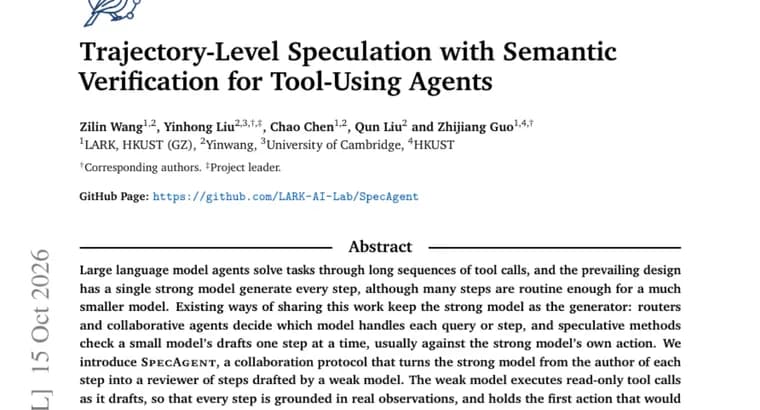
A paper introduces SpecAgent, a collaboration protocol for LLM agents that solve tasks through long sequences of tool calls. The usual design has one strong model generate every step, even though many steps are routine enough for a much smaller model. Existing ways of sharing the work still keep the strong model as the generator: routers and collaborative agents decide which model handles each query or step, and speculative methods check a small model's drafts one step at a time, usually against the strong model's own action.
SpecAgent changes the roles. The strong model stops being the author of each step and becomes a reviewer of steps drafted by a weak model. While drafting, the weak model executes read-only tool calls, so every step is grounded in real observations, and it holds the first action that would modify the environment. The strong model then verifies the whole drafted segment in a single prefill pass, commits the longest prefix it judges semantically valid, and repairs the first rejected step. Because verification replaces autoregressive decoding with parallel prefill, the strong model decodes only short verdicts and occasional repairs rather than every step.
The abstract reports results on four benchmarks. On τ^2-Bench, SpecAgent comes within one point of the strong model's success rate while roughly halving memory traffic and wall time. On AutomationBench and VitaBench, it recovers 44-75% of the quality gap between the weak and strong models while lowering both. In an edge-cloud deployment on MCP-Atlas with three cloud models, it closes 53-75% of the weak-strong quality gap while the strong model generates at most half as many tokens.
The authors conclude that a strong model need not author every step of an agent: reviewing grounded drafts retains most of its quality while cutting both latency and memory traffic.
Key facts
- SpecAgent makes the strong model a reviewer of steps drafted by a weak model, instead of the author of every step.
- The weak model runs read-only tool calls while drafting and holds the first action that would modify the environment; the strong model checks the segment in one prefill pass, keeps the longest valid prefix and repairs the first rejected step.
- On τ^2-Bench it comes within one point of the strong model's success rate while roughly halving memory traffic and wall time.
- On AutomationBench and VitaBench it recovers 44-75% of the weak-strong quality gap; on MCP-Atlas with three cloud models in an edge-cloud setup it closes 53-75% of the gap, with the strong model generating at most half as many tokens.
Why it matters
Agents solve tasks through long sequences of tool calls, and the common design pays a strong model to write every step. SpecAgent moves the strong model into a checking role. The paper contrasts this with routers, which choose a model per query or step, and with earlier speculative methods, which verify one step at a time, usually against the strong model's own action. Here verification covers a whole drafted segment in one prefill pass, so the strong model decodes only short verdicts and occasional repairs.
Who it affects
Teams building tool-using agents and paying for strong-model inference are the obvious audience, as are those running split setups where a small model sits at the edge and a larger one in the cloud. The MCP-Atlas edge-cloud experiment with three cloud models speaks to that second case.
How to use it
The abstract describes a protocol, not a product. The loop: the weak model drafts steps and runs read-only tool calls, pausing at the first action that would change the environment; the strong model reviews the segment in one prefill pass, accepts the longest prefix it judges semantically valid, and rewrites the first step it rejects. The abstract does not say whether the code or models are released.
How solid is it
The claims are the abstract's own, across four benchmarks: τ^2-Bench, AutomationBench, VitaBench and MCP-Atlas. The gains are given as relative figures, such as within one point of the strong model, roughly halved memory traffic and wall time, and 44-75% or 53-75% of the quality gap recovered. The authors phrase the conclusion cautiously: the results suggest a strong model need not author every step.
Risks and caveats
The abstract names no specific strong, weak or cloud models, and gives no absolute success rates, wall times or memory-traffic numbers, only relative ones. The 44-75% range is not broken down between AutomationBench and VitaBench. The baseline for the 'at most half as many tokens' figure is not stated. The abstract names no authors or institutions. Recovering part of the quality gap also means part of it stays open on those benchmarks.
“These results suggest that a strong model need not author every step of an agent: reviewing grounded drafts retains most of its quality while cutting both latency and memory traffic.”
— SpecAgent paper abstract