SynthSelf lets a slightly larger model rewrite data to post-train small models continually
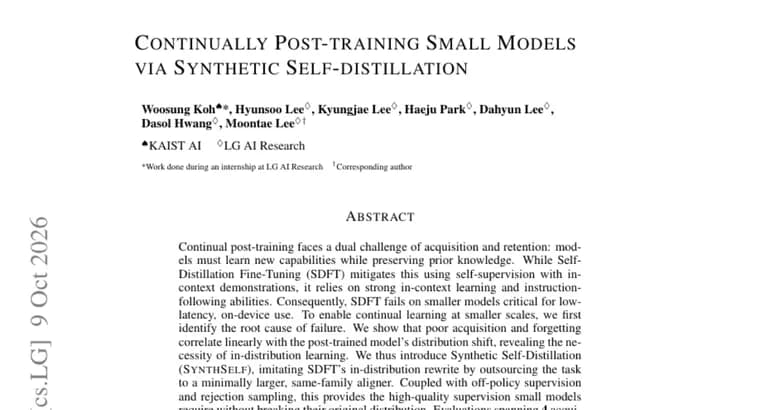
The paper tackles continual post-training, where a model has to learn new capabilities (acquisition) while keeping what it already knows (retention). It starts from Self-Distillation Fine-Tuning (SDFT), an approach that eases this problem through self-supervision with in-context demonstrations. SDFT, the authors say, depends on strong in-context learning and instruction-following abilities, so it fails on smaller models, which are the ones that matter for low-latency, on-device use.
Before proposing a fix, the authors look for the root cause of the failure. They report that poor acquisition and forgetting correlate linearly with the post-trained model's distribution shift, which they take to show that learning has to stay in-distribution.
Their answer is Synthetic Self-Distillation, or SynthSelf. SDFT works by rewriting data in the model's own distribution. SynthSelf imitates that in-distribution rewrite but outsources it to a minimally larger aligner from the same model family, so the small model does not need to do the rewriting itself. This is coupled with off-policy supervision and rejection sampling. According to the authors, the combination gives small models the high-quality supervision they need without pushing them away from their original distribution.
The evaluation covers 4 acquisition datasets (one of them a mixture) and 14 retention benchmarks. The authors report that SynthSelf consistently outperforms 6 methods, including off-policy and on-policy distillation, across 3 small model scales. They add that further analyses confirm SynthSelf paves the way toward effective small-model continual learning. The abstract gives no numeric results, so the size of the gains is not stated.
Key facts
- SynthSelf (Synthetic Self-Distillation) targets continual post-training of small models, where models must learn new capabilities while preserving prior knowledge.
- The authors say SDFT relies on strong in-context learning and instruction-following, and therefore fails on smaller models used for low-latency, on-device work.
- Poor acquisition and forgetting are reported to correlate linearly with the post-trained model's distribution shift, which motivates in-distribution learning.
- SynthSelf has a minimally larger, same-family aligner rewrite the data, then adds off-policy supervision and rejection sampling.
- It is reported to outperform 6 methods, including off- and on-policy distillation, across 4 acquisition datasets, 14 retention benchmarks and 3 small model scales.
Why it matters
Small models are the ones suited to low-latency, on-device use, and the authors argue that the existing SDFT approach to continual learning fails on them because it needs strong in-context learning and instruction-following. SynthSelf is presented as a way to let small models keep learning new capabilities without losing prior knowledge. The paper also offers a diagnosis: poor acquisition and forgetting track the model's distribution shift linearly, so keeping supervision in-distribution is the lever.
Who it affects
The work is aimed at people who post-train small models and want them to acquire new skills over time while retaining earlier ones, particularly where the models are meant for low-latency, on-device deployment. It also speaks to researchers working on continual learning and distillation methods, since it compares against off- and on-policy distillation.
How to use it
The abstract describes the recipe at a high level. A minimally larger aligner from the same model family rewrites the training data so that it stays close to the small model's own distribution. That rewritten data is combined with off-policy supervision and rejection sampling to train the small model. No code, model or data release is mentioned, so anyone wanting to apply it would need the full paper for details such as which aligner sizes to pair with which small models.
How solid is it
The claims come from the paper's abstract and are the authors' own. The evaluation is broad on paper: 4 acquisition datasets (including a mixture), 14 retention benchmarks, 6 compared methods and 3 small model scales. But no numeric results are given: no accuracy figures, margins of improvement or forgetting rates. The three small model scales are not named or sized, and the datasets, benchmarks and most of the 6 compared methods are not named beyond SDFT and the mention of off- and on-policy distillation.
Risks and caveats
The approach needs a larger aligner from the same family, described only as 'minimally larger', with no concrete ratio or parameter count given. That means the method depends on such a model being available. No on-device or latency measurements are reported; on-device use is only named as motivation. The linear correlation between distribution shift and poor acquisition and forgetting is presented by the authors as showing a necessity, and the abstract does not show the evidence behind it.
“poor acquisition and forgetting correlate linearly with the post-trained model's distribution shift, revealing the necessity of in-distribution learning”
— Paper abstract