UniForge3D joins 3D reconstruction and generation in one shared space
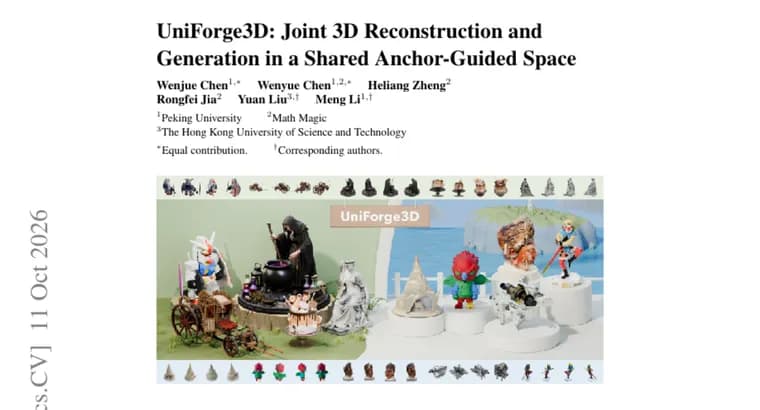
A new paper presents UniForge3D, a method for generating complete 3D assets from sparse, unposed images. The task has two demands: keep the geometry that the input images actually show, and fill in the regions they do not show. The authors argue that joint reconstruction and generation can serve both. Reconstruction recovers the observed geometry, while generation contributes learned shape priors.
The paper points to two obstacles. First, reconstruction works relative to the camera, while generation works in a canonical space, and that coordinate mismatch makes direct geometric interaction between the two harder. Second, conditioning each 3D location on all views without accounting for their relevance may mix useful geometric evidence with unrelated image content, which hinders recovery of local detail.
UniForge3D answers the first problem with a shared anchor-guided space in which reconstruction and generation are modelled jointly. This space follows the anchor view's azimuth while keeping the object upright. The two branches exchange features bidirectionally to predict per-view point maps and a complete sparse voxel structure.
For the second problem, point-map prediction is further conditioned on the generated structure. This establishes pixel-to-voxel correspondences and lets the method select the most informative input view for each voxel. Features from the selected views then guide detailed shape generation, which the authors say helps preserve observed geometric details.
The authors report that the method achieves state-of-the-art appearance and geometry results on Toys4K and GSO, generating complete 3D assets with improved fidelity. A project webpage accompanies the paper.
Key facts
- UniForge3D jointly models 3D reconstruction and generation in a shared anchor-guided space to produce complete 3D assets from sparse, unposed images.
- The shared space follows the anchor view's azimuth while keeping the object upright, which resolves the coordinate mismatch between camera-relative reconstruction and canonical-space generation.
- Two branches exchange features bidirectionally to predict per-view point maps and a complete sparse voxel structure.
- Point-map prediction is conditioned on the generated structure to pick the most informative input view for each voxel, and features from those views guide detailed shape generation.
- The authors claim state-of-the-art appearance and geometry results on Toys4K and GSO.
Why it matters
Building a full 3D asset from a few unposed photos means being faithful to what is visible and plausible about what is hidden. Reconstruction recovers the geometry observed in the input images, while generation contributes learned shape priors. UniForge3D tries to combine the two by putting them in one coordinate space, so that the geometry recovered from images and the shape priors from generation can interact directly.
Who it affects
Mainly researchers working on 3D reconstruction and 3D generation from sparse image sets. The paper frames its contribution as a way to let reconstruction and generation share geometry, which is of most direct interest to those building or comparing such pipelines.
How to use it
This is a research paper, not a packaged product. The authors point to a project webpage at https://xishuxishu.github.io/uniforge3d-project/. No code, model or dataset release is mentioned beyond that project webpage link, so readers who want to build on the method should start there and with the paper itself.
How solid is it
The evidence here is the authors' own claim of state-of-the-art appearance and geometry results on Toys4K and GSO. No quantitative results are given: no metric names, scores or margins over baselines. The baselines or competing methods are not named. The source is the paper's abstract, so the strength of the claim cannot be judged from it alone.
Risks and caveats
The state-of-the-art claim is the authors' own and comes without figures in the abstract. No inference speed, compute cost or model size is given, and the number of input views used is not stated, so practical cost and how well the method holds up with very few views remain open. The two named benchmarks are the only evaluation settings mentioned.
“This space follows the anchor view's azimuth while keeping the object upright.”
— UniForge3D abstract