Vela turns real user behavior logs into LLM training tasks
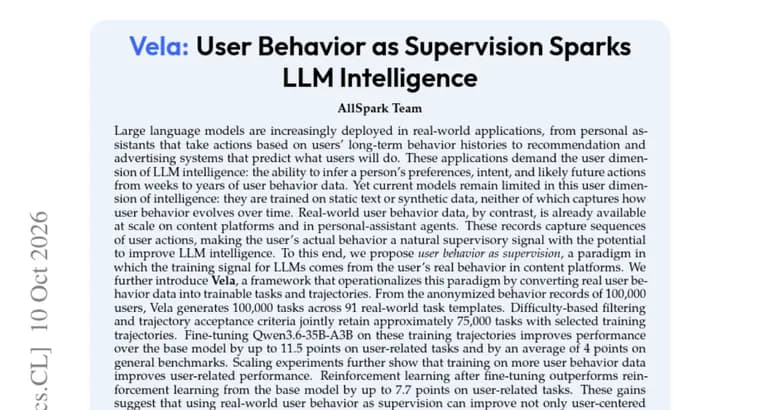
A new paper proposes treating real user behavior as a source of supervision for large language models, and introduces Vela, a framework that converts real user behavior data into trainable tasks and trajectories.
The motivation is that LLMs are increasingly deployed in applications that act on users' long-term behavior histories, from personal assistants to recommendation and advertising systems. Those applications need what the authors call the user dimension of LLM intelligence: inferring a person's preferences, intent and likely future actions from weeks to years of behavior data. The authors argue that current models are trained on static text or synthetic data, neither of which captures how user behavior evolves over time. Behavior records, in contrast, are already available at scale on content platforms and in personal-assistant agents, and offer a natural supervisory signal.
The pipeline starts from the anonymized behavior records of 100,000 users. Vela generates 100,000 tasks from them across 91 real-world task templates. Difficulty-based filtering and trajectory acceptance criteria then cut this down to approximately 75,000 tasks with selected training trajectories.
The team fine-tuned Qwen3.6-35B-A3B on these trajectories. Against the base model, performance improved by up to 11.5 points on user-related tasks and by an average of 4 points on general benchmarks. Two further results are reported. Training on more user behavior data further improves user-related performance. And reinforcement learning applied after fine-tuning outperforms reinforcement learning started from the base model by up to 7.7 points.
From these gains the authors conclude that real-world user behavior is a scalable source of supervision, both for user-centered capabilities and for the broader intelligence of LLMs.
Key facts
- Vela converts anonymized behavior records of 100,000 users into 100,000 tasks across 91 real-world task templates.
- Difficulty-based filtering and trajectory acceptance criteria keep approximately 75,000 tasks with selected training trajectories.
- Fine-tuning Qwen3.6-35B-A3B improves on the base model by up to 11.5 points on user-related tasks and by an average of 4 points on general benchmarks.
- Reinforcement learning after fine-tuning beats reinforcement learning from the base model by up to 7.7 points.
- More user behavior data in training further improves user-related performance.
Why it matters
Models that power personal assistants, recommendation and advertising have to reason about what a person is likely to want or do next, based on a long history. The paper argues that static text and synthetic data do not capture how user behavior evolves over time. Vela is a proposal to train on that behavior directly. If the reported gains hold, behavior logs that platforms already collect become a training signal, and the authors suggest it also helps general capability, not only user-specific tasks.
Who it affects
The target users are builders of personal-assistant agents, content platforms, and recommendation and advertising systems, the applications the paper names as acting on long-term behavior histories. Researchers working on LLM post-training and reinforcement learning are the other audience, since the paper reports a gain from reinforcement learning started after fine-tuning. Platform users are affected indirectly, because their behavior records are the raw material; the paper describes the records as anonymized.
How to use it
The abstract describes a recipe rather than a product. Take anonymized behavior records, generate tasks from a set of real-world task templates, filter by difficulty, keep trajectories that meet acceptance criteria, then fine-tune a model and optionally continue with reinforcement learning. The paper's own run used 100,000 users, 91 templates and Qwen3.6-35B-A3B. No release of code, data or model weights is mentioned.
How solid is it
This is a preprint, summarised here from its abstract, so the claims are the authors' own. The headline numbers are maxima: the 11.5-point and 7.7-point figures are "up to" values, and only the 4-point gain on general benchmarks is stated as an average. The abstract does not name the general benchmarks or the user-related tasks, nor the metric behind "points". The authors word their conclusion as gains that suggest user behavior is a scalable supervision source.
Risks and caveats
The abstract does not say which platforms or assistant agents supplied the behavior records of the 100,000 users, so it is hard to judge how well the results transfer elsewhere. Privacy handling beyond the word "anonymized" is not described, and training on behavior logs raises obvious questions about consent and data governance that the abstract leaves open. The results come from a single base model, Qwen3.6-35B-A3B.
“Real-world behavior records, already available at scale on content platforms and in personal-assistant agents, offer a natural supervisory signal.”
— From the Vela paper abstract