University of Utah bionic hand that feels pressure goes home
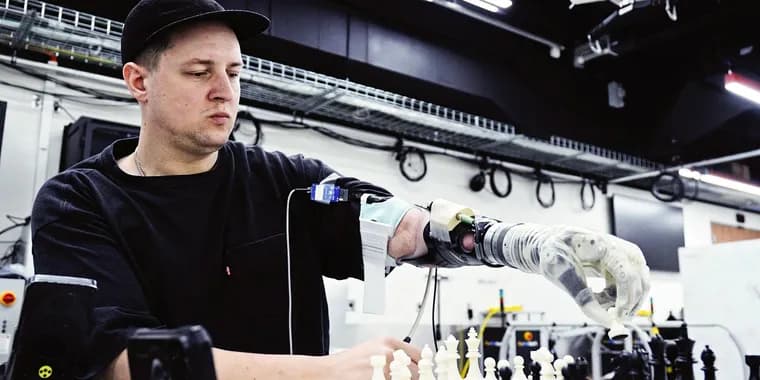
Avi Davidson, a 33-year-old trauma therapist who lost his left hand as a teenager, is using an experimental bionic hand at home that lets him feel pressure, MIT Technology Review reports. The hand is wired to nerves in the upper part of his forearm. For the first time in years, he can use his left limb on delicate objects such as grapes, eggs and a loved one's hand. He is the ninth person to have the device implanted in a University of Utah clinical trial, and the first to take it home and use it independently.
The hand is part of the LUKE arm, named after Luke Skywalker. That arm was developed in the 2000s, first trialed in 2014 and approved by the FDA the same year. The Utah study focuses less on the arm than on a new connection to the nervous system, which lets the wearer control movements and receive feedback on how much pressure they are applying. Since 2013, the team had been running a trial of a system that connects to the nerves of a residual limb so an amputee can control a bionic one.
Davidson's injury dates to 2009, when he was 16. He says he climbed about 35 feet up a telephone pole to photograph a sunset, lost his footing on the way down and grabbed a wire, which electrocuted him before he fell. He says he suffered second and third degree burns over 37% of his body and broke his back in about 50 places. He also broke eight ribs and severed his spinal cord. About 10 days later his dominant left hand had started to develop gangrene and was amputated. He was in a coma for around a month. Since then he has tried a range of prosthetics, from a basic hook to hands with individually controlled fingers, including one he bought on eBay.
A chance meeting with a scientist at a supermarket led him to the research team. Jake George, director of the university's neurorobotics lab, says he turned out to be an ideal candidate. After physical and psychological evaluations, a brain scan to confirm he still had a mental representation of his left hand, and nerve tests, Davidson flew from Florida to Utah in late January for surgery. A surgeon exposed three nerves and implanted a 100-needle electrode array in each, fired in at very high velocity with what George calls a compressed-air gun. Another 24 electrodes went into the surrounding muscles, with wires left protruding from his skin.
Training ran in two directions. Teaching a computer to turn nerve activity into hand, wrist and finger movements takes about five minutes, George says. Mapping which electrodes produce which sensations, by stimulating each connection point in turn, is a process of about three days. Davidson also needed extensive physical therapy. Occupational therapist Leanne Seckinger worked with him on his goal of cooking at home: he cracked an egg and made an omelet.
He has had the hand at home since July 10. Writing his name took a few minutes at first and now takes seconds. He wears the hand around six days a week, changes its batteries once or twice a day, takes it off overnight and says it weighs around five pounds. He sometimes feels pain in it, possibly phantom pain, and a stiffness in the prosthetic wrist that he eases by pulling the bionic fingers back.
The researchers plan a bigger study and hope to win FDA approval for the two-way sensation device so insurance can cover it. Davidson will keep the implants and hand for at least a couple more months. The trial was designed to last at least one year, a mark it reaches by the end of January 2027. George hopes for an extension, which depends on funding.
Key facts
- Avi Davidson, 33, is the ninth person implanted with the experimental device in the University of Utah trial and the first to use it independently at home, since July 10.
- Surgeons implanted a 100-needle electrode array in each of three arm nerves, plus 24 electrodes in the surrounding muscles.
- Movement training takes about five minutes, while mapping electrode stimulation to sensations takes about three days, says lab director Jake George.
- Davidson wears the roughly five-pound hand around six days a week and reports occasional pain and stiffness in the prosthetic wrist.
- The team plans a bigger study and hopes for FDA approval; the trial's minimum one-year term is up by the end of January 2027.
Why it matters
The advance being tested is the link to the nervous system more than the arm, which the FDA approved in 2014. The connection works both ways: the wearer controls movements and gets feedback on how much pressure the hand is applying. Davidson's home use gives researchers a chance to answer long-standing questions: how useful the technology really is day to day, when it helps, where it might fail, and how it affects his well-being, brain and nervous system.
Who it affects
The most direct stake belongs to Davidson and to amputees who might one day use such a system. The researchers hope to get the two-way sensation device approved by the FDA so that health insurance can cover it. That matters for cost of access: Davidson says his insurance allows prosthetic replacements around every five years, and he has bought some hands himself. Team members also hope the technology will let users operate other devices, such as remote controls and wheelchairs.
How to use it
This is an experimental device inside a clinical trial. Getting it involved physical and psychological evaluations, a brain scan, nerve tests, implant surgery, two rounds of system training and extensive physical therapy. In daily use, Davidson puts the prosthetic on, connects it to the wires and starts it with a small computer. George compares the simplified connection to plugging in an HDMI or USB-C cable. Seckinger says using this kind of technology is almost like learning a different language.
How solid is it
This is a journalistic feature from MIT Technology Review about one participant's experience, drawing on Davidson, George, Seckinger and Chris Duncan. Duncan is a rehabilitation doctor and chief medical officer at BIOS, a neurotechnology company that supports the trial. No peer-reviewed publication or quantitative performance results are cited. The gains described, such as writing his name in seconds instead of minutes or making an omelet, are individual examples. Davidson is the first to use the device at home, so there is no earlier home experience to compare with.
Risks and caveats
Participants are not paid, do not keep the device and undergo two operations, one to put it in and one to take it out, George says. Davidson finds the hand heavy and sometimes feels pain in it, which could be phantom pain. The wrist stiffness is unexplained: Duncan says relief from stretching makes no physiological sense because a bionic arm has no tendons, and he suspects it may relate to how the hand is represented in Davidson's mind. What happens after January 2027 is unclear to Davidson, and any extension depends on funding.
“The things I’m able to do with it now are tremendous, comparatively to where I was at initially”
— Avi Davidson, trial participant