Vernier tool shows GIFT-Eval cannot resolve its top ten ranks
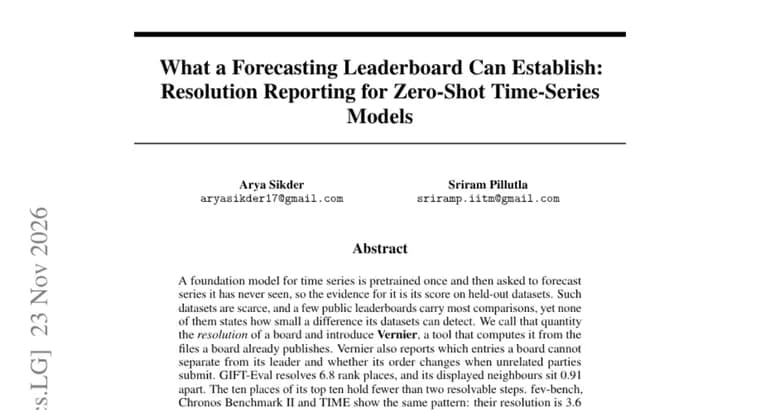
A foundation model for time series is pretrained once and then asked to forecast series it has never seen, so the evidence for it is its score on held-out datasets. The authors of a new paper note that such datasets are scarce and that a few public leaderboards carry most comparisons, yet none of those boards states how small a difference its datasets can detect.
The authors call that quantity the resolution of a board. They introduce Vernier, a tool that computes it from the files a board already publishes. Vernier also reports which entries a board cannot separate from its leader, and whether the board's order changes when unrelated parties submit.
On GIFT-Eval, the resolution is 6.8 rank places, while neighbouring entries as displayed sit 0.91 apart. The ten places of its top ten hold fewer than two resolvable steps. fev-bench, Chronos Benchmark II and TIME show the same pattern, with a resolution 3.6 to 19 times the gap between neighbours. BOOM is the one board that resolves its top ten, a result obtained with each of its 2,554 series treated as an independent source.
According to the authors, the order below the resolution depends on who else submitted. Across four boards, ranking rules that score entries against the pool reversed 43 top-ten pairs although neither entry in a pair was rerun, a figure the paper ties to one update in seven.
The paper also points out that leaderboards do not record how much history a model receives. On 70 configurations, shortening that history raised the error of three of four open models, two of them by 15%.
The authors have released Vernier at https://github.com/therealram18/vernier. It runs the report with one command on any leaderboard that publishes per-dataset scores.
Key facts
- Vernier computes a leaderboard's resolution, the smallest difference its datasets can detect, from files the board already publishes.
- GIFT-Eval resolves 6.8 rank places while its displayed neighbours sit 0.91 apart; its top ten holds fewer than two resolvable steps.
- On fev-bench, Chronos Benchmark II and TIME the resolution is 3.6 to 19 times the gap between neighbours; BOOM resolves its top ten when each of its 2,554 series counts as an independent source.
- Across four boards, pool-relative ranking rules reversed 43 top-ten pairs with neither entry rerun, in one update in seven.
- Shortening model history on 70 configurations raised error for three of four open models, two of them by 15%.
Why it matters
Time-series foundation models are judged on how they forecast data they have never seen, and a few public leaderboards carry most of those comparisons. The authors say none of these boards states how small a difference its datasets can detect. Their measure, resolution, puts a number on that limit. If the resolution is coarser than the gap between two neighbouring entries, their relative position says much less than the ranked table suggests.
Who it affects
Anyone who picks a forecasting model by leaderboard position has a direct stake, as do researchers who cite a rank as evidence that their model is better. The findings also concern the people who run these boards: the paper names GIFT-Eval, fev-bench, Chronos Benchmark II, TIME and BOOM, and reports that boards do not record how much history each model receives.
How to use it
Vernier is available at https://github.com/therealram18/vernier. The authors say it runs the report with one command on any leaderboard that publishes per-dataset scores. The output covers the board's resolution, the entries it cannot separate from the leader, and whether the order changes when unrelated parties submit. When reading a ranking, check whether the gap you care about is larger than the resolution, and ask how much history each model was given.
How solid is it
The figures are the authors' own results, summarised here from the paper's abstract. The tool is released and works from files that boards already publish, which gives others a route to rerun the report. The positive result for BOOM comes with a stated condition: each of its 2,554 series is treated as an independent source. The history experiment covers 70 configurations and four open models.
Risks and caveats
A coarse resolution means a board's datasets cannot detect differences that small. It does not by itself show that any model is worse than its rank, or that the entries are equal in practice. The 3.6 to 19 range covers three boards together, so it should not be pinned to any single one. The history finding is also partial: error rose for three of the four open models tested, and the 15% figure applies to two of them.
“Below the resolution the order depends on who else submitted”
— The paper's authors