US public-sector unions win AI guardrails as nearly 70% of agencies use generative AI
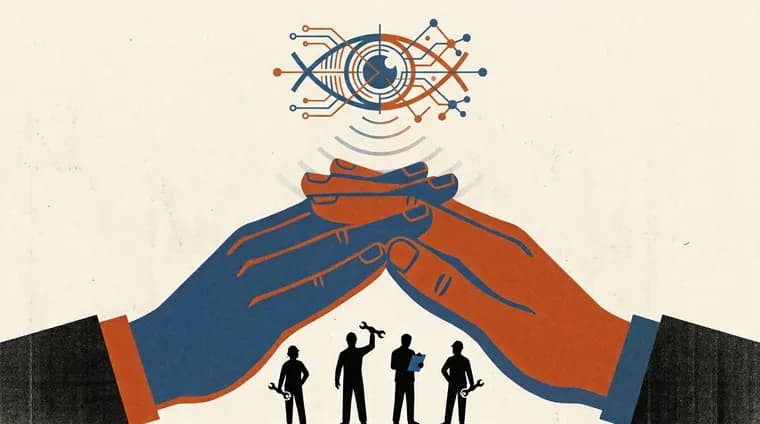
The Decoder reports that US public-sector unions are winning more protections against AI surveillance and automation-driven job losses. It frames the issue as increasingly urgent because, according to an Ernst and Young survey, nearly 70 percent of US government agencies already use generative AI.
The article lists a run of recent wins. In Oakland, IFPTE Local 21 secured retraining programs instead of AI-related layoffs after a strike vote in October. In Pennsylvania, Governor Josh Shapiro guaranteed SEIU Local 668 human oversight during a pilot of OpenAI's ChatGPT Enterprise. The Transport Workers Union in Ohio won veto power over autonomous vehicles. California Governor Gavin Newsom banned AI surveillance software, often called "bossware", along with automated firings in September. And New York has protected state employees from AI displacement by law since late 2025.
The article adds two pieces of context. Labor researcher Kung Feng at UC Berkeley says employers are pushing automation to cut costs. And, as the Guardian reports, union leaders such as Liz Shuler of the AFL-CIO, Lorena Gonzalez and TWU's John Samuelsen support AI safety systems where they help workers, but insist on mandatory human control over every AI application in the workplace.
Key facts
- An Ernst and Young survey finds nearly 70 percent of US government agencies already use generative AI.
- IFPTE Local 21 in Oakland secured retraining programs instead of AI-related layoffs after a strike vote in October.
- Pennsylvania's governor, Josh Shapiro, guaranteed SEIU Local 668 human oversight during a pilot of OpenAI's ChatGPT Enterprise; the Transport Workers Union in Ohio won veto power over autonomous vehicles.
- California Governor Gavin Newsom banned AI surveillance software ("bossware") and automated firings in September; New York has protected state employees from AI displacement by law since late 2025.
- Union leaders back AI safety systems that help workers but demand mandatory human control over every workplace AI application, the Guardian reports.
Why it matters
Government use of generative AI is already widespread, with nearly 70 percent of US agencies using it per the Ernst and Young survey, and the workers affected are starting to set terms. The examples span several levels of action: union negotiations in Oakland, a governor's commitment in Pennsylvania, a ban in California and a state law in New York. Kung Feng of UC Berkeley says employers are pushing automation to cut costs, which is the pressure these protections respond to.
Who it affects
Public-sector employees in the places named: Oakland workers represented by IFPTE Local 21, Pennsylvania workers represented by SEIU Local 668, Ohio workers represented by the Transport Workers Union, and state employees in California and New York. It also touches the government agencies deploying AI, and vendors such as OpenAI, whose ChatGPT Enterprise was being piloted in Pennsylvania.
How to use it
The article works as a list of the kinds of guardrails unions are securing: retraining in place of AI-related layoffs, human oversight during AI pilots, veto power over autonomous vehicles, bans on AI surveillance software and automated firings, and statutory protection against AI displacement. Union leaders quoted by the Guardian want mandatory human control over every workplace AI application while supporting AI safety systems that help workers.
How solid is it
This is a short roundup by The Decoder that leans on an Ernst and Young survey and on Guardian reporting for the union leaders' stance. The source does not say how many agencies the survey covered, when it was run, or what 'use' means. No year is given for the October strike vote or the September California action. The Ohio, California and New York measures get only one-line descriptions.
Risks and caveats
The 'nearly 70 percent' figure is a headline number with no stated method. The source does not say how many staff the Oakland retraining programs cover, and it gives no details of the New York law, the California ban or the Ohio veto power. The Pennsylvania guarantee concerns a pilot of ChatGPT Enterprise, so the source does not show it extends beyond that pilot. 'Wins piling up' is the article's own framing.