Video-blind timer beats published mistake F1 on Ego-MC-Bench
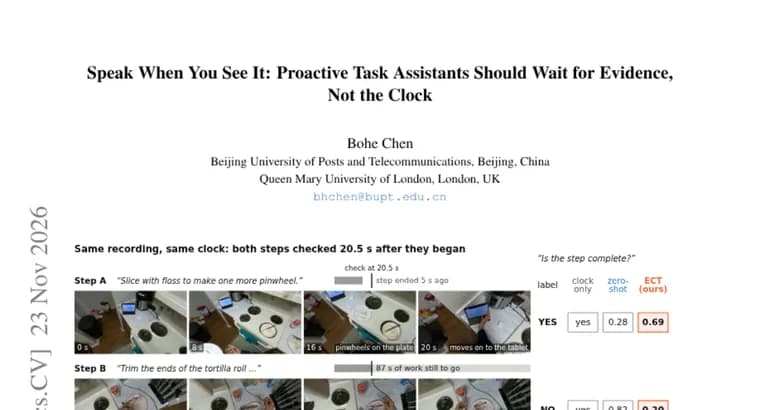
Proactive assistants that guide people through physical tasks have to decide every few seconds whether a step is complete and whether a mistake has occurred. The authors of the paper "Speak When You See It" report that two benchmarks for this job largely reward knowing when to respond rather than seeing what is happening.
Their clearest example is a timer that never looks at the video. It raises an alarm at 25 s and confirms each step at 30 s. On Ego-MC-Bench it reaches a mistake F1 of 0.373, while every published result is at most 0.27.
The authors formalize this as the "video-blind frontier": the best trade-off between completion accuracy and mistake F1 that a policy can reach from elapsed time, the instruction and training statistics alone. According to the paper, every published per-step result on Ego-MC-Bench lies inside that frontier, and so do all twelve zero-shot models the authors ran on a second benchmark, QICD.
To get beyond it, they introduce Evidence-Contrastive Training (ECT). A model is fine-tuned on the benchmark's own questions, and each set of positive examples is paired with negatives from the same recording at the same elapsed time. Elapsed time therefore cannot separate the two sides of a pair.
A 2B model trained with ECT on 209 QICD videos, in about 15 GPU-hours, crossed the frontier on both benchmarks in all four seeds. Transferred to Ego-MC-Bench without adaptation, it confirmed 59% of mistake-free steps in time. A published model with the same backbone, trained on about 25k synthetic counterfactuals and real recordings, confirmed 30%.
The authors also tested whether the model's decisions depend on the video. At equal elapsed time, it told a finished step from an unfinished one in 90-92% of test pairs, against 65% for a baseline based on the instruction's typical duration. Rescaling the time stamps between frames left the model essentially unchanged. Swapping in another recording, of the same recipe where one exists, cut its completion accuracy by two thirds.
The authors say the code and model weights will be publicly released.
Key facts
- A timer that ignores the video (alarm at 25 s, step confirmation at 30 s) reaches 0.373 mistake F1 on Ego-MC-Bench; published results top out at 0.27.
- Every published per-step result on Ego-MC-Bench, and all twelve zero-shot models the authors ran on QICD, lie inside the video-blind frontier.
- Evidence-Contrastive Training pairs positives with negatives from the same recording at the same elapsed time, so timing cannot separate them.
- A 2B model trained on 209 QICD videos in about 15 GPU-hours crossed the frontier on both benchmarks in all four seeds.
- Moved to Ego-MC-Bench without adaptation, it confirmed 59% of mistake-free steps in time, against 30% for a published model with the same backbone.
Why it matters
An assistant that coaches someone through a physical task is only useful if it reacts to what the person actually did. The authors' finding is that two benchmarks for this largely reward good timing instead. If a fixed 25 s and 30 s schedule can post a higher mistake F1 than any published result on Ego-MC-Bench, a score there does not by itself show that a system is watching. The video-blind frontier gives that concern a measurable form: it marks the best a policy can do from elapsed time, the instruction and training statistics, so a new result can be checked against it.
Who it affects
The most direct audience is researchers who build or evaluate proactive task assistants, especially anyone reporting results on Ego-MC-Bench or QICD. The paper says every published per-step result on Ego-MC-Bench falls inside the video-blind frontier. Teams that rely on zero-shot models have a related warning: all twelve that the authors ran on QICD fell inside it too.
How to use it
Two ideas carry over from the abstract. First, compare a model with what can be achieved without the video, using elapsed time, the instruction and training statistics. Second, when training, follow the ECT recipe: fine-tune on the benchmark's own questions and draw negatives from the same recording at the same elapsed time as the positives. The reported training run was small, with a 2B model, 209 videos and about 15 GPU-hours. The authors say code and model weights will be publicly released, but give no date or link for that.
How solid is it
These are the authors' own results as stated in the paper's abstract. Several checks point in the same direction. The model crossed the frontier on both benchmarks in all four seeds. At equal elapsed time it separated finished from unfinished steps in 90-92% of test pairs, compared with 65% for the instruction's typical duration. Changing time stamps had essentially no effect, while swapping the recording cut completion accuracy by two thirds. The abstract does not name the twelve zero-shot models, the backbone or the published comparison model.
Risks and caveats
The 59% versus 30% comparison measures one thing: how many mistake-free steps were confirmed in time. The abstract gives no mistake F1 or completion accuracy values for the ECT model itself, so its margin over the 0.373 timer cannot be read from these figures. ECT also trains on the benchmark's own questions, which is worth keeping in mind when judging results on QICD, the source of its training videos. No real-world deployment or user study is mentioned.
“We find that two benchmarks for this task largely reward knowing when rather than seeing what”
— The paper's authors