Virtual Head Attention paper claims smaller KV cache and better quality than GQA
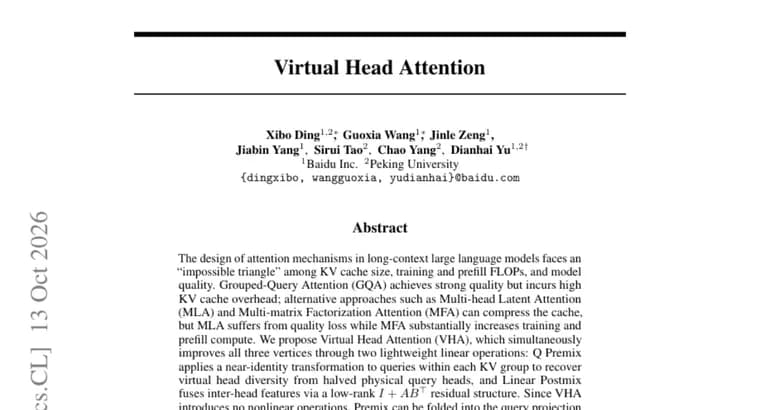
A paper on Hugging Face proposes Virtual Head Attention (VHA), an attention design for long-context language models. The authors start from what they call an "impossible triangle" in attention design: KV cache size, training and prefill FLOPs, and model quality pull against each other. In their telling, GQA gives strong quality but a large KV cache. MLA and MFA can compress the cache, but MLA loses quality and MFA substantially increases training and prefill compute.
VHA is presented as improving all three at once, using two lightweight linear operations. Q Premix applies a near-identity transformation to queries within each KV group, recovering "virtual head" diversity from physical query heads that have been halved in number. Linear Postmix fuses features across heads through a low-rank I + AB^T residual structure. Because neither operation is nonlinear, Premix can be folded into the query projection and Postmix into the output projection at inference time. The model then reduces to a standard GQA-2 architecture and reuses existing GQA inference optimizations. The authors add that with only two KV heads, the group size in large models readily reaches 64, which they say makes full use of Tensor Core parallelism during decoding.
The results come in three groups. First, in pretraining across four scales with 4K context and 50B tokens, VHA beats the standard GQA baseline at every scale, by +0.05% to +0.81%. In the same setting it reduces KV cache by 4x versus GQA-8 at dense scales and by 2x versus GQA-4 at the MoE scale, and lowers training and prefill FLOPs by 7.9% (quoted for the 1.7B model at sequence length 4096).
Second, on an industrial 30B-A3B MoE model trained on 500B tokens at 8K context, VHA outperforms both MLA and GQA-4 by +0.70 and +2.60 respectively on a 12-benchmark base-model evaluation suite.
Third, in a separate matched 10B-A1B MoE comparison after long-context mid-training, VHA reaches an average RULER score of 84.4 over 8K to 128K, against 73.0 for GQA, while using two KV heads rather than four in the full-attention layers.
Key facts
- VHA adds two linear operations, Q Premix and Linear Postmix, and halves the physical query heads; at inference both fold into the projections, leaving a standard GQA-2 architecture.
- Across four scales (4K context, 50B tokens), VHA beats the GQA baseline at every scale by +0.05% to +0.81%, with 4x less KV cache than GQA-8 at dense scales and 2x less than GQA-4 at the MoE scale.
- Training and prefill FLOPs fall by 7.9% for the 1.7B model at sequence length 4096.
- On an industrial 30B-A3B MoE (500B tokens, 8K context), VHA leads MLA and GQA-4 by +0.70 and +2.60 on a 12-benchmark suite.
- In a matched 10B-A1B MoE comparison, VHA averages 84.4 on RULER over 8K to 128K versus 73.0 for GQA, using two KV heads instead of four.
Why it matters
KV cache size is a central cost of serving long-context models, and the paper frames the usual options as a trade-off: GQA keeps quality but carries a big cache, MLA shrinks the cache at some cost in quality, and MFA shrinks it at the cost of more training and prefill compute. VHA's claim is that it improves cache size, compute and quality together. Its practical hook is compatibility: since the extra operations fold away at inference, the deployed model is a plain GQA-2 network that can reuse existing GQA inference optimizations.
Who it affects
Teams that train and serve long-context LLMs, especially those already built around GQA kernels and serving stacks. The reported gains span dense models and MoE models, including a 30B-A3B MoE and a 10B-A1B MoE. The paper's text does not name the authors, their institutions, or the owner of the industrial 30B-A3B model.
How to use it
Nothing here is a ready-to-use release: no code or model release is mentioned. For a team evaluating the idea, the recipe in the abstract is to halve the physical query heads, add Q Premix within each KV group and Linear Postmix after attention, train with them, then fold Premix into the query projection and Postmix into the output projection for deployment as a GQA-2 model.
How solid is it
This is a preprint abstract with pretraining results at several scales, from a 1.7B dense model up to an industrial 30B-A3B MoE trained on 500B tokens. The 4K-context, 50B-token runs cover four scales and VHA is reported ahead at each. The 12 benchmarks are not named, and the metric behind the +0.05% to +0.81% and the +0.70 / +2.60 figures is not stated, so it is unclear whether they are percentage points or relative gains. The 10B-A1B RULER comparison is against GQA only, not MLA, and is a separate matched comparison from the 30B-A3B one. The 7.9% FLOPs reduction is quoted only for the 1.7B model at sequence length 4096. The abstract gives no inference latency or throughput measurements, only KV cache and FLOPs reductions.
Risks and caveats
The headline gains are the authors' own claims and are not independently confirmed. The quality margins at the four smaller scales are small at the low end (+0.05%). The RULER gap of 84.4 versus 73.0 comes from one matched MoE pair after long-context mid-training. Without latency or throughput numbers, the speed benefit in real serving is not shown; the decoding argument rests on the group size reaching 64 with two KV heads. Treat the work as a promising design pending the full paper's details and any code release.
“simultaneously improves all three vertices through two lightweight linear operations”
— From the paper's abstract, describing Virtual Head Attention